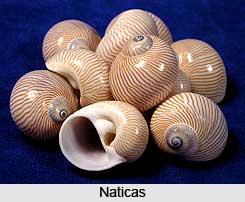
 Naticas or Moon Shells are very common univalves found in large numbers on the littoral sand-beds. They are active sand-burrowing molluscs. In appearance they look like apple-snails. Some species have much flattened shells. They all feed voraciously on bivalves. Their foot is very large, produced before and behind, and it contains a system of water canals that enables the animal to burrow swiftly. The front lobe of the foot is turned back on the head. Eyes are absent or buried. The lobes of the foot are so extensive and developed that in one genus, Sinum, it measures nearly six to seven times the size of the shell; and this animal when it moves looks like an elongated flattened leaf. This overdeveloped foot serves the animal in more than one way: firstly, it is singularly well adapted for working its way through a sandy bottom; secondly, the enfoldment protects the animal from abrasion; and thirdly, it is used to engulf and smother the bivalves buried in sand upon which it preys.
All naticas possess a long and powerful radula with sharp, file-like teeth. Having engulfed a clam or mussel in the folds of the foot the natica, using its radule, bores a neat hole through one of the valves and eats the flesh.
Natica deposits her eggs in what looks like a long strip of sandpaper curled like a shirt collar. The sand is agglutinated by copious mucus into a sort of sheet and thousands of eggs are deposited inside this collar, each egg enclosed in a coating of viscid fluid. During the breeding season (which is from the month of April to May) such egg-laden collars are found in large numbers firmly implanted on sand flats and in shallows at the mouths of rivers where the high-tide waves are not violent. These egg-cases therefore are not ordinarily swept away. The eggs develop into embryos within the capsule and come out of it when they have developed all parts and are able to move about and feed independently.