|
 The monuments of Champaner in Gujarat comprise both Hindu and Mughal edifices. The city of Champaner lies 1255 km south-east from Ahmedabad and 435 km north-east from Vadodara. It was the ancient stronghold of local Rajput kings until, in 1484, Mahmud Begada, enraged by provocative raids from Champaner, besieged and took the city. It was Mahmud who founded the new city and made it his capital. In 1535 Emperor Humayun himself led a small party which scaled the outer defences by means of iron spikes driven into the bare rock and threw open the main gate. With the collapse of the Mughal Empire, Champaner fell to the Marathas. In 1802 it was held for a short period by the British before reverting to Scindia. In 1861 it was finally ceded to the British. The monuments of Champaner in Gujarat comprise both Hindu and Mughal edifices. The city of Champaner lies 1255 km south-east from Ahmedabad and 435 km north-east from Vadodara. It was the ancient stronghold of local Rajput kings until, in 1484, Mahmud Begada, enraged by provocative raids from Champaner, besieged and took the city. It was Mahmud who founded the new city and made it his capital. In 1535 Emperor Humayun himself led a small party which scaled the outer defences by means of iron spikes driven into the bare rock and threw open the main gate. With the collapse of the Mughal Empire, Champaner fell to the Marathas. In 1802 it was held for a short period by the British before reverting to Scindia. In 1861 it was finally ceded to the British.
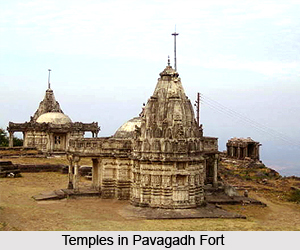 As far as the monuments in Champaner are concerned, the Fort of Pavagadh is an important one. It stands at the crown of an isolated rock at a height of 2,700 feet and is visible from a great distance. The fortifications enclose a large space within which are two forts, the upper and lower. Both are difficult to assail. The former has a temple to Kali and the latter, ancient Hindu monuments. The ascent is steep and passes several interesting ruins, including the Medi and Medi Talao, the Champavati, the Champa Ranina Mahal (a three-storey summer pavilion) and the Buria Darwaza. The temple on the summit is crowned by the shrine of Sadan Shah, a Muslim saint, the original temple spire having been removed to accommodate it, a deliberate and overt representation of Muslim victory over the Hindu Rajput kings. As far as the monuments in Champaner are concerned, the Fort of Pavagadh is an important one. It stands at the crown of an isolated rock at a height of 2,700 feet and is visible from a great distance. The fortifications enclose a large space within which are two forts, the upper and lower. Both are difficult to assail. The former has a temple to Kali and the latter, ancient Hindu monuments. The ascent is steep and passes several interesting ruins, including the Medi and Medi Talao, the Champavati, the Champa Ranina Mahal (a three-storey summer pavilion) and the Buria Darwaza. The temple on the summit is crowned by the shrine of Sadan Shah, a Muslim saint, the original temple spire having been removed to accommodate it, a deliberate and overt representation of Muslim victory over the Hindu Rajput kings.
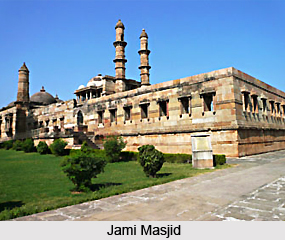
Within the town many of the buildings are ruins, set in grass-lined streets, but the citadel walls and bastions and one or two civic buildings, such as the Mandir or Custom House and guardrooms, still survive. Most of the intact structures are mosques or tombs, the most important of which is the Jami Masjid (1523). It is a large, well-articulated symmetrical structure of considerable architectural significance. A notable feature is the rich ornamental treatment of the exterior, with traceried openings and fine entrance pavilions of unusual sophistication. Inside, the sanctuary fa‡ade contains five pointed archways with two slender minarets flanking the central opening, enriched with prominent oriel windows, a typical Gujarati vernacular device. It is modelled on the Jami Masjid at Ahmedabad.
 The architecture of the surviving monuments of Champaner has particular local characteristics not found elsewhere in Gujarat. This can be attributed to its isolated location. Other mosques of note include the beautiful Nagina Masjid (mid-16th century), a similar variation on the theme of the Jami Masjid, and the Borah Masjid (mid-16th century). The numerous tombs are also noteworthy, with domed central chambers surrounded by arcades crowned with smaller domes. Access is usually provided via a portico on one side, but the real delight of these funerary monuments is the use of the carved arch, which imparts exceptional vigour and elegance. The architecture of the surviving monuments of Champaner has particular local characteristics not found elsewhere in Gujarat. This can be attributed to its isolated location. Other mosques of note include the beautiful Nagina Masjid (mid-16th century), a similar variation on the theme of the Jami Masjid, and the Borah Masjid (mid-16th century). The numerous tombs are also noteworthy, with domed central chambers surrounded by arcades crowned with smaller domes. Access is usually provided via a portico on one side, but the real delight of these funerary monuments is the use of the carved arch, which imparts exceptional vigour and elegance.
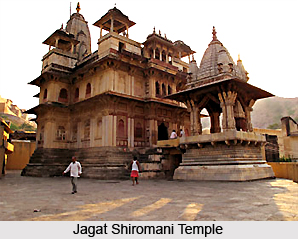
Besides these the Old Palace lies at the base of Jaigarh Fort and the palace of Man Singh I. A stone path from Chand Pol leads to the ruins. The buildings were commenced by Rajdeo in 1216. Only the Sal of Bah Bai is worthy of note. Bala Bai was responsible for the conversion of the Raja to the Vaishnavism, and two idols are associated with her. In the courtyard of the Narsingha shrine is a marble swing or jhoola. The Jagat Shiromani Temple and Lakshmi Narayan Temple lie close together, on the northwest side. The Ambakeshawar Mahadeo Temple lies to the north-west of the old palace. An ancient sun temple (945) lies on an isolated outcrop.
On the left of the road to Delhi is the Jami Masjid, built for Akbar by the architect Bharmall in 1569. Following extensive subsequent alterations, it retains few original features. Around the valley runs the outer curtain wall, the Sahar-Panaha, fortified with bastions and towers. There are only five main gates but several entrances. The Birhi Darwaza is the most impressive, a large double gateway with a temple to Birhi Mala between the two entrances. To the right of the Delhi road lie the chhatris of the ruling dynasty. Sagar Tank, with octagonal bastions and huge dams, lies north-west of Jaigarh. A chhatri stands on the upper dam.
|





