


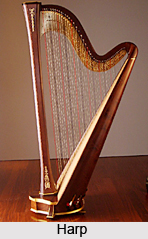
 The harp is a stringed instrument that is plucked with the fingers. There are many different types of harps found in Africa, Europe, Asia and the Americas. In antiquity, harps and the closely related lyres were very prominent in nearly all cultures. The harp is a stringed instrument that is plucked with the fingers. There are many different types of harps found in Africa, Europe, Asia and the Americas. In antiquity, harps and the closely related lyres were very prominent in nearly all cultures.
The harp has a long and rich history behind it. It was a popular instrument in Ancient Egypt and in Babylon, as is confirmed by many contemporary illustrations. It has even found mention in the Bible. It arrived in Europe sometime in the Middle Ages. The modern harp as is known today developed from the gothic and medieval instrument. The first harp with pedals was built in 1720, significantly different on the underside from the Renaissance harps that had no pedals, such as those played in the fifteenth and sixteenth centuries. The chromatic harp with seven pedals was made almost a hundred years later in 1811. This new instrument made it possible for the first time to play in all seven keys. The form and construction of the harp has the harp has undergone a huge change during the entire period of its existence. The instruments of Antiquity had only five or six strings; nowadays the harp has 46-48. The longest string measures about 60 inches, the shortest about 5 inches. In order to make the strings sound to their greatest potential, the instrument has to be very sturdily built. The sound board regulates the fullness of tone. From it the strings are stretched to the metal "ram" above, where they are attached to metal pegs. Sycamore, a wood that is odourless, tasteless, and very strong, is used throughout for the construction of the modern harp. The longer strings are usually metal and the shorter ones of gut. The lowest note on the harp is C flat. Depressing the pedal to its first position brings this up to C natural and in the second pedal position this becomes C sharp, and so on. A number of different types of harp are found used in the world, such as the Irish or Gaelic harp, the Triple harp which later developed into the Welsh harp etc. The strings of the harp can be played from both sides. It is usually played with the fingertips, though in earlier times the fingernails were also used. The flat of the palm is used to dampen the sound. Since there are a number of strings on the harp among which a player may get lost, they are coloured in white, red for the C strings and blue. The characteristic features of the harp lie primarily in arpeggios. Flageolet notes (harmonics), glissandi, and tremolo-playing are also particular qualities of the instrument. Music on the harp is essentially classical in nature. A lot of music has been written for the harp from baroque right down to modern times. The harp played an important role in the orchestra in French music of the late nineteenth century. In India, harps have been long used. The Indian harp is known as the Surmandal or Swarmandal. It is used for the drone to accompany the vocalists in Indian classical music. There is no standard size or number of strings for a surmandal. It is tuned according to the Raaga which is to be sung. |
| |||



Home > Movies & Entertainment > Indian Music > Indian Musical Instruments > String Instruments > Harp
Harp
| Harp is a string instrument found in almost all ancient cultures of the world; the Indian version of the harp is the surmandal. |
| ||||||||||||||||||||||||||||

