Barnacles, Indian Marine Species - Informative & researched article on Barnacles, Indian Marine Species
  Indianetzone: Largest Free Encyclopedia of India with thousand of articles History of India


in  
Art & Culture | Entertainment | Health | Reference | Sports | Society | Travel
Forum  | Free E-magazine
History of India : Sources of History of India l Ancient History of India l Medieval History of India l Modern History of India l Indian Historical Dynasties l Indian Battles l Sepoy Mutiny 1857 l Indian Rulers l History of India l Indian Freedom Struggle l Indian Governor- Generals l British Indian Acts l Post Independence India l Iron Age in India
Home > Reference > Geography of India > Indian Natural History > Barnacles
Barnacles, Indian Marine Species
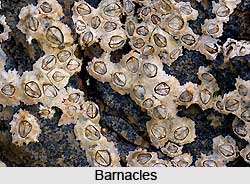
Barnacles are entirely marine and they generally in tidal and shallow waters, mainly in erosive settings.

Barnacles, Indian Marine SpeciesBarnacles are closely allied to water-fleas and copepods and when young are free-swimming with three pairs of appendages. While still free-swimming they develop additional limbs, feed, moult and change their forms. Later they attach themselves by their first pair of antennae to rocks or timber and after a resting stage become shelled adults. The shell is in divisions which overlap and when closed are thoroughly protective. A barnacle is therefore described as a kind of shrimp standing on its head, attached to some support and with its legs projecting upwards. These legs serve to produce currents in water enabling the animal to respire and capture food.

There are two kinds of barnacles - stalked or Goose barnacles and unstalked or Acorn barnacles. Lepas is an example of the former and Balanus of the latter and both the kinds of barnacles when adults, measure three to five centimetres across. Barnacles are so abundant and so widely distributed that all rocks on the littoral, pilings, shelled animals like molluscs and crabs, the keels and hulls of ships and canoes are all encrusted by these crustaceans. In the Goose barnacles, found in clusters on logs of driftwood or on the hulls of ships after long voyages, their fleshy stalks grow from 2.5 centimetres to more than thirty centimetres long.

This article is a stub. You can enrich by adding more information to it. Send your Write Up to content@indianetzone.com
(Last Updated on : 12/02/2010)
  More Articles in Indian Natural History
 
Indian Natural History in Mauryan Period Indian Natural History in Mughal period Indian Natural History in British Period
Indian Natural History after Independence Ants Ark Shells
Cowries Amphibians Bombay Duck
Crustaceans Algae Amoeba
Arachnids Clams Air Breathing Fishes
Sea Anemones Sea Cucumbers Sea Horse
Sea Lilies Sea Perches Sea Urchins
Scallops Slugs Small Cats
Snails Spider Sponges
Squids Mudskippers Mullets
Murrels Naticas Barnacles
Barracuda Tuna Perch
Piddocks Pomfret Mackerel
Mahseer Mantid Hydra
Loach Horn Shell Flying Fish
Cockroach Dugong, Sea Cow Garden Harvestmen
Caecilian Bristle Worm Trout
Volutes Water Spider Whelk
Termites Threadfin Thrip
Trapdoor Spider Sea Turtle Turtle
Recently Updated Articles in History of India
  • Mughal Architecture
    Mughal architecture is a combination of Islamic, Persian, Turkish and Indian architecture. It is a style that was developed under the Mughal dynasty in the sixteenth and seventeenth centuries.
  •  
  • Mansabdari System in Mughal Dynasty
    Akbar introduced the Mansabdari System in the Mughal army which primarily meant the ranking of officers on decimal system.
  •  
     
  • Deccan Policy of Mughal Dynasty
    Deccan Policy of the Mughal dynasty was weak during the reign of Babur and Humayun but after the accession of Akbar on the throne, the political situation changed and the Deccan policy was a success.
  •  
  • Coins of Pandyas
    Coins of Pandyas bear the legend of different Pandya ruler in different times.
  •  
  • Art and Architecture of Mughal Empire
    Art and architecture of Mughal Art offers an aesthetic degree to all art lovers. The subtlety of the finesse and the dazzle of the aura create huge amount of interest among tourist.
  •  
    E-mail this Article | Post a Comment
    RSS Feeds
    Forum
    Forum on Geography of India

    Free E-magazine
    Subscribe to Free
    E-Magazine on Indian Crafts
     
     
    Barnacles, Indian Marine Species - Informative & researched article on Barnacles, Indian Marine Species
    Sitemap
    Contact Us   |   RSS Feeds
    Copyright © 2008 Jupiter Infomedia Pvt. Ltd. All rights reserved including the right to reproduce the contents in whole or in part in any form or medium without the express written permission of Jupiter Infomedia Pvt. Ltd.