Nistha, Dhammapada - Informative & researched article on Nistha, Dhammapada
  Indianetzone: Largest Free Encyclopedia of India with thousand of articles Indian Religion


in  
Art & Culture | Entertainment | Health | Reference | Sports | Society | Travel
Forum  | Free E-magazine
Indian Religion : Vastu Shastra l Indian Religions l Indian Myths l Indian Mythology l Gods of India l Goddesses Of India l Religious Thinkers of India l Types of Religion in India l History of Indian Religion l Indian Yogis l Ajivikas l Sacred Scriptures in Indian Religion l Tantrism l Shaivism l Indian Communities l Sacred Animals in India l Roman Impact on South Indian Art and Society l Bhattacharyas l Indian Classical Terms
Home > Society > Indian Religion > Types of Religion in India > Buddhism > Schools of Buddhism > Theravada Schools of Buddhism > Dhammapada > Nistha
Nistha, Dhammapada
Nistha is the third philosophy of Dhammapada which has given a lot of emphasis to dedication and faith.
  Brahmana In Buddhism      

The third section of the Dhammapada is Nistha or Faith. The six requisites of Nistha are as follows: The Buddha and His followers, the Dhamma, the Wise, the Bhikku, the Arhant and the Brahmin. It has been declared that unless an individual follows all the six requisites in a proper manner it is not possible for him to attain the ultimate stage or the Brahmana.

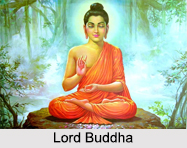
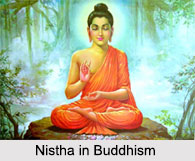
The first postulate of Nistha or Faith in the Dhammapada explains Lord Buddha and his followers. This section focuses on the fact that Lord Buddha had renounced everything and he had become free by destructing all sorts of craving that was present in him. Similarly the followers of the Lord are always vigilant and constantly focus their minds on Buddha-meditation, Dhamma-meditation and Sangha-meditation. All followers of the Lord constantly dedicate their minds on non-violence. It can be said that just like the Lord himself his follower also gets delighted only at the destruction of craving.

Lord Buddha had declared that he had come across a number of births to seek the finder of his body and in the process he had realised that birth is painful in nature. He had declared that a true follower of Buddha delights only in the destruction of craving. Rather it can be said that a disciple of the completely enlightened one or the Buddha shines even among a pile of rubbish. The followers of Buddha always concentrate on meditation or culture of their minds so that they are able to fill their minds with complete love and compassion and culminate to the stature of enlightenment or the Buddha.

Dhamma is the second postulate of Faith or Nistha. Lord Buddha had established an order. And he had also established certain commandments for that Order. The commandments of Buddha included his advice which forbade individuals to commit sin, asked them to cultivate goodness and purify the mind.

Lord Buddha called forgiveness the highest penance and patience- long suffering-the highest Nirvana, the supreme attainment. A man is not an anchorite, who strikes others and he is not an ascetic who causes grief to others.

The whole philosophy of the Buddha is based on Four Noble Truths. Suffering was the main cause of Buddha`s detachment. He had realised that both this world and the body is transitory in nature and this particular mode of thinking led him to find the conclusion which said that detachment is the solution to all pangs and sufferings and finally he claimed that unless an individual is able to detach himself from all worldly attachments, he will not be able to seek happiness.

The Lord believed that all created things are transitory, unreal and perishable and when an individual realises this with the help of wisdom he is free from pain and it is the path which leads to purity that is Nirvana. In the book the Lord had also laid down other ways of attaining Nirvana. He had said that when individual realises with the help of wisdom that all created things are sorrowful and they also lack in self or reality, the individual moves close to attaining of Nirvana and when an individual is seized by death nothing can protect him and a wise man restrained by mortality should be quick enough to move in the Path which leads to Nirvana.

Later on the concept of Dhamma was taken up by Ashoka of Maurya Empire who had accepted Buddhism. Ashoka followed a religious policy of his own and is remembered by posterity for his famous policy of "Dhamma" or "Law of Piety". After converting into Buddhism, Ashoka disseminated the teachings and knowledge of the Buddhist scriptures. He always had faith in morals and principles and had high ideals in life. These came to be known as Dhamma of Emperor Ashoka.

The third concept of Nistha or Faith is a detailed explanation about the Wise. It has been declared in the Dhammapada that one who follows all the commandments established by Lord Buddha is a wise man. The Lord had said that, "After hearing the precepts of Dhamma- the Law, wise persons become exceedingly tranquil, just as a lake deep, clear and still". He had said that such wise people get rid of all cravings. The Lord had described the state of such persons as: "He alone is good, wise and virtuous who neither for himself nor for others craves for sons, or wealth, or any kingdom and does not wish for his success by unfair means." Buddha believed that only such people are worthy of being called wise, good and saint. In fact it was the opinion of the Lord that an individual who is free from impurities like envy, selfishness and wickedness and is away from any kind of sin is indeed a sadhu or a saint.

A wise man always rejoices in the Dhamma which is revealed by the Noble. The wise man also has the capacity to control their mind. He is neither shaken by blame nor by praise. It has been said that the wise man or the good man goes on walking in spite of all calamities. They are also able to give up all attachments. Those who have culminated to sainthood do not crave for sensual pleasures. They do not appear elated or depressed whether touched by happiness or by pain. Lord Buddha preached that he alone is good, wise and virtuous, who neither for him nor for others craves for sons, or wealth, or any kingdom and does not wish for his success by unfair means. A person who is wise in the true sense considers him a fool but a fool considers himself to be wise. The Dhammapada believes that even if a fool associates himself with a wise person he will not be able to realise the essence of Dhamma but if a thoughtful person associates himself with a wise person he will be in a position to realise Dhamma.

Lord Buddha had said that only few individuals are able to attain the ultimate goal of life, only those people who adhere to the Precepts all through their life are able to arrive at Nirvana which is the ultimate goal of life in spite of all difficulties.

The other postulates of Nistha are the Bhikku, Arhant and the Brahmana. As an individual becomes the follower of Lord Buddha he starts adhering to the path of Dhamma and as he acquires Dhamma in him he gradually becomes the Bhikku, the Arhant and finally the Brahmana.
(Last Updated on : 18/02/2011)
  More Articles in Dhammapada
 
Non-Enmity Virtue Company of the Righteous
Consequences of Action Ethics Non-Slandering
Self Control Transitoriness Of The Body Vigilance
Self Purification Wisdom Eradication Of Craving
Bhikku Nistha Arahant
Recently Updated Articles in Indian Religion
  • Life of the building
    Vastu Shastra provides exhaustive information about the life of a building.
  •  
  • Basement
    Vastu shastra recommends certain tips for the construction of the basement.
  •  
     
  • Tips for Purchasing a Flat
    Tips for Purchasing a Flat, as suggested by Vastu Shastra, an ancient Indian science for construction, will lead to prosperity and pleasure
  •  
  • West-North-West Extended Plot
    The residents of these buildings will experience a steady increase in the wealth.
  •  
  • Upper Floor
    According to this ancient architectural form, the upper floor needs special attention whiles constructing.
  •  
    E-mail this Article | Post a Comment
    RSS Feeds
    Forum
    Forum on Indian Religion

    Free E-magazine
    Subscribe to Free
    E-Magazine on Indian Crafts
     
     
    Nistha, Dhammapada - Informative & researched article on Nistha, Dhammapada
    Sitemap
    Contact Us   |   RSS Feeds
    Copyright © 2008 Jupiter Infomedia Pvt. Ltd. All rights reserved including the right to reproduce the contents in whole or in part in any form or medium without the express written permission of Jupiter Infomedia Pvt. Ltd.