


 Shiva is one of the most popular elements of the orthodox Brahmanical triad. The epic or Puranic Shiva undoubtedly had his Vedic and pre-vedic counterparts. Rudra was the Vedic counterpart of Shiva. Lord Shiva is generally associated as the originator and exponent of a number of arts like those of yoga, expounding the sastras of music, dancing etc in the early and medieval Brahmanical texts. Shiva is one of the most popular elements of the orthodox Brahmanical triad. The epic or Puranic Shiva undoubtedly had his Vedic and pre-vedic counterparts. Rudra was the Vedic counterpart of Shiva. Lord Shiva is generally associated as the originator and exponent of a number of arts like those of yoga, expounding the sastras of music, dancing etc in the early and medieval Brahmanical texts.
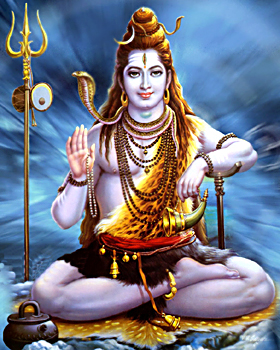
Lord Shiva is shown in a seated position or in the pose of a Padmasanaon a double petalled lotus in deep mediation with eyes half closed holding a water vessel in front left hand. He has four hands. His back right hand is generally broken; the front right one is in varada pose, while the black left hand possibly holds a trisula. The aksabalyas are on his arms as ornaments. He wears a beautifully arranged jata-mukta and a sacred thread. A snake coiled with a raised hood is shown on the left shoulder of the deity. Sometimes the god is shown as sitting under a Banyan Tree, the like of which may be seen in one of the Vishnu-Kanchi sculptures where the lord is represented in vitarkamudra while the two garlands bearing flying Vidyadharas are shown at the top from either side of the stele. On the left hand side near the lotus pedestal is the linga while on the right a male figure which is possibly Bhringi with a monkey like face and Bhringi is represented playing a musical instrument. In the iconography of Lord Shiva, below the lotus the bull or Nandi is found seated in a graceful pose with a band round the neck and with his eyes looking upward as if listening to some music and a tub apparently meant for food has been placed in front of him. This unusual motif is generally not found in most of the sculptures of Lord Shiva. Some of the deities of the Lord have two figures one male and the other female having snake hood upon their heads are represented as seated with folded hands on either side of the compartment which shows the bull. The image of the lord has an exquisite modelling and simplicity in approach. The main figure as well as the attendants all has the sublime expression of pleasant contemplation on the divine face. The variety of the images of Lord Shiva includes a lady who is represented lying down on a couch with the elbow of the right hand resting on the pillow holding his head on the palm. A child is shown lying beside the figure of the lady. The other figures which are present in and around the deity are generally effaced and only the linga remains visible. Also besides these a chauri bearing female attendant is standing near the head of the lady. Many such images have been discovered in various places of West Bengal and it has been analysed that the image of the child which is represented near the lingam is in fact the representation of the newly-born Shiva. Some of the earlier iconographies of Lord Shiva along linga also have the images of Lord Ganesha, Lord Kartikeya and sometimes also the Navagrahas. |
| |||



Iconography Of Lord Shiva
| Iconography of Lord Shiva is ancient and it has been represented in various forms all over India. |
| ||||||||||||||||||||||||||||

