


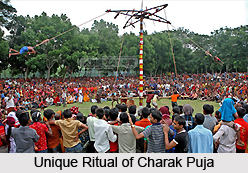
 Charak Puja is counted among the most valued festivals in rural and semi-urban Bengal. To the local residents in the city of Kolkata (Calcutta), West Bengal, this festival is known as “Batri Charak”. This grand festival is celebrated with lot of pomp and glory in the remote areas of West Bengal state by the members of different agricultural communities. This is one of the most fascinating folk festivals of the southern belt of West Bengal and Bangladesh. Charak Puja is also called 'Nil Puja'. The puja is celebrated by the Hindus on the last day of Chaitra or on the day of the Chaitra Sankranti, around April 14th or 15th. The festival marks the bidding of goodbye to the passing year. Charak Puja is counted among the most valued festivals in rural and semi-urban Bengal. To the local residents in the city of Kolkata (Calcutta), West Bengal, this festival is known as “Batri Charak”. This grand festival is celebrated with lot of pomp and glory in the remote areas of West Bengal state by the members of different agricultural communities. This is one of the most fascinating folk festivals of the southern belt of West Bengal and Bangladesh. Charak Puja is also called 'Nil Puja'. The puja is celebrated by the Hindus on the last day of Chaitra or on the day of the Chaitra Sankranti, around April 14th or 15th. The festival marks the bidding of goodbye to the passing year.
Rituals of Charak Puja Charak Puja is dedicated to the Goddess Shakti and the Lord Shiva, and people who take part in this puja are required to undergo a prolong fast. Generally during such fasts the devotees are not permitted to have food from early morning till evening and therefore, be subjected to physical pain. However, at the time of Charak Puja, those who take up fasting, are allowed only to have some fruits and are required to pray to the Lord Shiva for his divine blessings. This festival or puja is devoted solely to penance and it is, thus, quite unique in the huge list of several Bengali festivals. The group of women and men who take up this time bound ritual or 'Brata', are subject to practice a month long fasting which begins from sunrise and continues till sunset. The team which arrange for the festival, travel to different villages to gather necessary items like paddy, sugar, oil, money, salt, honey and a list of other items along with the arranged cosmetics like Narod, Shiva and Parvati. The cosmetic Shiva is known as 'Jal Katha' or 'Nil Pagol' locally. On the auspicious midnight of the Sankranti, the devotees gather in order to worship the God and after the puja is completed, the 'Prosad' is distributed among the devotees. 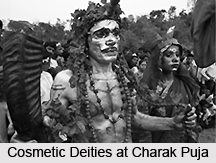 Unique Practices in Charak Puja Unique Practices in Charak Puja
On the auspicious day of the 'Gajan' or the 'Charak', bamboo stages are constructed over bamboo poles, and its height ranges from ten to fifteen feet and then follows a very fascinating incident. The devotees are popularly called 'Charak' who take up hardships for satisfying Lord Shiva. After the proper execution of a month long fasting and meditation, the devotees climb up to the high bamboo stage and jump or just through themselves forward. They fall on the ground which is completely filled with thorns, glass, knives and a list of other devious weapons. To the utter surprise of all, they are not hurt. It is believed that the divine blessing of the God helps them stay safe from being hurt by such difficulties. There are also other ways in which the devotees demonstrate the blessings of the Lord over them. They just impale some parts of their body and do not feel even a little pain. Charak Puja thus demonstrates the blind faith of the devotees and also shows their strong will to jovially accept penance in order to get salvation. These Charak also carry out other risky tasks like getting tied with a hook on the back and then being moved around a bar with a long rope. This is not the end; some also hurt their body parts to show the miracle of God. In this process they express their deep faith on their Gods and Goddesses. Normally ten to twelve members take part in this ritual together. The chief performer of this puja is called the Deoboinshi. Charak are of two types; one is known as the Chak Charak and the other is called the Chila Charak. Charak Puja is, thus, celebrated with lots of hardships. Beliefs of Charak Puja It is believed by the devotees that Charak Puja will bring in prosperity by wiping out the sufferings and sorrow of the last year. This is celebrated mainly to please the Lord Shiva, the renowned 'Debadideb' of the Hindus. Even if the festival is held on the mid night of Chaitra Sankranti, the preparation for the same normally kicks off before one month of the day. 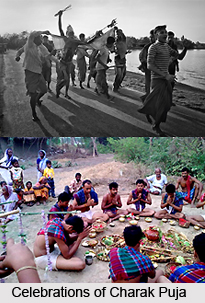 Celebration of Charak Puja Celebration of Charak Puja
Charak Puja is a widely celebrated religious event that draws enthusiastic participation from villagers with great fervor and devotion. This unique festival, which occurs around midnight, is marked by a series of rituals dedicated to venerating Lord Shiva and demonstrating the miraculous power of the deity. These rituals, while intriguing, often carry an element of risk. At the heart of Charak Puja lies the creation of a human "Charak" as a means to appease Lord Shiva. The term "Charak" refers to an individual who willingly undergoes a challenging physical ordeal in honor of the deity. To commence this ritual, the Charak is securely tied with a "Borshi," a type of hook, positioned at the individual's back. A group of 10 to 12 devotees collectively undertakes this task, led by the central performer known as the "Deoboinshi." Devotees' devotion to Charak Puja is so profound that many choose to observe a fast throughout the day, abstaining from food and drink until the midnight puja takes place. As the hours pass and anticipation builds, bamboo stages are erected with heights ranging between 10 and 15 feet. These stages are conspicuously laden with knives, glass shards, and thorns, creating an exceptionally perilous path. When the clock strikes midnight, signaling the commencement of the puja and the end of the fasting period, a remarkable spectacle unfolds. Devotees, undeterred by the hazardous terrain, courageously ascend the bamboo stages. Charak Puja in Different States Charak Puja is a widely celebrated festival, and while it is most prominently observed in West Bengal, it also holds significance in other states of India, each with its unique regional variations and customs. In West Bengal, Charak Puja is closely associated with the Gajan Festival. This festival carries immense popularity, and it serves as a means for village communities to seek spiritual redemption and divine blessings for a prosperous harvest in the upcoming year. Lasting for three days, the Gajan Festival culminates in a series of awe-inspiring rituals that capture the collective imagination of the villagers. The vibrant celebrations of Charak Puja are not confined to West Bengal alone. In the northeastern state of Tripura, as well as the northern state of Assam, this festival also finds its place on the religious calendar. Here, too, devotees participate in the rituals with great enthusiasm and dedication, aiming to cleanse their souls and invoke divine favor. Moving to the western state of Maharashtra, the festival takes on a unique local flavor. In Maharashtra, the festival is referred to as Bagad and it mirrors the essence of Charak Puja. Bagad involves the veneration of a ceremonial pole, typically obtained from an auspicious tree. This act of reverence symbolizes the spiritual connection between the people and the natural world, reinforcing the importance of environmental harmony. In Andhra Pradesh, a similar tradition known as the Sirimanu Festival is observed. This festival centers around the veneration of a ceremonial pole, much like Bagad in Maharashtra. It is an occasion for the local community to come together in celebration and devotion. Charak Puja reflects the unwavering faith and dedication of the villagers who participate in this extraordinary event. Through their willingness to undertake the physical challenges and risks involved, they express their deep reverence for Lord Shiva and their belief in his divine protection. This annual celebration not only exemplifies the religious fervor of the community but also shows the enduring connection between spirituality and human determination. Beliefs of Charak Puja |
| |||



Home > Art & Culture > Indian Festivals > Indian Religious Festivals > Hindu Festivals > Charak Puja
Charak Puja
| Charak Puja is one of the most famous festivals of rural Bengal which is celebrated every year on Chaitra Sankranti. Unique rituals are followed by the devotees in the festival, including physical hardships, to express their devotion to the deities. |
| ||||||||||||||||||||||||||||

