


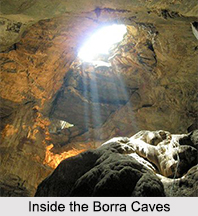
 The Borra Caves, also known as Borra Guhalu, are located on the East Coast of India, in the Ananthagiri hills of the Araku Valley of the Visakhapatnam district in Andhra Pradesh. The caves are one of the largest in the country, which is located at an elevation of about 705 m. The Borra Caves, also known as Borra Guhalu, are located on the East Coast of India, in the Ananthagiri hills of the Araku Valley of the Visakhapatnam district in Andhra Pradesh. The caves are one of the largest in the country, which is located at an elevation of about 705 m.
History of Borra Caves The actual name of the cave is Borra Guhalu. Borra means hole in Odia language and Guhalu means caves in Telugu language. Borra Caves were discovered in 1807, by William King George of the Geological Survey of India. Geography of Borra Caves Borra Caves are located in the Araku Valley of the Ananthagiri hill range and is drained by the Gosthani River. At the entry, the cave measures up to 100 m horizontally and 75 m vertically. Climate of Borra Caves Location The average annual temperature of Araku hills, where the Borra Caves are situated is about 25 ° C. Average annual rainfall is 950 mm. Legends of Borra Caves There are several legends regarding the discovery of the Borra Caves which are narrated by some Indian tribal people who stay close to the caves. These tribes include the Porja, Nookadora, Kondadora, Valmiki, Jatapu tribe, etc. One of the most popular legends is that a cow, which was grazing over the caves, and suddenly the cow fell 60 meters inside the earth. While looking for the lost cow, the cowherd discovered the caves. The cowherd noticed a stone inside the cave resembling a Lingam, which he interpreted as the Lord Shiva who saved his cow. The villagers believed on the cowherd and since there was a temple for Lord Shiva constructed outside the cave by them. People visit the temple to pray to Lord Shiva. Another lyrical legend is that the Shiva Lingam representing the Hindu God Lord Shiva, was found deep in the caves above which there was a stone formation of a cow (Sanskrit: Kamadhenu). It is surmised that the udder of this cow is the source of the Gosthani (Sanskrit: Cow's udder) River which originates from here, flows through Vizianagram and Visakhapatnam districts before emptying into the Bay of Bengal near Bheemunipatnam.
Formation of the Structures in Borra Caves The Gosthani River, which originates from the Borra Caves and flows between the solidified stalactites and stalagmites in the karstic limestones formation, is the cause for the development of the odd shapes of structures. Water, percolating from the roof of the caves dissolves limestone and trickle drop by drop to form stalactites at the roof of the cave and then dripping down to the ground form stalagmites. These deposits have developed into interesting forms and structures inside the caves. These forms are Shiva-Parvati, Mother-Child, Rishi’s beard, human brain, mushrooms, crocodile, temple, church, etc. These shapes have been interpreted by the tourists, while some have religious importance. Archeological Artifacts in Borra Caves Archeological artifacts have been found in the caves. The excavations carried out in the caves by the archeologists of the Andhra University, have unearthed stone tools of middle Paleolithic culture dating back 30,000 to 50,000 years, which confirm human habitation. Flora and Fauna in Borra Caves The fauna observed in the Borra Caves are predominantly bats, as well as the golden gecko. The type of bat observed here is the fulvous fruit bat (Rousettus leschenaultii) – this species of bat roosts in large caves, old buildings, dungeons and dark areas of old forts. Tourism in Borra caves An Arraku and Borra rail-cum-road package tour has been organized by the Andhra Pradesh State Tourism Department to visit the Borra Caves. A walk around the caves provides views of the mountainous area which is rich in flora and fauna. The Andhra Pradesh State Tourism Department has installed 26 mercury, sodium vapor and halogen electric lamps, which help the tourists to observe the formations. Visiting Information to Borra Caves Borra Caves is well connected to road, rail and air services. Nearest international airport to this site is Visakhapatnam Airport, which is 76 km from Borra Caves. Nearest railway station is Borra Guhalu rail station. The location of Borra Caves is 448 km from Bhubaneshwar and 656 km from Hyderabad. By road the site can be reached via National Highway 5. |
| |||



Home > Travel > Indian Cities > Cities of India > Cities of Andhra Pradesh > Visakhapatnam City > Borra Caves
Borra Caves
| Borra Caves form one of the major tourist destinations in Vizag where stalagmites and stalactites are found. |
| ||||||||||||||||||||||||||||

