Arachnids
|
Arachnids are essentially invertebrates belonging to the sub-phylum of Chelicerata.
|
|
|
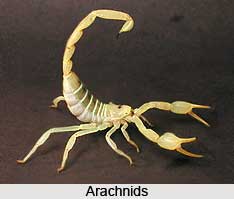 Arachnids are lower animals with a segmented body and jointed appendages. Unlike insects they have no mandibles or true jaws, feelers (antennae), or compound eyes but in their place they have a pair of false jaws (chelicerae), a pair of pedipalps variable in form and function, and a number of simple eyes. Their head and thorax are in most cases fused to form a cephalothorax which bears below it four pairs of jointed legs ending in claws. The abdomen is usually marked off by a distinct constriction or waist. In a few cases the abdomen is merged with the thorax. They all breathe by air-tubes or book-lungs. The sexes are separate. There is no metamorphosis or change in form among the arachnids during embryonic development, as in insects. Arachnids live on land with the exception of a few species which live in water, sea or fresh. Arachnids are lower animals with a segmented body and jointed appendages. Unlike insects they have no mandibles or true jaws, feelers (antennae), or compound eyes but in their place they have a pair of false jaws (chelicerae), a pair of pedipalps variable in form and function, and a number of simple eyes. Their head and thorax are in most cases fused to form a cephalothorax which bears below it four pairs of jointed legs ending in claws. The abdomen is usually marked off by a distinct constriction or waist. In a few cases the abdomen is merged with the thorax. They all breathe by air-tubes or book-lungs. The sexes are separate. There is no metamorphosis or change in form among the arachnids during embryonic development, as in insects. Arachnids live on land with the exception of a few species which live in water, sea or fresh.
Arachnids are basically invertebrates and have eight legs. Instead of haemoglobin the blood of arachnids consists of haemocyanin. The arachnids are carnivorous in their feeding habits. As far as reproduction is concerned among the arachnids they have evolved a complex process of courtship and they lay yolky eggs which resemble the adults.
Arachnids include groups of members of diverse appearance, structure and habits. The common examples are Scorpions, Whip Scorpions, Spiders, Scorpion Spiders, False Spiders, Sun Spiders, Garden Harvestmen, mites, Ticks and King-Crabs.
Arachnids are a much disliked group because of the painful stings of scorpions, poisonous bites of some spiders, the sinister look of whip scorpions, the diseases caused and spread by mites and ticks have all been abhorred by man.
This article is a stub. You can enrich by adding more information to it. Send your Write Up to content@indianetzone.com
|
|
|
|





