Traditional Sports in Ladakh, Jammu and Kashmir - Informative & researched article on Traditional Sports in Ladakh, Jammu and Kashmir
  Indianetzone: Largest Free Encyclopedia of India with thousand of articles Indian Cities


in  
Art & Culture | Entertainment | Health | Reference | Sports | Society | Travel
Forum  | RSS Feeds  | Free E-magazine
Indian Cities : Ancient Indian Cities l Metropolitan Cities in India l Indian hill stations l Indian Capital Cities l Indian Holy Cities l Port Cities in India l British Cathedrals in India l Indian Cities l Pilgrimages In India l Tourism in India
Home > Travel > Indian Cities > Indian Cities > Cities of Jammu and Kashmir > Ladakh > Tourism in Ladakh > Traditional Sports in Ladakh
Traditional Sports in Ladakh, Jammu and Kashmir
Traditional Sports in Ladakh encompasses games like Polo, Archery and Football.

Culture and customs play a significant role in the life of the Ladakhis. Hence the traditional sports in Ladakh, such as, polo or archery are closely associated with ancestry. These traditional sports are enjoyed by the people wholeheartedly.

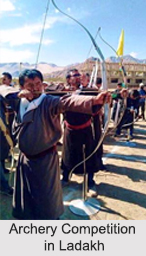
The traditional summer pastimes of the Ladakhis are archery and polo; and in the Leh district football is very popular. Championships are organised, and fans are as ardent and vociferous in support of their chosen teams as their counterparts anywhere else in the world. The standard of play is comparable to that of amateur football anywhere; no allowances have to be made for the altitude. The same cannot be said of archery; and as far as the Leh area is concerned, the so-called archery festivals seem to be little more than excuses for a summer party. The people gather under the boldly patterned `shamianas` to enjoy the sports. The sports are enjoyed with interludes of dancing and miscellaneous entertainment, with `chang` which is an important beverage of Ladakh. Nevertheless, as with the dance, a strict etiquette prevails in the archery festival. The competing teams must be captained by someone from an aristocratic family, preferably the senior member present. Whenever a person of high social status takes a bow the music, accompanying the shooting, swells in volume and increases in tempo to honour him.

On the other hand, in Kargil district archery has fewer extraneous accompaniments. The standard of archery is much higher here. The archery season in Kargil is in March and the archers practice for the competition throughout the winter. Whereas the Leh people are content with makeshift bows fashioned from willow branches, some of those used by the Kargil enthusiasts are objects of high craftsmanship, made to what is said to be a very ancient design incorporating a thin layer of ibex horn. It imparts a high degree of springiness to the bow, and velocity to the arrow.

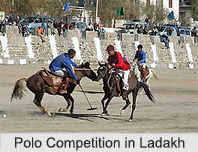
One of the main sports of Ladakh is Polo which is indigenous to Central Asia and parts of the Himalaya, but its precise origins are lost in the obscurity of time. The Iranians have claimed it for their own, and so have the Chinese, and it was being played by the princes of Byzantium in the twelfth century. It seems to have been the early Muslim rulers, who first introduced it into India, and it was popular at Akbar`s court. It survived however on India`s far eastern border, and in the western Himalaya where it had been played from time immemorial independently of its existence in medieval India. The sportsmen of the Raj first played polo in Calcutta (now Kolkata) in about 1860, having discovered it in Manipur. It had already been described by travellers in the western Himalaya like Moorcroft, Vigne and Cunningham earlier, and it was played by British visitors to Kashmir in 1863. From there it reached the Punjab, at about the same time as it also arrived from the direction of Calcutta and by the early 1870s it was being played in England. The British modified and `improved` the game and invented their own rules, introduced the chukker system out of consideration for the horses, and generally tidied it up. The game of international polo was born during this time.

But in Ladakh, and other remote areas of the Karakoram like Hunza, Nagar, Chitral, Gilgit and Baltistan, people continued to play polo as they had always done. In Ladakh the player is permitted to throw the ball between the posts, and a goal is awarded. There are no chukkers, but each half ends when either team has scored nine goals. The only foul is to cut across the path of another player`s horse, which is obviously dangerous. Otherwise there are no rules, least of all any regulating the size of the ground or the number of players. The size of the field is determined by how big a patch of level ground may be spared from cultivation in this rugged terrain of steep mountains and narrow valleys. The goals are fixed at either end of the street, and the players station themselves where it seems to them best. The strength of the team is determined by the number of good players present in the team. The Ladakh Chronicle records the laying-out of a polo ground in Leh in 1885.

The traditional sport of Ladakh, Polo, was introduced to central Ladakh from Baltistan. Some authorities say that it was brought to Ladakh by Sengge Namgyal whose mother was a Balti princess, early in the seventeenth century. It had also been said that Sengge who founded the first royal polo ground, in the Murtse garden below Leh (now the site of the Defence Ministry`s Field Research Laboratory). As per the view of some other scholars, polo was brought by the colony of Baltis settled at Chushot, a village just across the Indus, a few kilometres upriver from Leh. The Baltis were fanatically devoted to polo and it has been presumed that the half-Balti Sengge brought and settled a colony of his mother`s compatriots for the express purpose of playing polo and popularizing it in Ladakh. Chushot is the only village in central Ladakh with its own polo ground, where every year on 21 March polo is played to celebrate Nauroz, the Persian and Shia New Year. Till date many of the finest players in and around Leh are Baltis from Chushot.

The people of Ladakh show immense enthusiasm for the sport and the interest is universal, and there are a fair number of Buddhists among the front-rank players. But strangely enough, although horses and horsemanship were part of the way of life in old Tibet, polo seems not to have caught on in a big way in Buddhist Ladakh. Its distribution in the western Himalaya is more or less coextensive with the penetration of Islam. Apart from the immediate neighbourhood of Leh, polo is today played only in those parts of the district that have a Muslim population, such as the villages of Turtuk and Bogdang in Nubra, down the Shayok river to the north-west. In Kargil district, the austere rule of the Muslim clerics to some extent put a damper on the game in the immediate post-Independence years. In spite of this fact, it survived particularly in Dras, where it is said that the various villages can put as many as 24 teams in the field, and of recent years it has even made a comeback in Kargil and Chigtan.

Languishing in and around Leh in the middle decades of the century, polo revived from the mid-1970s due to the encouragement of the district administration. Exhibition and tournament matches have been held regularly since then, and as an integral part of the annual Ladakh Festival sponsored by the State Tourism Department. Ladakh polo has started to attract international interest, while the Leh Polo Club has secured affiliation to the Indian Polo Association. As played today, it is a slightly modified form of the original game, but still it makes few concessions to international polo. Usually there are six players on each side, and play lasts for an hour with a ten-minute break in the middle. There are no chukkers, but the hardy Zanskari ponies scarcely seem to suffer, even at the altitude of 3500 metres. The presence of the Army gives a sharpened interest to the game, for polo in post-Independence India has been almost exclusively an army pursuit. Undoubtedly the most exciting matches are those in which a local civilian team takes on the army.

The Leh polo ground provides a spectacular setting. At the start and finish of play, and to celebrate every goal, players of `surna` and `daman` strike up special polo music, which adds a final touch of excitement to an occasion whose atmosphere is unique. And there is one other striking difference. Balti-style polo as played in Ladakh is not a rich man`s game. The Chushotis and others who make up the local teams are for the most part small farmers, or school masters, or shopkeepers, or are employed in the various departments of the district administration as office messengers, drivers or syces. A few of the better off have their own horses, some of them very fine animals indeed; others ride departmental horses, or those belonging to the Polo Club.

The sports of Ladakh add a different tint in the lives of the Ladakhis who consider the sports as one of the important festivals. The sports are played by the local people of Ladakh with great gusto and the triumph and failure are emotionally perceived by the people who are closely attached to it.
(Last Updated on : 15/06/2009)
  More on Tourism in Ladakh...
 
Traditional Sports in Ladakh Leisure Tourism in Ladakh Adventure Sports in Ladakh
Nature Tours in Ladakh    
Recently Updated Articles in Indian Cities
  • Panchgani
    Panchgani is one of the prominent hill stations located in the state of Maharashtra in India.
  •  
  • Panaji
    Panaji is the capital city of Goa and also one of the major tourist destinations in India.
  •  
  • Idukki
    Idukki is a prominent hill-station and one of the districts of the state of Kerala.
  •  
  • Urayur
    Urayur was the capital of the early Cholas until the dynasty was revived by Vijayalaya Chola in 850CE.
  •  
E-mail this Article | Post a Comment
Free E-magazine
Subscribe to Free
E-Magazine on Indian Cities

 
Traditional Sports in Ladakh, Jammu and Kashmir - Informative & researched article on Traditional Sports in Ladakh, Jammu and Kashmir
Sitemap
Contact Us   |   RSS Feeds
Copyright © 2008 Jupiter Infomedia Pvt. Ltd. All rights reserved including the right to reproduce the contents in whole or in part in any form or medium without the express written permission of Jupiter Infomedia Pvt. Ltd.