About Architecture of Varanasi
 On the banks of the River Ganga, Varanasi is one of the most sacred pilgrim centres and is renowned for some of its exquisite architectures. In the state of Uttar Pradesh, Varanasi is a city of temples for example the Kashi Vishwanath Temple also known as the golden temple is located in the outskirts of Ganga. Varanasi is also known as Benaras. It is regarded as a holy city by the Hindus, Buddhists and the Jains. The Hindu temples of Varanasi enhance the religious importance of the place. The Ghats are also major architectural sites of Varanasi. The steps of the Ghats lead to narrow lanes like labyrinths, which are tightly packed with houses, shops, temples, etc. Islamic architecture also constitutes a vital portion of the architecture of this holy city. There are several mosques built under the reign of the Mughal emperors.
Varanasi existed even during Gautama Buddha`s era, which means it is at least three thousand years old. It was then a centre for architectural activities. In the twelfth century, it came under Delhi`s Islamic rule and the Mughal emperor destroyed the temple and built a mosque, which is the cause for unrest till today. In the 18th century, it came under the rule of a Hindu feudal lord and was revived as the sacred place of Hindus. Now it is the religious and cultural hometown of ten lakh people.
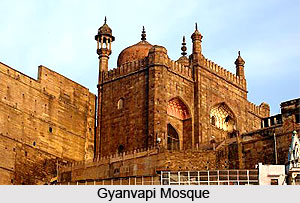
The Hindu architecture of Varanasi was destroyed under the reign of the Mughal emperor Aurangzeb. There are two mosques built on the banks of river Ganges by the Aurangzeb. The smaller mosque built on the site of a temple, is in the Mughal style. The larger mosque was built with material from the famous Vishwanath Temple, after it was destroyed, a fact that is still a sore point with Hindus. It has stucco painting on it. The height of its minaret is seventy meters from the riverbank and it acts as a good landmark. Located at the top of the very steep steps leading to Panchganga Ghat, the mosque was even more visible and clearly symbolised a powerful Muslim presence in this holiest of all Hindu cities when its very tall minarets still stood. The finely rendered stucco, stone and polychrome work suggests a patron of superior taste and enormous wealth.
Architecture of the Temples of Varanasi
The Kashi Vishwanath Temple was built in the year 1780 is an important religious centre of the Hindus. The Durga temple of Varanasi was constructed in the 18th century. The architecture of the temples is in the Nagara style of architecture of North India. The Sankat Mochan Temple is noteworthy for its outstanding architecture which is a perfect blend of old and the new. The architecture of the New Vishwanath Temple which was constructed in 1956 is the replica of the old Kashi Vishwanath temple. Most of the present architectural buildings of Varanasi were constructed during the 17th century.
Architecture of Ghats of Varanasi
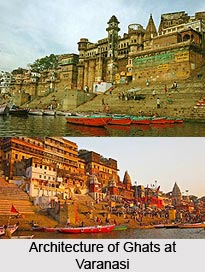
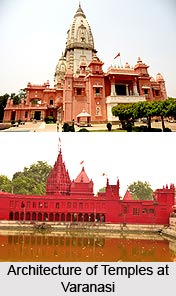 What brings hoards of people to this place is the anonymous collection of buildings in a row and the Ghats which are stepped terraces on the banks of the Ganga River that weave a religious spell. The banks of a river are considered sacred and terraces or steps are built there. These steps that lead into the river are called Ghats. Ghats of Varanasi are must-see architectural sites. The ghats line the Ganges River as immense staircases that build from the edge of the river to the sky. In Varanasi, the Ghats stretch for three kilometers or more and each section has its own name. The most important Ghat of Varanasi is the Dasashwamedh Ghat. Constructed by Peshwa Balaji Rao, it is one of the most holy bathing ghats of the Ganges. The sight of people worshipping sunrise while bathing at dawn, is altogether an unforgettable experience.
There are also cremation places at the top of the Ghats. The southern end has the Assi Ghat which leads to many ghats, ending in the Adikeshva Ghat in the north. Nearby is the Tulsi Ghat where Goswami Tulsidas lived till his death. Harishchandra Ghat is the cremation ghat where dead bodies are burnt day and night. Another cremation ghat is the Mani Karnika Ghat which is very old. It is a belief that only lucky people die in Varanasi.
Other Architectural sites at Varanasi
The Ram Nagar Fort of Varanasi is a Rajput architectural creation. The 17th century fort runs parallel to the river and has temples and palaces surrounded by courtyards with guards, guarding it. The palace facing the main courtyard is a blend of corbelled brackets and Mughal style arches. It reminds one of Akbar`s styles of construction. The side along the river has an entrance gate, allowing access to those who arrive by boat. The exterior walls are built with grand bricks. The interior has intricate ivory carvings, displays of clothes and remnants of the Maharaja of Benaras transport department.
Sarnath is another site near Varanasi which is famous for its ancient architecture as it has the old Dhamekh Stupa refurbished by Emperor Ashoka and also the Ashoka Column with the four lions atop it (India`s National Emblem) at the Sarnath Archaeological Survey of India Museum.
Varanasi is, thus, a home for Hindu religious architecture. The Muslim architectural creations are also very captivating. With a rich mythological past, Varanasi is noteworthy for the grandeur of its architecture.
Architecture of Varanasi During Aurangzeb
 The domain of `Mughal architecture` at once evokes in mind the magnificence, magnanimity, enormity, flamboyance and resplendence of these almost-godlike rulers, who had made possible such constructions like the Red Fort, the Agra Fort, Fatehpur Sikri, the Purana Qila, Humayun`s Tomb, the Shalimar Gardens, Tomb of Akbar the Great, the Jama Masjid, Delhi and of course, leaving the several others of princely patronage and the ones accomplished in Pakistan, culminating in the pristine Taj Mahal. Amidst such almost uncountable and unprecedented and unimagined architectural splendours in present times, it always comes to mind how exactly did the rulers accomplish such over-the-top projects in their lifetime! The exceedingly enriched legacy inherited from the famed and legendary Timur of Persian descent, Babur had invaded India for good, only to have been enamoured by the nation`s charms and enchantments, deciding to stay on forever. The Mughal Empire was established in 1526 A.D. under Babur, the legacy of which was being carried ably forward under his still illustrious progeny from century to century. However, things had suddenly come to a frozen stillness and an uncanny ill air hung in between just after Shah Jahan, with his successor Aurangzeb. The reasons of which of which if described in such an article, will take pages to be completed. However, it can be stated that Aurangzeb was more and more inclined to overstretch his empire and paid less and less attention to architectural masterworks, which still show to this date. During Auranzgeb`s later years of reign, his kingly patronage and consistent backing, however had achieved much, praises of which have been restored by historians for research purposes. Ill-famed and notoriously blamed to have ransacked Hindu architectures around India to establish Islamic domination, architecture of Varanasi during Aurangzeb absolutely comes under such a `ransacking` category. Varanasi`s architecture under Aurangzeb had suffered much, serving primarily as a Hindu society, later during a Mughal Aurangzeb, being replaced by Islamic edifices.
Architecture of Varanasi during Aurangzeb as a Mughal-dominated tradition, was passionately based thus upon the ushering in of a temple-demolishing period. Tradition still perpetuated in Varanasi, thoroughly blaming Aurangzeb for destroying many of the city`s temples, even though imperial documents indicate that he long had been concerned with maintaining harmony between the Hindu and Muslim communities there. In fact, there exists evidence only for his demolition in 1669 of the Vishwanath temple, built almost certainly by Raja Man Singh during Akbar`s reign. It is also stated that Aurangzeb`s demolition of the temple was motivated by specific events, not bigotry. One was the rebellion of zamindars in Benaras, some of whom indeed had assisted the Maratha legend Shivaji in his escape from Mughal authorities. It widely was believed that his escape initially had been facilitated in Agra a few years earlier by Jai Singh, Raja Man Singh`s great-grandson, thus explaining the destruction of this particular temple. Another was the reaction to recent reports of obstructive Brahmins interfering with Islamic teaching. The demolition of the Vishwanath temple, then, was intended as a warning to anti-Mughal factions - in this case troublesome zamindars and Hindu religious leaders who wielded great influence in this city. Moreover, the temple had been built by a Mughal amir, some of whose successors recently had abetted the emperor`s most persistent enemy. As such, Benaras serving as the melting-pot of Muslim-Hindu contentions, was up in dichotomous flames concerning with architectural replacements. Architecture of Varanasi during Aurangzeb was thus accomplished under strict and sensitive vigilance
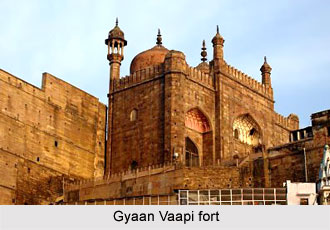
The Vishwanath temple was largely replaced and was utilised as the qibla wall (an Arabic word for the direction that should be faced when a Muslim prays during Salah; most mosques contain a niche in a wall that indicates the qibla) of the large mosque constructed in its place, underscoring Aurangzeb`s displeasure with Benares` politically and religiously `active Hindu elite`. In present times this mosque, whose facade is modelled partially on the entrance to the Taj Mahal, is legendary as the Gyanvapi mosque. The name of the patron is not known and its construction is cited in no Mughal text either, making architecture of Varanasi during Aurangzeb stand out as specialised `Mughal dynastic` construction as different from its erstwhile counterparts.
Tradition holds that another mosque during Aurangzeb`s reign was constructed on the site of a destroyed temple in Varanasi, although no evidence supports this. Presently acknowledged as the Jami or Aurangzeb`s mosque, this legendary architecture of Aurangzeb in Varanasi dominates the famed and celebrated Benaras riverfront. Located at the top of the very steep steps leading to Panchganga Ghat, the mosque was even more visible and clearly symbolised a powerful Muslim presence in this holiest of all Hindu cities when its very tall minarets still stood. Inscriptions of later date record repairs to the mosque, but none reveal its original construction date or patron. Yet it is characteristic of Aurangzeb-period architecture in Varanasi. The proportionately tall height of this three-domed mosque and its now-missing minarets emphasises the structure`s verticality. Unusually refined, the stone-faced mosque is a single-aisled three-bayed type usually associated with private, not imperial, patronage. Its brown stone facing is delicately carved with niches and arches. The finely rendered stucco, stone and polychrome work suggests a patron of fine taste and great wealth.
Architecture of Varanasi During Later Mughals
 Architecture of Varanasi during later Mughals can smoothly be stated to have fallen within the purview of North Indian Mughal architecture, during the last phase. Varanasi had served as a crucial and decisive region since the Vedic Age as a Hindu-dominated cultural expression. However, the earlier Mughal rulers like Akbar or Jahangir were intelligent enough to maintain and preserve tolerant and friendly relations with the Hindus, after the gushing of Muslim arrival to India. As a result, besides an overwhelming response to Hindu culture, Islamic architecture is also known to have prevailed in Varanasi under the Mughal ruling clan. So much was their influence upon the gross Hindu population that Mughal architecture in Varanasi is still one of research and historic wonder, admired by the common eye. However, the scenario during the later Mughals was one that was much different and spun in a rather wholly opposite direction, in every sphere of administering or beautifying India. As a matter of course thus, architecture of Varanasi under the later Mughals had suffered a tremendous and sudden blow, a mar which could never be wiped out in the generations to come.
Mughal rulers had held Varanasi until the mid-eighteenth century when the city and the region around it fell to Hindu zamindars, who had been awarded the title `raja` by the Mughal emperor. The new ruler`s authority, however, was less than absolute, for the territory held by the Varanasi raja was under the larger umbrella of the British East India Company. Construction in Varanasi by Muslims, as such, had diminished during this period. Although mosques continued to be built, the most noteworthy Islamic structure built is the tomb of Lal Khan, dated 1768-69. This latter masterpiece architectural work in Varanasi under the later Mughals overlooks the Ganges at the site where today the famed Mughal Serai Bridge spans the river. The form of this square-plan tomb surmounted by a dome and four chattris is highly conservative, sticking by closely to Mughal-period monuments. Glazed-tile decoration on the tomb`s surface produces a conspicuous and arresting polychrome effect. While glazed-tile embellishment is not generally associated with Mughal and post-Mughal architecture in eastern India, such an embellishing feature was also utilised in a mosque almost precisely contemporary in date, the erected by Mir Ashraf, dated 1773, in Patna. There, however, the tiles had been placed on the floor.
In Varanasi, still looked at as the most sacred of all Hindu cities, temples were erected in prolific numbers during the late Mughal period and the years of rule by zamindars. Most important of these was the now-legendary Vishwanath temple, whose predecessor had been mercilessly razed by Aurangzeb. A small structure, with delicate reduplicated spires that punctuate the temple`s height, it was once again revitalised as the major site of pilgrimage in the holy city. In addition to temples, the ghats - often leading from massive edifices facing the waterfront, were chiselled by Hindu rajas, some residing at a considerable distance, as a means of establishing their own standing in this sacred city. Quite as a consequence, architecture of Varanasi during the later Mughal rule was an overwhelming and overpowering sole dazzling instance in the whole of India, enwrapped in architectural darkness.