


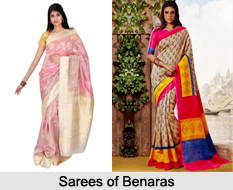
 Sarees of Banaras are much coveted items that are a must in the treasure trove of an Indian woman. Varanasi, still locally known as Banaras, is the undisputed centre of India's zari figured-silk weaving industry. The authenticity and ethnic look of Indian costumes are reflected in a woman when she is clad in an intricately designed traditional saree of Banaras. Sarees of Banaras are much coveted items that are a must in the treasure trove of an Indian woman. Varanasi, still locally known as Banaras, is the undisputed centre of India's zari figured-silk weaving industry. The authenticity and ethnic look of Indian costumes are reflected in a woman when she is clad in an intricately designed traditional saree of Banaras.
History of Sarees of Banaras Buddhist texts that mention Banaras fabrics, Varanasi seems to have been a centre of fine textile weaving for at least two millennia. Some Varanasi weavers trace their history back as far as AD 990, which is about the period that the ‘Naksha Drawloom’ is believed to have been introduced into India. Nowadays, and during the past few centuries, its weavers are almost exclusively Muslim, belonging to the Julaha community. They are well known for their high level of technical and aesthetic skill. Designs and Patterns in Sarees of Banaras The Banarasi sarees have a rich variation and the Banaras brocade sarees vary tremendously because weavers create different products to suit different regional markets and changing fashions. Moreover, though the Banarasi sarees have a wide variation, several weaving and design characteristics distinguish them from other Indian brocades. The designs and patterns of the Banarasi silk sarees differ as the supplementary thread designs, including dense border patterns, are almost always woven as discontinuous supplementary-weft with the highly decorated endpiece or pallu. These endpieces usually end abruptly in a strip of unembellished cloth 15 to 40 centimetres long. The designs, and consequently the threads, are usually extremely fine, with thread sizes ranging from medium to the finest on the market. There are exceptions, but most Banarasi brocades usually have strong Mughal design influences. This particular Banarasi sarees are designed with intricate intertwining floral and foliate motifs, kalga and bel. According to the creativity and the tradition, the artisans create different designs including ‘buti’ (small single flower), ‘buta’ (a large flower) and ‘jaal’ (shrub) that are typical to Banaras brocades. A characteristic motif found along the inner and sometimes outer edges of borders is a narrow fringe-like pattern that often looks like a string of upright leaves, called ‘jhaalar’ or frill. 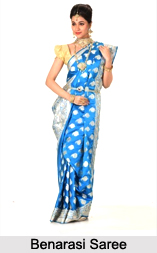 Most Banaras brocade motifs are densely patterned and look three-dimensional, quite unlike the static, two-dimensional quality of Deccan and south Indian brocades. Traditional Banaras brocade sarees are usually found in light colours that are which may be quite pale compared to western and southern Indian silks. Throughout the 20th Century there has also been a class of Banaras brocades that are embellished with patterns from distinctly Western (European, American) design schools that range from mid-Victorian Naturalist through to late 20th Century Modernist. Most Banaras brocade motifs are densely patterned and look three-dimensional, quite unlike the static, two-dimensional quality of Deccan and south Indian brocades. Traditional Banaras brocade sarees are usually found in light colours that are which may be quite pale compared to western and southern Indian silks. Throughout the 20th Century there has also been a class of Banaras brocades that are embellished with patterns from distinctly Western (European, American) design schools that range from mid-Victorian Naturalist through to late 20th Century Modernist.
Varieties in Sarees of Banaras Besides the excellent bridal sarees, the sarees of Banaras fall into several categories. The types of Banaras sarees include opaque zari brocades, Amni brocades, Kincab Brocades etc. Though silk is predominantly used in making sarees in Benaras, fabrics like Organza (Kora), with Zari and Silk, Pure Silk Saree (Katan), Georgette and Shattir are used in creating exclusive and modernised Banaras sarees. Apart from the traditional Banarasi sarees, several other sarees are also woven in Banaras and these are known as Banaras sarees as they are woven here. Banaras Silk Jamdani, Jangla saree, Jamawar Tanchoi saree, Tissue Saree, Cutwork Saree, Butidar saree etc are created with great excellence and creative exuberance that suit the repute of Banaras. Benarasi Saree: Famous Saree of Benaras One most important sarees of Banaras is the Banarasi saree. The history of Banarasi saree dates back to the Mughal era when the fame and appreciation of Banarasi silk sarees of India reached the zenith of success. The progression of time and the involvement of different groups of artisans in the weaving sector have caused a subtle change in the patterns and motifs of Banarasi sarees. The excellent amalgamation of Indian and Persian patterns are created and the sarees got a new look and glamour. |
| |||



Sarees of Banaras
| Sarees of Banaras have an age long tradition and are much coveted items for Indian women. |
| ||||||||||||||||||||||||||||

