Panchayat System in India is one of the essential institutions that evolved in the country since ancient times. The word Panchayat literally means governance by a `council of five`. Panhayat systems are often referred to as the grassroot level of democracy. It is an institution of local self government at the village level. Since ancient times, in India a sort of village council or an association of the residents of the village often consisted of village elders, herein the gram sangha or the Panhayat performed distinct administrative and judicial functions. Manu smriti or code of Manu has reference of Gram Sangha. Gram Sangha also finds importance in the epics such as Mahabharat and Ramayana. Moreover, Kautilya`s Arthashastra and Nitishastra of Sukracharya also contain mention of the Gram Sangha or Sansad.
Ancient India was predominantly an agricultural society and the basic unit was the self governing system. The villages were governed by their elected Panchayats. Every year the Panchayats were elected. In addition to that, during Buddhist period, there were regional councils or janapadas, city councils or Nagara Sabhas as well as Paura Sabhas and the village assemblies or Gram Sabhas. The Paura Sabhas were presided over by a leading citizen. Panchayat System in India throughout the period of Mahabharat included Paura Sabhas and janapadas who provided to put check on the arbitrary authority. Simultaneously with the monarchial form of government in India, the Panchayat system prevailed.
Advent of British rule contributed mammoth changes in the Indian society. Panchayat System in India advanced with a relatively new meaning. The term `panchayat raj` originated during the British administration. It was a decentralized form of Government where each village was responsible for its own affairs. This system of the Panchayat was adopted by state governments during the 1950s and 60s. Moreover, the Amendment Act of 1992 provides provision for delegation of powers and responsibilities to the panchayats. The panchayats are important in the Indian society for preparation of plans for economic development and social justice and also for implementation in relation to twenty-nine subjects listed in the eleventh schedule of the constitution.
At present Panchayat System in India comprise of districts which are the principal subdivision within the state. These districts are further subdivided into taluqs or tehsils areas that contain about 200 to 600 villages. The taluqdar or tehsildar is the chief member of the taluq revenue department and is the preeminent official at this level. Article 40 of the Constitution announces about panchayati system in India. These Panchayats serve as institutions of local self-government. There are recommendations; the popularly elected village council (gram panchayat) is the basic unit. Village council chairs, elected by the members of the village council, serve as members of the block council (panchayat samiti). The district council (zilla parishad ) is the top level of the system. Its jurisdiction includes all village and block councils within districts.
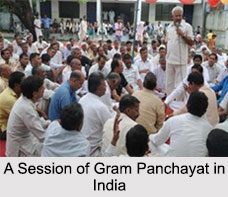
Panchayat System in India also refers to a council of elected members, who take decisions on issues which are important for the village social. A panchayat is thus a body of elected representatives in the village. The council leader is termed as `sarpanch` and each member is a panch. The panchayat acts as a means of expression between the local government and the people. In such a system each villager can voice his opinion in the governance of his village. In the recent times Panchayat is included in the constitution of the Government of India. This system is serving as a backbone in the present society at present.