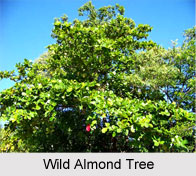
 Wild Almond Tree is a soft wooded tree that can grow up to 115 feet tall. The origin of the name of the bad-smelling Sterculia genus comes from the Roman god, Sterquilinus, who was the god of fertilizer or manure. The Wild Almond is a tall, straight and noble tree which takes a magnificent look when in the month of March and April; the leafage is at its fullest. Because of an extraordinary height of about 36m, this tree is calculated as one of the giant trees in India. The origin of the tree lies in East Africa and North Australia. In Burma, Sri Lanka and down the West of Peninsula, the tree grows very generously. Wild Almond Tree belongs to the family named "Sterculiaceae".
Different Names of Wild Almond Tree
The scientific name of the Wild Almond Tree is "Sterculia Foetida". The Wild Almond tree is called in different names in different languages. Both in Hindi and Bengali languages, it is known as "Jungli Badam". In Tamil, it is called as "Pinari" or "Illawa" while in Sinhalese it is "Telembu". In Malayalam it is called as "Kelumpang" or "Kayu Lepong" and in English, it is known as the "Wild Almond", "Poon Tree", "Java Olive" or the "Indian Almond".
Different Species of Wild Almond Tree
There are some other species of the Wild Almond Tree. "Sterculia" does have a lot of species. And the flowers are also different from each species to another. Some of the flowers are very large and gorgeous while some others are small and almost unnoticeable. Some of them have very sweet scents and some other have offensive strong smells.
 Amongst the various species, "Sterculia Urens" is quite common. It is called "Culu" in Hindi. The specie named "Sterculia Villosa" has some handsome fruits and their hairy pods are like a starfish in shape. "Sterculia Alata" is another species that is very popular for the roadside planting. As the large and wooden nuts are often more than 15 cm in diameter, it is very eye-catching when in fruit. In Bengali, it is called as "Buddha Narikella". Another species is "Firmiana Colorata" or "Sterculia Colorata". This normally loses all of its leaves in the winter and in March; it gets decorated with numerous upright branches that have orange-red colour blossoms and buds. The seeds are largely lobed and they appear shortly. They are known as "Marambarutti" in Tamil and "Maramparatti" in Malayalam.
Characteristic Features of Wild Almond Tree
The grey bark of the tree is brown-spotted and slightly wavy and also very smooth. Sometimes in the year, the pieces of bark get loosen and also fall. This damages the normal beauty of the tree. Usually the branches of the tree are horizontal. But the several branchlets are very stylishly curved to the top and towards the end; it`s crowded with some large leaves.
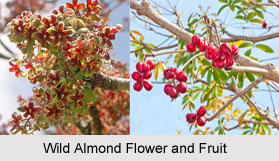
The flowers of the Wild Almond don`t have any kind of similarity with the tree. They appear early in February and form at the tricky ends of the wrinkly aged branch lets. They spread in a relaxed way just immediately under the new leaves. Normally, they are about 30 cm in length. The most distasteful thing that one can find in these flowers is their unpleasant odour which reminds of the stink of that of a drain or of the septic tank. This is very much unmatchable with the tall and handsome characteristics of the tree. The leaves of the tree normally bounce from the end of the branch lets in groups consist of about seven, in a length of about 15 cm. A green dye can be obtained from the young leaves that are slightly feathery and of pale green in colour. Evidence suggests that the seeds of Sterculia Foetida are edible, but they should be roasted prior to eating. Each fruit generally contains 10-15 seeds. In India, flowers appear in March, and the leaves appear between March and April. The fruit is ripe in February (11 months after the flowers appeared).
Uses of Wild Almond Tree
The leaves and bark of the tree have some significant medicinal value. A gum that is obtained from the trunk and branches can be used for book-binding and similar purposes. The seeds of the tree are also safe to eat. The oil of Wild Almond has been found to be comparable to sunflower, soybean and rapeseed oils for the use of biofuels.