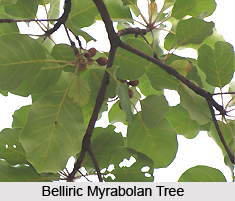
 The `Belliric Myrabolan` is found in India. The tree cannot grow in any waterless region and is therefore quite a common tree in India. The tree has a height of about 900 m. Named as `Terminalia Bellirica` in science; the tree belongs to a very large family of `Combrefaceae`. There are a lot of important forest trees that also belongs to the same family. In both the Hindi and Bengali language, this tree is known as `Sabera`. The Tamil people call it either `Tani` or `Tanti`. It is called `Tanni` in Malayalam and Telugu languages.
Being overwhelmed by the extraordinary beauty of the tree, people often plant it by roadsides well proportionately. The tree sheds its foliage at the end of the growing season. In the dry places, it loses its leaves between the months of November and April and in restraint situations the timing extends to the months of February and March. Poor soil provides it the best growth and in the most suitable conditions, the tree can reach the height of 36 m. or more. As the insects can attack it very easily, the timber of the tree is not very much popular in some places. In the other places, it is used quite frequently for planking and packing cases. However, the inhabitants of the Southern part of India never touch the wood, as they superstitiously believe that the demons inhabited it.
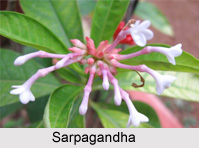
 The bark of the tree has a lot of longitudinal cracks and is dark grey in colour. The straight and structured trunk can attain a very large belt and also bears many horizontal branches. From the month of March to June, the little flowers of the tree appear in style and fill up the surrounding air with their nice and strong honey scent. Many people can call the scent unpleasant, but to some others it is exactly like honey and they also find it wonderful. The flower sprays bear a lot of circular buds and tiny, cup-like flowers and they also bounce from between the leaves at the ends of the branches, like long, creamy tassels. Each flower spray divides into five lobes and from these lobes, ten stamens arise.
The large, fresh and shining leaves appear with the flowers. They remain closely packed round the ends of the branches. When new, they bear a beautiful copper colour. Usually, they grow from the range of 2.5 to 10 cm in length on stalks. At the base, they are shaped triangularly and terminate directly like the leaves of a Jackfruit tree. They are also very hard and have a strong, large center rib.
The bark of the tree has a lot of longitudinal cracks and is dark grey in colour. The straight and structured trunk can attain a very large belt and also bears many horizontal branches. From the month of March to June, the little flowers of the tree appear in style and fill up the surrounding air with their nice and strong honey scent. Many people can call the scent unpleasant, but to some others it is exactly like honey and they also find it wonderful. The flower sprays bear a lot of circular buds and tiny, cup-like flowers and they also bounce from between the leaves at the ends of the branches, like long, creamy tassels. Each flower spray divides into five lobes and from these lobes, ten stamens arise.
The large, fresh and shining leaves appear with the flowers. They remain closely packed round the ends of the branches. When new, they bear a beautiful copper colour. Usually, they grow from the range of 2.5 to 10 cm in length on stalks. At the base, they are shaped triangularly and terminate directly like the leaves of a Jackfruit tree. They are also very hard and have a strong, large center rib.
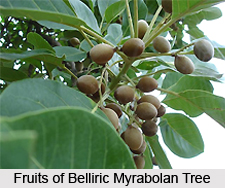
The fruit is the most significant part of the tree. It is like a velvet ball that is grey coloured and around 2.5 cm in length. People use this fruit commercially as medicine. The immatured fruits are also used as an inferior dyeing and tanning material and also for making ink. An oil obtained from the kernels of the tree is also used on the hair. Though some people think that it can produce intoxication to an extent, people do eat it as well. Not only to the people, some of the animals like Monkeys, Deers, Squirrels, Pigs and Goats also eat this fruit. In fact, they really favour this fruit.
The first part of the scientific name of the tree `Terminalia` derived from a Latin word that means "terminal". The tree is given such a name because the leaves cluster at the ends of the branches in many of the species, including this one. The second part `Bellirica` is a Latinised form of the fruit`s Arabic name. The popular name of the tree `Myrabolan` is also for the fruits of `Phyllanthus Emblica` and `Terminalia Chebula`. The combination of these three fruits make a famous tonic named as `Trefala Churan`.