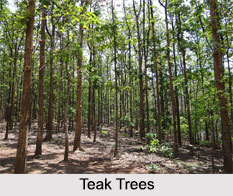
Teak tree is one of the most common Indian trees. People can usually find these nice and striking trees in separated clusters that grow best by the riversides. The scientists know teak trees as `Tectona Grandis`. Both the names `Tectona` and `Teak` have been derived from the Portuguese name `Teca`. The word came from the Greek word `Tekton` that means `a carpenter`; and in Latin, `Grandis` means `large`. This tree is a member of `Verbenaceae` family. These trees can grow up to 45 metres in height when they are in their highest maturity of about sixty to eighty years. The trees have a lot of names in various languages like `Takku` in Sinhalese; `Kyun` in Burmese; `Satgun` in Hindi and Bengali; `Tek` or `Teaku-maram` in Tamil and `Jati` in Malayalam. The tree is more popularly known as `Indian Oak`.
Indian teak tree grows naturally in dry and moist deciduous forests from the southern extension of the Aravalli mountain ranges in Rajasthan to southern Uttar Pradesh, through Madhya Pradesh to Orissa and southwards through peninsular India. Its best growth occurs in the warmer and moister parts that receive around 125 to 250 cm of rainfall annually with a dry season of 3 to 5 months on fertile, well-drained soils.
From the month of June to September every teak tree looks very fresh with all the new leaves and also capped with a haze of blossom. This time, they form a marvelous spectacle. However, for almost the rest of the year, the teak tree does not look that beautiful, as a certain type of insects eat up nearly all the huge leaves making the tree somewhat bare and uncovered. However, this helps in studying the wonderful network of veins of the tree. Growing in pairs, the large and strong leaves of the tree remain diagonally to the next. The tender leaves can grow up to 60 cm in length. The branchlets of the tree bear countless, little white flowers. They also remain in pairs and alternate in direction. Each scented flower normally contains five or six-petals. Out of the million flowers that the tree produces, only a few appear to be fertile. In the month of September, those flowers also increase in size to 2.5 cm for the maximum. The teak tree looks very gorgeous at this time even though most of its leaves have been eaten up.
Uses of Teak Tree
Teak tree is cultivated widely throughout the country. The tree is also known for its vast medicinal properties. Though the tree has great value as timber, in many parts of these countries the tree will grow but not produce timber of any commercial value. The wood of this tree is very heavy, tough and durable as well. It also contains oil that has strong and distinctive scent. This oil preserves the timber and also the nails that are driven into it. The wood of this tree is broadly used for making furniture, houses and also ships. The juice that is obtained from the leaves of the tree can be used as a fabric dye as well. People can also use them as plates or umbrellas if there arouse any emergency. Most of the parts of the tree are medically valuable. The wood is used to lessen headaches, dyspepsia and also to solve stomach problems.
Further, a paste prepared from the powdered wood of teak tree is considered astringent, diuretic, hepatic, stimulant, sedative and a local refrigerant. It is recommended for reducing inflammatory swellings and toothache; taken internally, it is said to be useful as a vermifuge and for dyspepsia with a burning sensation in the stomach. The wood ash is applied to swollen eyelids and is believed to improve vision. The oil obtained by distillation of the wood is used by tribal inhabitants of Bastar District to treat eczema and ringworm. The bark of the teak tree is considered to be astringent and is used to treat bronchitis. The oil extracted from the seeds (nuts) is used to promote hair growth and to relieve scabies and itches. The flowers and seeds are diuretic and useful for treating bronchitis and biliousness. Indian teak trees are also used in Ayurvedic practices.
Indian teak tree is an important plantation species in the country and in many other tropical countries, where it is valued for its rapid growth and high quality timber.