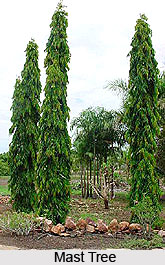
 Known as `Polyalthia Longifolia` to the world of scientists, the `Mast Tree` is distinctly elegant with its downward-sweeping branchlets and shining, green foliage. The word `Polyalthia` derived from two Greek words `Polys` and `Altheo` that mean "much" and "to cure" and refers to believed medicinal qualities. `Longifolia`, in Latin, means long-leaved. This tree is a member of the `Anonaceae` family. In Hindi language, the tree is known as `Devdar`, `Ashoka`, `Debdaru` and `Asok`. The Bengali people call it as `Debdaru`. In Tamil, it is named as `Assothi` and `Mara Illupai` and it is `Choruna` in Malayalam. The tree is the weeping variety of P. Longifolia and has wide-spreading slender branches that are issued from the trunk and form a compact and proportioned crown.
The bark of the `Mast Tree` is soft and dark grayish-brown in colour. During the months of March and April, the flowers appear in the tree, but all the neighboring trees do not have flower at the same time. The tree remains covered with a large number of delicate, star like flowers for a short period of about two or three weeks only. The flowers are palest-green in colour and give the tree a strange hazy appearance. They normally grow in clusters from small bumps all along the dark branchlets. Each of the flowers bears a slim, green coloured stem. It has a little calyx and six long, narrow, wavy petals arranged in two sets of three. The stamens remain packed firmly together in a small, pale-green dome.
From each of the flowers, there appear several egg-shaped fruits. Each fruit is placed on a short stalk and contains one seed. The Bats and flying foxes admire these fruits and during the evening the tree will be covered by the noisy, screaming throngs. They will leave some evidence of their orgy in the nut-strewn ground in the morning. The leaves of the `Mast Tree` are a bit uncommon in form. They can grow up to 22.5 cm in length and their shapes are like lances. They are usually bright, shining-green in colour and wavy-edged. The tree attains its most attractive view when the new leaves appear. The contrast between the deep-green colours of the aged leaves, the yellow-green of the half-grown leaves and the oxidized touch of the bendy new tiny leaves are extraordinarily striking.
The Hindus held it in great esteem and plant it near their temples. The tall straight trunks have light and flexible wood and were ideally suitable for making masts in the days of sailing ships. The wood is straw-coloured and people also use it for making small articles such as pencils, boxes etc. A medicine that can lower the body temperature is prepared from the bark of the `Mast Tree` and a useful fibre can be yield from the inner bark. People often use the festoons of leaves to make arches and they also strung them across doorways during their religious ceremonies. Not only this, people also frequently use the combination of the leaves and various flowers as a decoration.. In India, the spreading form of this tree is cultivated in all the hot areas. The main usage of the tree is to shade the roadsides. The pendulous variety of the tree is more often seen in large gardens, sometimes close together as a high screen.