Jalal-ud-din Khilji
|
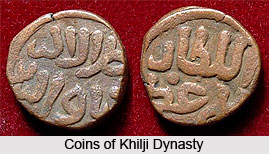
Jalal-ud-din Khilji was the founder of the Khilji dynasty and was the first Indian ruler of the Delhi Sultanate who ruled from 1290 to 1296.
|
|
|
Jalal-ud-din Khilji was the founder of the Khilji dynasty. He neither occupied the throne on the basis of heredity or election nor was it the result of a conspiracy. Jalal-ud-din Khilji captured the throne by his power. He ruled from 1290 to 1296.
 The family of Jalal-ud-din had been in the service of Turk - Sultan since long time. By his own merit, he rose to the position of sir -i- jandar, that is, the head of the royal bodyguard. He was then appointed as the governor of Samana where he successfully fought many battles against the Mongols. Kaiqubad gave him the title of Shaista Khan and appointed him as 'Ariz-I-Mumalik'. Thus Jalal-ud-din enjoyed the reputation of being a capable commander and held highest military position in the reign of Sultan Kaiqubad, whom he ultimately murdered and occupied the throne.
Jalal-ud-din Khilji sat on the throne at a ripe old age of seventy years and the weaknesses of his old age affected his attitudes and activities. He lost interest in battles, became extremely liberal and tolerant and thus adopted a pacific policy. Neither his behaviour nor his ambitions were worthy of a sultan. He did not act according to the circumstances which proved to be a major reason that led to his murder. Jalal-ud-din carried on his generosity to the extreme. He pardoned not only those who revolted against him but also the thags and the robbers. He exhibited his weakness of temperament and action in matters of foreign policy as well.
Jalal-ud-din Khilji was the first Sultan who tried to reconciliate even those who opposed him. He had been a successful general and had successfully repulsed many Mongol invasions prior to his becoming the Sultan. But after his coronation, he left the policy of war and conquest. His behaviour was most liberal even with his enemies and instead of terrorising them he tried to win over their sympathies. Jalal-ud-din Khilji was not a coward but his policy of peace and kindness was so pursued to the extreme that it became his weakness which was not in the interest of the state. His generosity was appreciable as a person but as a Sultan it created misgivings about his capabilities among his nobles. His reluctance to war and bloodshed lowered down the prestige of the Delhi Sultanate.
Jalal-ud-din was certainly a religious, kind hearted and pious person but as a Sultan he failed. He was repeatedly warned by his loyal nobles but he fell into the trap laid down by Ala-ud-din Khilji and was finally put to death. However inconsequential his reign was, but being the founder of the Khilji dynasty, the rule of Jalal-ud-din Khilji has found an important place in history.
|
|
|
|





