 Indian reptiles mainly inhabit water bodies like rivers, ponds, lakes and swamps. India is home to numerous reptile species and they constitute 6.2 percent of the total population of reptiles in the world. Out of all the Indian reptiles, about 30 have been listed as threatened in the IUCN (International Union for Conservation of Nature) red list of threatened animals.
Indian Crocodiles
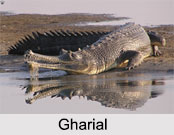
Crocodiles are large semi-aquatic reptiles. These tropical species belong to the order namely, Crocodilia. They are carnivorous animals and consume vertebrates such as fish. They occupy freshwater habitats. Gharial is the largest crocodile species in the world. It belongs to the family namely, Gavialidae. Indian Gharial has an elongated and narrow snout, which gradually thins as it ages. There is a bulbous growth on the tip of an adult male snout, known as `ghara`. Mugger Crocodile is scientifically known as Crocodylus palustris. The color of the adult mugger crocodile is bright olive, while the young ones are on the paler side. The entire body of this species is spotted with black and is scaled. Outer toes as well as fingers are webbed at the base. Apart from Gharial and Mugger Crocodile, Saltwater Crocodile has also been recorded in India.
Indian Snakes
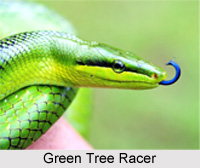
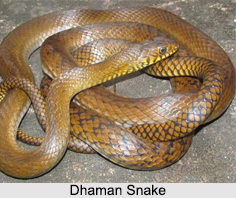
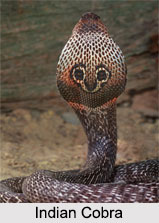 Snakes are one of the most common Indian reptiles. They belong to the order of Squamata or scaled reptiles, which is the largest order of reptiles. This order includes both snakes and lizards. Even though snakes and lizards share the same reptilian order, there are many differences between them. Snakes do not have eyelids, external ear openings and limbs, unlike the lizards. Snakes are carnivorous reptiles that have an acute sense of sight and feel. They are scaly and elongated. Snakes have poison glands that are modified salivary glands. They secrete poison and it`s their principal weapon for capturing prey. Snakes mainly inhabit paddy fields and open sandy areas and they adapt to the environments in the tropical and temperate regions. Snakes smell the presence of food by their forked tongue and as they do not have external ears, they can only feel vibrations. Some of the Indian snakes are Indian Cobra, Flatbread Snake and Dog-Faced Water Snake.
Indian Turtles
Turtles form one of the oldest reptile group. Indian turtles, along with tortoise and terrapin, belong to the Testudines order of reptiles and the Chelonia crown group. The body of a turtle is covered with special bony or cartilaginous shell, which develops from the ribs. Some of the Indian turtles are Black Pond Turtle, Indian Eyed Turtle, Amboina Box Turtle and Red-Crowned Roofed Turtle.
Indian Tortoises
Tortoises are land-dwelling reptiles. They belong to the family namely, Testudinidae. Indian tortoise has both an endoskeleton as well as an exoskeleton. Tortoises can differ in size, ranging from a few centimeters to 2 meters. They have a shell, which protects them from predators.
Some of the Indian Tortoises are Asian Forest Tortoise, Elongated Tortoise and Indian Star Tortoise.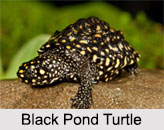
Indian Lizards
Lizards are squamate reptiles. They are known to utilize a number of anti-predator adaptation techniques like camouflaging and reflex bleeding. They are mainly carnivorous and consume smaller species like insects. Indian Water Monitor Lizard is one of the largest as well as the heaviest lizards, second only to the Komodo Monitors. The usual length of a water monitor is around 4 feet. Its entire upper body is full with round and protruding scales and the abdomen is covered with smooth scales. Other lizards which have been traced in India are Khasi Hills Forest Lizard, Southern Flying Lizard and Indo-Chinese Forest Lizard.
Indian Chameleon
The term `Chameleon` is a combination of two Greek words namely, `Chamai` and "Leon". `Chamai` stands for `on the ground or earth` and "Leon" means `lion`. Thus, `chameleon` means `earth lion`. Indian Chameleon is the only species of chameleon found in the Indian subcontinent. Its scientific name is Chamaeleo Zeylanicus. It belongs to the family, Chamaeleonidae. It is endowed with the ability to change skin color. This chameleon exists in the shades of green or brown or with bands. It has large eyes and a long tongue. Its neck is very short and the body is compressed. The tail is prehensile and has the ability to grasp.