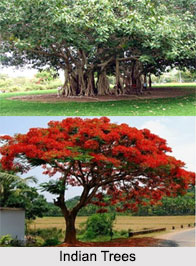
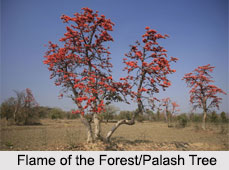
 Flame of the Forest, also known as Palash Tree is a very beautiful Indian tree with bright crimson orange coloured flowers. Flame of the Forest/Palash Tree is such a tree when it is in its fullest beauty, it can change the view of the entire forest in a very graceful way. From the month of January to March, the tree stands it all its glory with a lot of orange and vermilion flowers that covers the entire crown. Palash trees are distinct as they have more flowers than leaves. This is the state flower of Madhya Pradesh as well as Jharkhand.
Different Names of Flame of the Forest/ Palash Tree
The scientific name of the tree is "Butea Monosperma". Its family is "Leguminosae" and sub-family is "Papilonaceae". It"s called in several names in Hindi language like "Chichra tesu", "Desuka Jhad", "Dhak", "Palas", "Chalcha" and "Kankrei". In Urdu it is called as "Palashpapra". The Bengali people call it as "Palas" or "Palashi" and the Tamils call it as "Porasum" or "Parasu". It is named like "Muriku" and "Shamata" in Malayalam, "Modugu" in Telugu, "Khakda" in Gujarati and "Kela" in Sinhalese. In English it has two names; "Flame of the Forest" and "Parrot Tree".
 Structure of Flame of the Forest/ Palash Tree
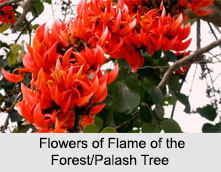
Flame of the Forest/ Palash Tree is a medium size tree of around 6-12m of height. Usually, the shaft of the tree is curved and twisted with irregular branches that are rough and has grey bark. The scentless flowers are massed along the ends of the stalks that are dark and velvety green like the cup-shaped calices. There are 5 petals in each flower that comprise one standard and two smaller wings and also a curved beak-shaped keel. The name "Parrot Tree" is given because of this keel only. The leaves of the tree appear in April and May and are large and trifoliate in size.
Usage of Flame of the Forest/Palash Tree
Flame of the Forest/ Palash Tree is very popular amongst the people as it has a numerous use. The brilliant colouring matter obtained from an infusion of the flowers may be used into water-paint or into a dye. A lucid oil is also obtained from the seeds and the gum that exudes from the stems is known as Bengal Kino. This Bengal Kino is very much valuable to the druggists as it has astringent qualities and because of its tannin, it is useful to the leather workers also. Making of rope sandals is one of the most important uses of the young roots of the tree that can make a very strong fibre. Because of their strengths, the leaves of the tree are also used as wrapping papers. Not only the leaves and flowers, the wood of the Flame of the Forest tree has some uses as well. As the dirty white and soft wood is durable under water, it can be used for well-curbs and water scoops. Good charcoal can also be made from it.
Religious Significance of Flame of the Forest/ Palash Tree
The flower of Flame of the Forest/ Palash Tree has some religious value as well. The Palash flower is sacred to the moon and to Brahma and it is said that it has sprung from the feather of a falcon impregnated with the "Soma", the beverage of the Gods. It is used in Hindu ceremonies for the blessing of calves to ensure that they become good milkers. During the thread ceremony, when the Brahmin boy"s head is shaved, a Palash leaf is given to him to eat. Sacred utensils are made from the Palas wood.