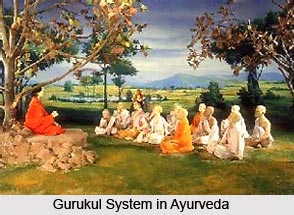
Ayu means life and Veda indicates the ancient Indian form of preserving knowledge. Therefore, Ayurveda is a collection of studies related to life. Ayurveda evolved around 600 BC in India. Since printing technology had not developed during that time, this knowledge was recorded in the form of shlokas which are two lined poems, rhythmic in nature. These shlokas were easy to remember and passed on orally from the teacher (guru) to the student (shishya) across generations , helping in the treatment of all kinds of mental and physical troubles. With the advent of printing technology, these shlokas were compiled as a part of the Sanhitas ----- big books, which contain a wide range of information on the arts, the sciences and commerce, all related to life. Different schools of thought interpreted Ayurveda in different ways but had a few central ideas like `what you eat is what you are` or `health comes from within` or `health is a miraculous gift which comes from nature`, in common. Charak, Sushrut and Vagbhat are some of the Ayurvedic schools named after their proponents.
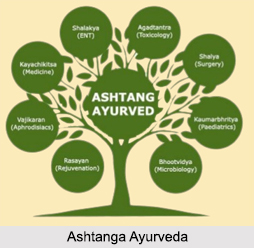
The renowned ayurvedic sage Charak rishi talks about eight specific branches of Ayurvedic treatment designed to treat every human ailment. In accordance with Charak sanhita, a scientific creation of Charak rishi, we have divided the science of Ayurveda into eight different parts, collectively known as Ashtang Ayurved .These eight branches are as follows:-
Internal medicine or "Kaya-chikitsa"
Paediatrics or "Kaumar-bhritya"
Psychiatry or "Bhoot-vidya"
Otorhinolaryngology and Opthalmology or"Shalakya"
Surgery or "Shalya"
Toxicology or "Agad -tantra"
Geriatrics or "Rasayana"
Eugenics and Aphrodisiacs or"Vajikarna"
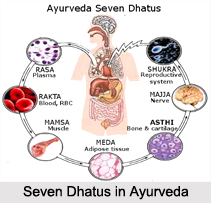
Kayachikitsa tantra or internal medicinal treatment: This Atreya methodology corresponds to the general medicine therapy, required to treat chronic diseases, namely tuberculosis, asthma or general health ailments like, fever or even mania.It covers specialities like pathology, cardiology or neurology also . Kaya is the living body,which includes both the physical body as well as the essential constitution, within. The illness may be caused by some disturbances in the mind or by imbalances in the three "doshas", "vata-pitta-kapha" or by "dhatus"(tissues) and "mala"(toxin deposits).Nidana Sthana of Charaka Samhita explains that proceeds through etiology, pathogenesis and diagnosis of sickness. It reads the development of a disease as six stages of aggravation, accumulation, overflow, relocation, build up in a new site and manifestation into an identifiable disease.It is ahead of modern medical science in this respect. The latter detects diseases only at the fifth and sixth stage.
Kaumarabhrutya or Bala-chikitsa: This is the Ayurvedic section of Paediatrics which cures child diseases .It is also an Atreya - house technique.Kashyapa Samhita or Vridhha Jivaka Tantra ,written under the supervision of Maricha Kashyapa is the parent text of this discipline.
Grahachikitsa or Psychiatry: When the mind is diseased, this Ayurvedic science of spiritual rejuvenation heals the mental wreck. It is also the tool of dealing with psychosomatic disorders. We come across references of this psychology-oriented therapy in the Atharvaveda. Here recovery comes through sound therapy. The religious Hindu and Buddhist Ayurvedic specialists asserted that the repeated chantings of Sanskrit Mantras composed by Rishis and Siddhas generates in one`s soul a connection with the Divine, which gifts the individual miraculous power to overcome all misery.Thus the spiritual gurus used to deliver these sermons to their disciples-a practice which still continues in some areas of India and Nepal.
Shalakya : This Ayurvedic subdivision of Otorhinolaryngology (ENT) and Opthalmology(Eye) handles all problems of the ear, nose ,throat, tongue and eyes. Susruta has described about 72 diseases of the eye. His unique way of conducting surgery in cataracts, pterygium, and other eyes, nose , and ear dysfunctions, amazes the modern medical science of the posterity. Janaka ,the king of Videha gave Shalakya Tantra a concrete shape in the first textbook of this sphere, Videha Tantra. One of the main pillars of this Shalakya structure, Janaka and his work were cited in Susruta Samhita.
Shalya Tantra : Sophistication in surgery was no new phenomenon in ancient India. Study and dissection of dead bodies, awareness of intestinal obstructions and extraction of bladder stones, deserve mention. Dhanvantari Divodasa ,the king of Kashi in Varanasi, was the founder of this school. And his student was the famous Susruta .He used his surgical magic for tumour , internal-external injuries, complications during pregnancy,child-birth etc. Susruta`s version of Shalya Tantra reports that it was surgery done with Yantra(blunt surgical instruments),Shastra(sharp tools),Kshara(bio-chemical substances),Agni(cauterization by blood-coagulation and tissue-destruction) for removing harmful foreign bodies.
Agada Tantra : This is the Ayurvedic equivalent of Toxicology. Susruta stated that this detoxification or anti-poision therapy saves life from the fatal venom of snakes, insects etc. and even from food-poisoning, water-pollution or epidemics.
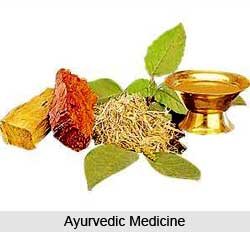
Rasayana Tantra : Longer and immune youthful life of the body and the spirit by deferring old age and increasing the potency of the life-force(Ojas) is the goal of Geriatrics. It is the maintenance and the regenaration of body tissues(Dhatus). Rasayana is prepared from the medicinal herbs like haritaki, amla , triphala, bhringaraja ,ashwagandha etc. to sustain perpetual vigor.
Vajikarana Tantra : The vital function of multiplication and reproduction of healthy life(birth of progeny) is taken care of by Vajikarana-Tantra. The literal meaning of the word "Vaji" is "Stallion". This implies that Vajikarana is the Ayurvedic process of creating a stallion in a man, in terms of his sexual capacity and fertility. Deficiences like infertility both in male and female,weak Shukra Dhatus or reproductive fluids in the body fall under the scope of its treatment. Major books on this are Charaka-Samhita, and the records left by Susruta and Vagbhata.

Mind in Ayurveda
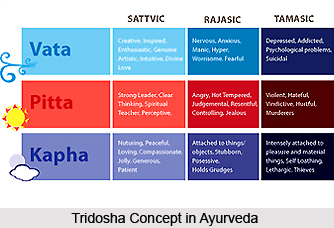
Mind, the abstract manifestation of the inner self, coordinates with the material body to make a normal human being.The Ayurvedic practitioners believe that life is the product of an intricate functional coordination between the soul (Atma), the mind (Mana), the senses (Indriya) and the body (Sharira). These are associated with the five panchamahabhootas or the five supreme powers that constitute the body structure of each individual, called prakriti. The proper functioning of the prakriti depends upon a balance between the three physical energies - Vata, Pitta, Kapha and the three energies of the mind - Satwa, Rajas, Tamas.
Aama in Ayurveda
Aama is half-digested mucus produced in the body when the body`s normal digestive process is hampered. According to Ashtang Ayurveda, each and every disorder in the body is an outcome of the building up of aama. Aama is the fundamental internal source, which initiates disease, helps in establishing it and impedes the body machinery if not tackled in time.
(Last Updated on : 09/12/2010)