India is the country with largest followers of Hinduism. The country takes pride and tries to live by the different theories and principles showed by the Hindu Religious Leaders. The emergence of the religious leaders was due to the tolerant and liberalist traditions. These religious thinkers not always advocate themselves as reformers but sometimes as prophets or founders of new religions.
There would seem to be two forces at work within Hinduism in the modern world: on the one hand a trend towards a universalisation which contributes to contemporary global culture and processes, yet on the other a trend towards exclusive, local or national identity formations. Both of these trends have emerged during the last two centuries. Hinduism as a global religion, expressed in the ideas of the Hindu Renaissance, has developed since the nineteenth century as a reaction to colonialism and Christianity. This kind of Hinduism has been inclusive and has firmly established itself on the world stage, reformulating `Hinduism` and discovering its ancient origins.
Through the work of
Ram Mohan Roy and later of
Swami Vivekananda and his followers, Hinduism has become a world religion which has had a deep impact both on India and on the West at all cultural levels, from the scholarly study of texts in Indology departments in universities, to devotion to popular gurus. Yet in contrast to these universalizing tendencies, there has also developed a Hindu political nationalism which connects Hinduism, or Hindu Dharma, with the nation-state of India. This political nationalism has inspired friction between the Hindu, Muslim and Christian communities in India and evoked some terrible violence. Hinduism has, as have all religions, been a cause of bloodshed and intolerance. Yet Hinduism also contains within it profound resources for peace and reconciliation - forces which demand expression, and which may contribute to finding solutions to the global problems which face the human community in the coming century.
Among these Hindu religious leaders,
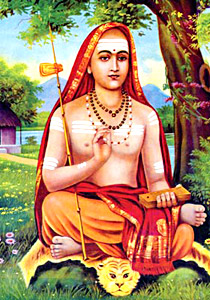
Adi Shankaracharya or Adi Shankara was known as an Indian philosopher whose great work was combining the doctrine of
Advaita Vedanta, a sub-school of Vedanta. His teachings are based on the unity of the soul and Brahman. Moreover, in the Smarta tradition, Adi Shankara is regarded as an incarnation of
Lord Shiva. Another most important religious figure whose contribution marks the
Hindu philosophy is
Ramanujacharya who was a theologian, philosopher, and scriptural exegete. He is an important teacher of the Hindu. This Hindu religious leader was the expounder of Visistadvaita, which is one of the classical interpretations of the dominant Vedanta school of Hindu philosophy. Madhvacharya is also considered to be famous among the Hindu Religious Leaders in India. He was the chief proponent of Tattvavada or the True Philosophy, popularly dualistic school of Hindu philosophy. Shri Madhva was a prominent philosopher during the Bhakti movement.
Another most eminent figure whose name can be taken as a religious leader and whose involvement in Hinduism ushered a new way of belief and credence is Dayananda Saraswati (1824-83). Born in Gujarat to a Shaiva Brahman family, Dayananda was initiated by his father into a cult of the Shiva linga at the age of ten. However, Dayananda lost his faith in the Shaiva religion of image worship and he wandered as an itinerant holy man, having taken the personal name Dayananda and the name of the renunciate order Saraswati, on a personal religious quest to find truth. At Mathura he met an old blind guru, Virjananda Saraswati, who predicted that he would restore Hinduism to its Vedic glory. Dayananda then abandoned his quest for personal liberation and became a reformer and preacher, intent upon the transformation of Hinduism. He argued that the
Veda is revelation and that Hindu `superstitions` should be abandoned along with reverence for other scriptures such as the Epics and
Puranas. He did, however, accept the teachings of the Dharma Sastras, such as the `Laws of Manu`, which reveal the formless and omnipresent God which Dayananda believed in. In 1875 he founded a society in Mumbai (
Bombay), the Arya Samaj (the `Noble` or `Aryan` Society), to promote his Hindu reformation.
Dayananda advocated a return to a purer form of Vedic religion whose focus is an eternal, omnipotent, impersonal God. He wanted to return to the eternal law or `sanatana dharma`, which Hindus had moved away from by worshipping icons and incarnations, by going on pilgrimages, and by revering the stories and doctrines of the Epics and Puranas. All these things are not found in the four Vedas, Dayananda maintained. His metaphysics were basic, more in line with Visistadvaita teachings than with Advaita teachings: that liberation (moksa) is not a merging of the soul into God, but a freedom from suffering in which the soul retains its distinct identity. However, more significant than his metaphysics are his social teachings about caste, education, language and the reformation of Hinduism into an aggressive, political force against Christianity and Islam. It was the reforming aspects of the
Arya Samaj, and its counter-offensive against attacks on Hinduism by
Christianity. Dayananda does not condemn the caste system but reinterprets it to mean that class (varna) refers to individual differences in character, qualifications and accomplishments. Dayananda even claimed that all modern scientific discoveries are previewed in the Veda, a claim which is still maintained by many Hindus today.
Arya Samaj promoted a certain view of India which, while elevating Dayananda`s vision of Hinduism, occluded other elements and forces within Indian society, particularly
Islam, Christianity, and Dravidian, notably Tamil, Hindu religions. Indeed, the Arya Samaj has not been open to pluralist understandings of Hinduism, advocating, rather, an aggressive Hindu nationalism, based on a `return` to the ancient Vedas and being critical of the tradition which has developed since then. The Arya Samaj has been a powerful voice in the development of Hindu nationalist politics, but intolerant of other faiths and views. While the influence of the Arya Samaj can be seen in contemporary Indian politics and cultural life, another force within Hinduism, of tolerance and accommodation, is also found, stemming in the modern world from the Bengali saint Ramakrishna and his devoted disciple and interpreter, Vivekananda.
Ramakrishna Paramahamsa (1836-86) was known to be one of the notable spiritual and religious leaders of Hinduism. He was a Hindu mystic who declared the unity of all religions. Being a priest of the
Dakshineshwar Kali temple, he became ecstatically devoted to
goddess Kali. He was married to
Sarada Devi and at the age of seventeen, his wife walked the thirty miles to Dakshineshwar to be with her husband. By that time he had become transformed through his religious practices and could not be a husband in a conventional sense. Ramakrishna worshipped his wife as a manifestation of the Mother and she served him in the temple until his death.
After his experience of unity with the absolute, he next realized the Vaishnava ideal of love for God through devotion to
Lord Krishna, as
Radha is devoted, and experienced a vision of Krishna. He had visions of other deities, including Jesus Christ, and practiced the paths of other religions, including Christianity and Islam. Having practiced and, according to Ramakrishna, realized the goals of these religions, he concluded that all religions are true. All religions are different paths to the One, the eternal undivided being which is absolute knowledge and bliss. His disciple,
Swami Vivekananda (1863-1902) is a figure of great importance in the development of a modern Hindu self-understanding and in formulating the West`s view of Hinduism. As a renouncer he wandered the length and breadth of India and his philosophy is the Vedantic idea that the divine, the absolute, exists within all beings regardless of social status. Human beings can achieve union with this innate divinity (as Ramakrishna had done) and seeing the divine as the essence of others will promote love and social harmony.
Vivekananda preached a doctrine of the unity of all religions and tolerance: that there should be recognition of diversity and that there is value in diversity, furthermore, that India did not need missionaries to convert its people to Christianity, nor churches, but material support to stop starvation. Vivekananda stayed in the West to promote his ideas and founded the Vedanta Society in New York in 1895. Indeed, Vivekananda might be seen as the first effective proponent of Hinduism as a world religion. Upon returning to India in 1895 he founded the
Ramakrishna Mission, a monastic order which differs from traditional Hindu orders in promoting education and social reform, and in helping the sick. The mission lays great importance on this aspect of its work which it regards as karma yoga, the yoga of action or good works, and there are colleges, high schools and hospitals run by the Ramakrishna Mission throughout India. The order disseminates Vivekananda`s vision of Hindu modernism as Neo-Vedanta: that there is an essential unity to Hinduism underlying the diversity of its many forms. Whereas Christianity accepts only itself as the truth, claimed Vivekananda, Hinduism is pluralistic and accepts all religions as aspects of the one truth. This message had great popularity among India`s emergent, English-educated, middle classes, along with Vivekananda`s stress on Hinduism as a `scientific` religion. Vivekananda might be regarded as the first to clearly articulate the idea of Hinduism as a world religion, taking its place alongside Christianity, Islam, Judaism and
Buddhism. The vision of Hinduism promoted by Vivekananda is one generally accepted by most English-speaking middle-class Hindus today.
Since the end of the nineteenth century, Westerners, regarding themselves as seekers after truth reacting against the `organized religion` of their homelands, went to India in search of spiritual truth and often found it there in the form of various gurus. Apart from the teachers of the Hindu Renaissance, the most important western movement responsible for the transmission of Hinduism to the West is Theosophy. Among Hindu teachers to attract a wide western following is
Aurobindo Ghosh (1872-1950). As a young man Aurobindo was involved with the Indian independence movement and jailed for terrorist activities as a result. While in prison he had a religious experience, achieving a state of samadhi through yoga. Upon release, he went to Pudducherry where he started an ashram and lived a life of study and contemplation for forty years, developing a philosophical system inspired by Vedanta, but integrating elements from Yoga, Tantra and the theory of evolution: the spiritual path is a path towards higher forms of awareness and an integration of matter with spirit.
Of the same generation as Aurobindo, was the Tamil mystic Ramana Maharshi (1879-1950) who lived and taught at Tiruvannamali. His teachings, which are pure Advaita, and simple lifestyle attracted many Westerners whom he taught to ask the question "Who am I?" The teachings of Ramana have inspired many other gurus such as Nisarga Datta Maharaj, who, having experienced a state of nondual consciousness proceeded to teach. These teachings have had wide influence in the West and have produced `western` gurus such as Jean Klein and Andrew Cohen who continue to attract large crowds of - mainly - western devotees. Two other contemporaries of Aurobindo and Ramana Maharshi to attract western interest have been Paramahamsa Yogananda (1890-1952) who founded the Self-Realization Fellowship, and Sawan Singh, the master of the Radhasoami Satsang at Beas. Yogananda was a renouncer who achieved states of samadhi and wrote a fascinating autobiography of his spiritual journey and the founding in California of the Self-Realization Fellowship. The Punjabi mystic of the Sant tradition, Sawan Singh (master from 1903 to 1948), also attracted a western audience, though his teachings were very different: rather than `self-realization`, he taught `God-realization` through the practice of the yoga of inner sound.
Bhaktivedanta Prabhupada, who brought the Hare Krishna movement to the West in 1965; Swami Muktananda who founded Siddha Yoga; and Bhagavan Shree Rajneesh, who radically reinterpreted the traditional Hindu understanding of renunciation, calling his followers Sannyasis, and who fused eastern meditation with western psychotherapies. Other teachers who have had an influence on the West have remained in India, such as Anandamayi, regarded as a living deity and identified with the
Goddess Durga; Satya Sai Baba, who commands a large following in India and abroad, famous for his magical powers of producing images and sacred ash from his fingertips; and Swami Shivananda from Rishikesh, who taught the Neo-Vedanta formulated by Vivekananda. Some of Shivananda`s disciples, such as Swami Chinmayananda, have started centres throughout the world and have taught further swamis to carry on their Neo-Vedanta teachings.
This great influx of Hindu teachers and ideas to the West during the 1960s and 1970s has contributed to Global Hinduism. These teachings are not homogenous and there are great differences between the various teachers.
It will be increasingly difficult, or desirable, to separate out the more recent manifestations of Hinduism in the teachings of the gurus who have come to the West from more traditional understandings of the diaspora communities. Indeed the new religious movements loosely referred to as `New Age`, many of whose ideas are derived from Hinduism via Theosophy, may also contribute to Global Hinduism in the future.