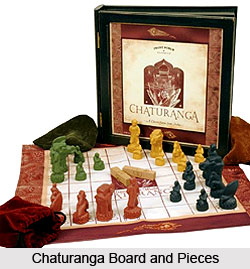
 Chaturanga is one of the oldest of brain games in the world, played in ancient India. The game is considered to be the ancestor of modern day chess and the kings and princes of ancient India were quite fond of the game. The Sanskrit word `Chaturanga` means "having four limbs or parts" and it was also used to describe the Indian army of Vedic times, where a platoon had four divisions like elephants, chariots, cavalry and infantry. The board of Chaturanga was called `Ashtapada` (eight-square).
History of Chaturanga
Chaturanga was played during the Gupta period. The game is presumed to be the common ancestor of the games of Chess, Shogi, and Makruk and it is related to Xiangqi and Janggi, as well. No certain time frame can be mentioned regarding the inception of Chaturanga. However, there are historical evidences that suggest that the game was played during AD 620. Banabhatta`s Harsha Charitha (c. 625) contains the earliest reference to the name `Chaturanga`. The game developed in Gupta India around the 6th century and in the 7th century, it was adopted as Shatranj in Sassanid Persia. There are evidences like Sanskrit document, `Vasavadatta` from Subhandu that suggests Chaturanga as the ancestor of modern Chess.
Rules of Chaturanga
The pieces of Chaturanga had a lot of similarity with that of modern Chess. The pieces in Chaturanga were called as Raja (King), Mantri (Counsellor, ancestor of the Ferz), Gaja (Elephant, also named as Fil, later), Asva (Horse), Ratha (Chariot, later called Rook), and Pedati (Infantry or Pawns). The game was played on an un-checkered board of eight by eight squares. According to the opening set-up of the board of Chaturanga, the King of White side was placed at e1, Counsellor at d1; Rook at a1, h1; Knight at b1, g1; Elephant at c1, f1; and the Pawns at a2, b2, c2, d2, e2, f2, g2, h2. In case of the Black side, the King was placed at d8; Counsellor at e8; Rook at a8, h8; Knight at b8, g8; Elephant at c8, f8; and the Pawns at a7, b7, c7, d7, e7, f7, g7, h7.
The rules of moving the pieces in Chaturanga were also quite similar to that of modern Chess. The King was allowed to move as usual, but it had an additional power. It could make one knight-move during the game, provided that it hasn`t been checked before it makes the knight-move. There were no rules of castling in Chaturanga. The Counsellor in Chaturanga, was allowed to move one square diagonally and the Elephant used to move two squares diagonally. However, the Elephant was allowed to jump the intervening square. In Chaturanga, the rules of moving the Knight were the same as a usual Knight and the Rook or Chariot also moved like usual Rook. Though, the Pawns or Soldiers in Chaturanga also moved like a usual pawn, they were not allowed to make a double step on its first move, like modern Chess.
According to the rules of Chaturanga, the Pawns could be promoted only when they arrived at the last rank of the board. However, promotion was available only to the type of piece that was on the promotion-square in the opening setup, e.g., a white pawn that moves to b8 can only promote to a knight. In addition, promotion was available only if the player had already lost a piece of the type, so the pawn moving to b8 will only promote to a knight, when the white player already lost a knight during the game. In Chaturanga, the Pawns were never allowed to promote on e1 or d8.
The main objective of a player in Chaturanga was to mate the opponent`s King. The player that stalemates its opponent was declared as the loser in Chaturanga. However, apart from the two-handed version of Chaturanga that has been discussed so far, there was also another version named Chaturaji, having four hands. There is game described in the Indian epic, Mahabharata that had similarity with that of Chaturaji.