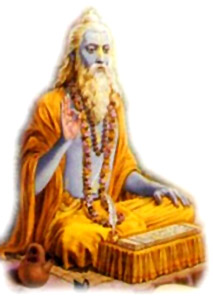
 Tat Tvam Asi means "That thou art," which is one of the Mahavakyas in Vedantic Sanatana Dharma. The meaning of this phrase is that the self in its original state is partially or wholly identifiable with the ultimate reality which is the origin of all phenomenon. Tat Tvam Asi Mahavakya is stated in such a manner as if one person is speaking to the other, in a direct speech. "That is what you are!" is the correct form of punctuation when referring to Brahman. The person speaking in this Mahavakya is the teacher and the person being spoken to is considered as the student.
When the teacher has explained to the students all of the Mahavakyas, that the student has already reflected on these, and that the student has started to gain some sense of the meaning of the oneness called Brahman. The Guru explains his student that Brahman is that oneness, who resides at the deepest level of one`s being. The mundane accept the identity of the roles in their work area or in their families, such as father or mother, sister or brother, son or daughter. Sometimes, eventually, the common people believe that who they are, is their personality character that have developed through their way of living. If the common men forget their true nature, they come underneath all of the relative identities. The laymen continue their duties, holding identities loosely. The realisation of this Mahavakya, Tat Tvam Asi, leads the mundane to see that the relative identities are not who they actually present. It does not mean that people drop their duties in the world, or stop acting in service of other people because of this realization. Rather, with time any person becomes more liberal to hold those identities loosely, while increasingly being able to act in the loving service of others, independent of attachment to the innate false identities.
Tat Tvam asi Mahavakya should be practiced in soliloquy pattern. The Yogi talks to him in profound concentration inward, possibly towards the heart centre. The Yogi has to say himself that "That is who you are!" The Yogi has to even point his index finger at his own chest, the place from where he experience, "I am." As he holds in awareness the essence of the truth that this Brahman, this oneness, is who the person actually is and observe how the person can gently let go of the false identities, seeing that they are only temporary and relatively him.
When reflecting on the other Mahavakyas, such as Brahman is the supreme knowledge, then shift the observation from that truth, directing attention to one`s own inner being and saying, "Tat Tvam asi; That you are!" The Yogi should be alert enough to allow his inner feeling to understand that comes from this Mahavakya and realizes his spiritual nature, rather than his more surface level of mental or physical identity.