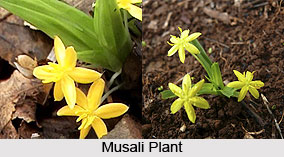
 Musali is quite a common Indian Medicinal Plant, widely used in Ayurveda. Musli grows as forest herb. It is native to China, Japan and Indian Subcontinent. In India, the herb musali grows in the subtropical Himalayas from Kumaon in Uttarakhand, eastwards to Assam and in western regions of peninsular India from Konkan in Maharashtra, southwards to an altitude of about 2400 metre, on marshy sites, in rock crevices and on laterite soils. Since generations, it is in use as folk medicine. In many parts of India, due to it"s over exploitation; Kali Musli is becoming rare in occurrence.
Different Names of Musali
Musali carries the botanical name "Curculigo Orchioides Gaertn". This plant is commonly recognized as "Kalimusli" by the people of Gujarat and the local people of Tamil Nadu call "Nilappanaikkilhangu" and in Sanskrit it is called "Musali". It is commonly called "Golden Eye-Grass", "Black Musli" in English and "Kali Musli" or "Kali Musali" in Hindi.
Characteristic Features of Musali
Musali is a small, perennial herb with a long, stout, cylindrical rootstock and copious fleshy root fibres. The leaves of the herb are aroused from the base. They are 15 - 45 cm long and 1.3 - 2.5 cm wide, are linear or linear-lanceolate, smooth or sparsely hairy, plicate, apex acute, and are often bearing bulbils. The flowers of musali are small, bright yellow in colour and star-shaped. The flowers generally blossom on very short flattened scapes (stalks) just above the ground, hidden in the leaf sheath. Being hypogenous, the fruits are 1.3 cm long, generally carrying one to four seeds and are oblong, black, shiny, deeply grooved with wavy lines. In central India the plant appears during the rainy season, and the flowers are essentially blossomed between June and August and dies down during the cold season.
Medicinal Values of Musali
Musali is used against the poison of viper and keeps the kidney working in the victims of viper. The rhizomes of the plants are used for the treatment of decline in strength, jaundice and asthma. According to Ayurveda, root is heating, aphrodisiac, alternative, appetizer, fattening and useful in treatment of piles, biliousness, fatigue, blood related disorders etc. Ayurveda considers the rhizome (tuberous root) of musali as a reputed rejuvenative drug. It is also used in the in the form of a poultice for treating skin diseases and relieving itches. The powdered rhizome is quite effective in treating several reproductive problems such as erectile dysfunction, low libido, low sperm count and low sperm motility. According to Unani system of medicine, root is carminative, tonic, aphrodisiac, antipyretic and useful in bronchitis, ophthalmia, indigestion, vomiting, diarrhoea, lumbago, gonorrhoea, gleet, hydrophobia, joint pains etc. This herb serves as an aphrodisiac and for treating diabetes and leucoderma. The dried, powdered or fresh and crushed rhizome is applied to bring a healing effect in cuts and wounds. A decoction of the pounded rhizome along with crushed Ajwain is supposedly given to the children suffering from unconsciousness. Among the tribal inhabitants of eastern Bihar, the dried, powdered tuber is given orally to promote the healing of leucorrhoea.