 Aghora ascetics are the devotees of the Hindu God Lord Shiva. They are monists who strongly believe in liberation from the cycle of rebirth or Samsara. The liberation of the Aghoris is a realisation of the self`s identity with the absolute. The Aghoris maintain that all opposites are ultimately results of illusion. The purpose of embracing pollution through various practices is the realisation of non-duality through surpassing social taboos, and seeing the deceptive nature of all conventional categories. Aghoris have based their beliefs on two principles - Lord Shiva is perfect and he is the ultimate thought for everything. Every rock, tree, animal, and even every thought has been derived from the devotion of Lord Shiva. Thus, everything that exists must be perfect, according to the Aghoris. They also say that to deny the perfection of anything would be denying the Gods.
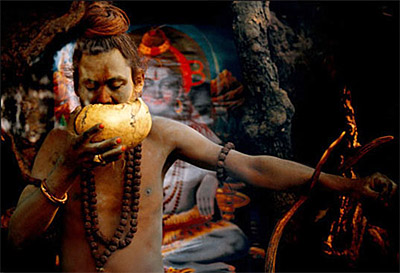
Although close to the Kapalika ascetics of medieval Kashmir, with whom there may be a historical connection, the Aghoris actually trace their origin to Kina Ram, an ascetic who is known to have lived up to 150 years and died during the second half of the eighteenth century. Kina Ram is said to have been an incarnation of the Hindu God Shiva, as have been each of Kina Ram`s successors. The Aghori ascetic is himself a symbol of the Lord Shiva. The Aghori saints usually stay naked or wear the shroud of a corpse and cover the body in the ashes of the cremation ground. The corpse upon which he meditates is a symbol of his own body and the corpse consuming ritual is a symbol of the transcendence of his lower self and a realisation of the greater, all pervading self.
Due to the secrecy of the Aghoris, no official figures of the numbers of these ascetics are available. At the end of the nineteenth century there were an estimated two or three hundred Aghori ascetics living in Varanasi, though now there are perhaps as few as twenty living in their main hermitage. Kina Ram`s Samadhi is a centre of pilgrimage for Aghori devotees. At this location, Kina Ram was buried in a tomb which happened to be a center of pilgrimage for Aghori devotees. Another center of this sect is Aghor Sodh Sansthan, Ravindrapuri, Varanasi. Apart from this, any cremation ground is considered to be a holy place for an Aghori ascetic.
The Aghoris clearly distinguish themselves from other Hindu sects and priests by their alcoholic and cannibalistic customs. The corpses, which may be either rescued from a river like Ganges or Yamuna River, or obtained from cremation grounds, are consumed by the Aghoris. They believe that mutilated corpses can be their ideal dish, what others consider as a "dead man", nothing but a natural matter devoid of the life force it once contained. The Aghori sect is one of the still surviving cannibal groups, for them its just partaking of what is useless for the rest of the world. In fact, the Aghoris continually try to discover how matter converts from one form to another. The Aghoris are still considered as one of the most pure races of hermits in India.