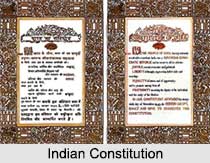
The National Commission for Scheduled Tribes (NCST) was formed by improving Article 338 and adopting a new Article 338A in the Constitution. This amendment, replaced the previous National Commission for Scheduled Castes and Scheduled Tribes, and formed 2 distinct Commissions, National Commission for Scheduled Tribes (NCST) and
National Commission for Scheduled Castes (NCSC), from February, 2004. Certain Communities in the nation were suffering from various Economic and Social problems, like untouchability, old agricultural practices, lack of infrastructure facilities and geographical isolation etc. thus in order to protect their interests, these communities were identified as Scheduled Tribes and Scheduled Castes according to the provisions mentioned in Clause 1 of Articles 341 and 342 of the Indian Constitution. In the year 1978, the Indian Govt. established a Non-Statutory Commission for SCs and STs and appointed Bhola Paswan Shastri as the Chairperson along with 4 other Members.
Article 338A of the Constitution provides for a National Commission for Scheduled Tribes-
(1) There shall be a Commission for the Scheduled Tribes to be known as the National Commission for the Scheduled Tribes.
(2) Subject to the provisions of any law made in this behalf by Parliament, the Commission shall consist of a Chairperson, Vice- Chairperson and 3 other Members and the conditions of service and tenure of office of the Chairperson, Vice-Chairperson and other Members so appointed shall be such as the President by rule determine.
(3) The Chairperson, Vice-Chairperson and other Members of the Commission shall be appointed by the President by warrant under his hand and seal.
(4) The Commission shall have the power to regulate its own procedure.
(5) Duty of the Commission-
* To investigate and monitor all matters relating to the safeguards provided for the Scheduled Tribes under this Constitution or under any other law for the time being in force or under any order of the Government and to evaluate the working of such safeguards;
* To inquire into specific complaints with respect to the deprivation of rights and safeguards of the Scheduled Tribes;
* To participate and advise on the planning process of socio-economic development of the Scheduled Tribes and to evaluate the progress of their development under the Union and any State;
* To present to the President, annually and at such other times as the Commission may deem fit, reports upon the working of those safeguards;
* To make in such reports recommendations as to the measures that should be taken by the Union or any State for the effective implementation of those safeguards and other measures for the protection, welfare and socio-economic development of the Scheduled Tribes; and
* To discharge such other functions in relation to the protection, welfare and development and advancement of the Scheduled Tribes as the President may, subject to the provisions of any law made by Parliament, by rule specify.
(6) The President shall cause all such reports to be laid before each House of Parliament along with a memorandum explaining the action taken or proposed to be taken on the recommendations relating to the Union and the reasons for the non-acceptance, if any, of any such recommendations.
(7) Where any such report, or any part thereof, relates to any matter with which any State Government is concerned, a copy of such report shall be forward ed to the Governor of the State who shall cause it to be laid before the Legislature of the State along with a memorandum explaining the action taken or proposed to be taken on the recommendations relating to the State and the reasons for the non-acceptance, if any, of any of such recommendations.
(8) The Commission shall, while investigating any matter referred to in sub-clause (a) or inquiring into any complaint referred to in sub-clause (b) of clause (5), have all the powers of a civil court trying a suit and in particular in respect of the following matters, namely,
(a) Summoning and enforcing the attendance of any person from any part of India and examining him on oath;
(b) Requiring the discovery and production of any document;
(c) Receiving evidence on affidavits;
(d) Requisitioning any public record or copy thereof from any court or office;
(e) Issuing commissions for the examination of witnesses and documents;
(f) Any other matter which the President may, by rule, determine.
(9) The Union and every State Government shall consult the Commission on all major policy matters affecting Scheduled Tribes.
Powers of National Commission for Scheduled Tribes : Under Clause (8) of Article 338A, the Commission is vested with certain powers of a Civil Court, for inquiry and investigations. The National Commission for Scheduled Tribes has the following authorities:
* Summon and enforce attendance of any individual and examine on oath;
* Detection and production of any documents;
* Receive evidence on affidavits;
* Requisition any Public Record or copy from any court or office;
* Issue Commissions for examination of witnesses and documents; and
* Any matter which President, may determine, by rule.
Union and every State Government are adviced to consult the Commission on all key Policy matters that might affect the Scheduled Tribes.

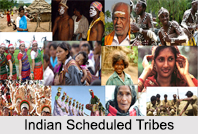 Indian Scheduled Tribes are the group of tribal communities and was given the name "Scheduled Tribes" during the post-Independence period, under the rule of Indian Constitution. Since the Independence of India, the Scheduled Tribes were given Reservation status. India can proudly be called the largest tribal population in the world. The scheduled tribes in India constituted 8.2 percent of India"s population, according to 2011 census. In all, 698 scheduled tribes exist at present in India.
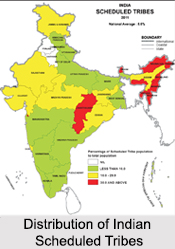 The word "Scheduled Tribe" is an administrative coinage, used for purposes of giving out constitutional privileges, security and benefits in independent India. The first pre-requisite of Indian Scheduled Tribes in relation to a particular
 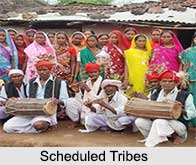 Scheduled Tribes (STs) are spread across the
  The Tribal Sub-Plans for Scheduled Tribes
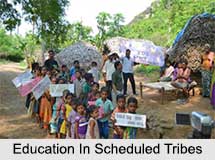 Education in the