


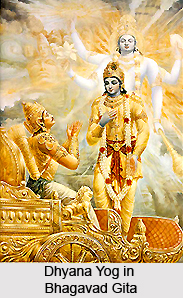
 Dhyana Yoga is a path for 'Nirvana' as stated by the Bhagavad Gita. It is the discipline of knowledge, the path of wisdom, which believes in the knowledge of the self (soul) and purity. According to this path, one needs to have self-control and should perform the actions with knowledge to attain 'nirvana'. The Gita says that one can be liberated from arrogance, pride and vanity through Dhyana yoga and can achieve the excellence of forgiveness. According to the Bhagavad Gita, a 'Jnani' (wise) person is one who identifies the self in all and all in the self. He does not quit normal activities of life, but acts for the welfare of the world or 'loka-samgraha'. This path of Gita asserts that every person can achieve supreme peace by the highest knowledge 'karma creates bondage, Jnana liberates from samsara'. Dhyana Yoga is a path for 'Nirvana' as stated by the Bhagavad Gita. It is the discipline of knowledge, the path of wisdom, which believes in the knowledge of the self (soul) and purity. According to this path, one needs to have self-control and should perform the actions with knowledge to attain 'nirvana'. The Gita says that one can be liberated from arrogance, pride and vanity through Dhyana yoga and can achieve the excellence of forgiveness. According to the Bhagavad Gita, a 'Jnani' (wise) person is one who identifies the self in all and all in the self. He does not quit normal activities of life, but acts for the welfare of the world or 'loka-samgraha'. This path of Gita asserts that every person can achieve supreme peace by the highest knowledge 'karma creates bondage, Jnana liberates from samsara'.
Theory of Wisdom Lord Krishna had initiated the theory of path of wisdom of Dhyana yoga in his discourses to Arjuna while in the battleground of Kurukshetra. Krishna's invaluable lectures are compiled today as Bhagavad Gita for Hindus, while Arjuna had sat down dejected and sullen, denying to fight his first-blood as opponents in war. What Krishna had spoken to Arjuna to clear his doubts and tribulations, made up a portion of the various ways to reach and attain the Lord, i.e., Lord Krishna. Dhyana Yoga is incorporated in one such chapter of several paths to perfection. According to Krishna, the path of wisdom or the imperishable philosophy was taught by Him to Viwaswana, founder of the Sun dynasty. Viwaswana gave it to Manu, the Lawgiver and Manu handed down to King Ikshwaku. Lord Krishna's advice to Arjuna According to Krishna's advice to Arjuna, the Divine Kings were aware of it, because it was their tradition. Then, after a long time, at last it was forgotten. "It is this same ancient Path that I have now revealed to thee, since thou art My devotee and My friend. It is the supreme Secret." Arjuna questioned his Lord that Viwaswana was born before Him; in that case, how could his Lord have revealed it to Viwaswana. Shri Krishna replied that He is always born again and again, from time to time. That is the case that applies to Arjuna also. Krishna is aware and knowledgeable of his births, but, Arjuna is ignorant and unaware of his. The Lord has no beginning; though He is imperishable, as well as Lord of all that exists, yet, He manifests himself by His own will and power. Whenever spirituality disintegrates and materialism is uncontrolled, then, only does Krishna reincarnate Himself. To protect the virtuous, to destroy the loathsome and to establish the kingdom of God, He is reborn from age to age. Realisation of Divine Truth He who realises the divine truth concerning Krishna's birth and life, is not born again; and when he leaves his body, he becomes one with Him. Dhyana Yoga, path of wisdom from Bhagavad Gita states that, "Many have merged their existence in mine, being freed from desire, fear and anger, filled always with Me, and purified by the illuminating flame of self-abnegation." To whatever extent men try to worship Him, so does He welcome them. By whatever path they travel, it leads to Him in the long run. Those who look for success, worship the powers; in this world their actions bear immediate fruit. The four divisions of society (the wise, the soldier, the merchant, the labourer) were in truth created by Krishna, according to the natural distribution of Qualities and instincts. Krishna is the author of them, though he himself is never active and is forever changeless. His actions do not enchain Him, nor does He desire anything that they can bring. One who thus realises Him is not confined by action. Theory of Action In the light of this wisdom, human ancestors who had searched for their liberation had performed their acts. Krishna thus advised Arjuna to also act as did his fathers. Krishna at that point tried to pacify Arjuna with his utter confusion in every sphere of living. Krishna told Arjuna, "What is action and what is inaction? It is a question which has bewildered the wise." But, He would explain to Arjuna the philosophy of action and knowing it, he would also be liberated from evil. It is necessary to consider what is right action, what is wrong action and what is inaction, because the law of action is fraught with mysteries. He who can perceive inaction in action and action in inaction, is the wisest among men. He has in reality become a saint, even though he still acts. This is the crux of the philosophy of Dhyana yoga, path of wisdom counselled in Bhagavad Gita. The wise call the wise a sage; because, whatever he undertakes is devoid of the motive of desire and his acts are purified by the fire of wisdom. Controlling Power of Mind Having yielded all claims to the results of his actions, he is always comfortable and independent; in reality he performs nothing, even though he is manifestly acting. Expecting nothing, his mind and personality is tremendously under control, without greed, he does bodily actions only; though he acts, yet he remains untarnished. Satisfied with whatever comes to him without any effort from his part, he mounts above the pairs of opposites unnoticed. The wise is free from envy, his mind is balanced both in success and failure, though he acts, yet the consequences do not bind him. Such is the power of Dhyana yoga, or the path of absolute wisdom suggested by Bhagavad Gita. He who is free from all attachments and is liberated, his mind is centred only in wisdom. His actions, being done as an act of sacrifice, leave no line behind. For him, the sacrifice itself is the Spirit; Spirit and the oblation are one. It is the Spirit itself which is sacrificed in its own fire and the man in action is merged with God. This occurs because while performing his act, his mind never ceases to be fixed on Him. Rules of Path of Wisdom Some sages sacrifice themselves to the Powers; others offer themselves on the altar of the Eternal. Some sacrifice their physical senses in the fire of self-discipline; others offer their attachment with external objects in the sacrificial fire of their senses. According to the rules of the path of wisdom, Dhyana Yoga counselled by Bhagavad Gita, there exists others, who again sacrifice their activities and their life force in the Spiritual fire of self-abnegation, enkindled by wisdom. And yet others offer wealth as their sacrifice, together with austerities and meditation. Monks tied to their vows abdicate their scriptural learning and even their spiritual powers. There are some who practise restraining of the 'Vital Energy' and regularise the subtle forces of 'Prana' and 'Apana', thereby sacrificing their Prana to Apana, or their Apana to Prana. Others, while controlling their diet, sacrifice their worldly life to the spiritual fire. Each comprehends the principle of sacrifice and by its means their sins are washed away. Eternal Life of Spirits Tasting the nectar of immortality, as the honour of sacrifice, they reach the Eternal. This world is not meant for those who decline for a sacrificial act, the other world is hence entirely out of question for such self-centred men. In this way other sacrifices too can be undergone for the Spirit's behalf. Krishna in the meantime, continues to counsel Arjuna, to set him free from bouts of confusion. Krishna thus concludes that every person's state of achieving wisdom depend on action. Knowing this, one is sure to be liberated. The sacrifice of wisdom is superior to any material sacrifice, because, the climax of action is always Realisation. Dhyana yoga, the path of wisdom in Bhagavad Gita begins and ends in this crux. This philosophy can be learned by prostrating oneself at the master's feet, by questioning Him and by serving Him. The wise who have realised the Truth will teach another their wisdom. Having known that, one shall never again suffer from bewilderment; and, by the power of that wisdom, one shall perceive all these people as if they were one's own Self and therefore as Lord Krishna himself. If one is still the greatest of all sinners, yet, one shall cross over all sin by the ferryboat of wisdom. Knowing the Self As the conflagrated fire consumes the fuel, so, Krishna explained to Arjuna that, in the flame of wisdom the residue of action are burnt to ashes. "There is nothing in the world so purifying as wisdom; and he who is a perfect saint finds that at last in his own Self." He who is full of faith achieves wisdom, together with that individual who too can control his senses. Having attained that wisdom, he shall before long accomplish the Supreme Peace. But, warns Dhyana yoga in path of wisdom, that the ignorant man and he who is unfaithful and the sceptic, are lost within nowhere. Neither in this world, nor elsewhere, is there any happiness in store for him who always is filled with doubts. But, according to Bhagavad Gita, the man who has abdicated his action for meditation, who always remains installed within his Self, is not restrained by his acts. Thus, Krishna instructs Arjuna to rip apart the seeds of doubts in his heart by the sharp sword of wisdom, which his own ignorance has spawned; and is urged to follow the Path of Wisdom and rise up. |
| |||



Dhyana Yoga
| Dhyana yoga, path of wisdom from Bhagavad Gita instructs followers to have right knowledge to attain nirvana. |
| ||||||||||||||||||||||||||||

