 Kumbhakar or the potter caste, also known as Kumars in West Bengal is a traditional professional group engaged in clay modeling and making earthen wares, various household items and toys from clay.
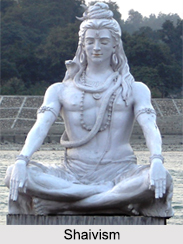
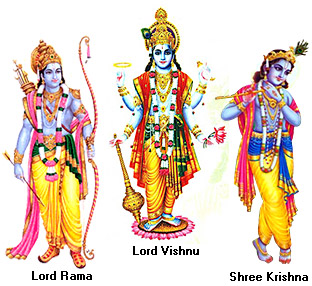
There is a mythical story relating to the origin of Kumbhakar. Lord Shiva is believed to have created a man and a woman during his marriage, from the beads of his garland and bade them to manufacture a `Kumbha` or water pot, which was required during his wedding ceremony.
Therefore the potters call themselves the dependent of Shiva and place his idol on the center of their wheel, leaving it unturned for the entire first of the Bengali Calendar. On the last day of the Bengali calendar, they worship the idol with devotion before immersing it. The Kumbhakar also worship Lord Viswakarma and believe that he had passed this exquisite art of pottery down to them.
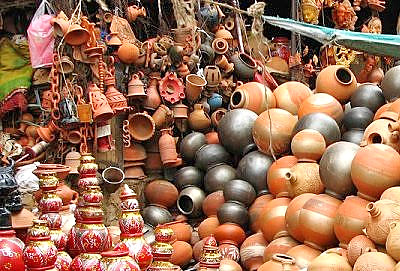
The Kumar or the potter makes a number of clay wares like kalshi (household water vessel), handi (cooking pot), jala (big water jar), hara/dhakna (pot covers), shanki (dish), sharai (jug), plates, cups, badna (water pot) and dhupdani (vessel for scented sulphur). Clay made toys and clay fruits like palm, banana, jackfruit or mango, are popular sale items in traditional fairs and festivals made by the potters. All the earthen wares are made by the hand and often display considerable ingenuity.
All the Kumars or potters use a simple technology in making the earthenware. The clay dug from the earth`s surface is prepared by beating and kneading with the hands, feet or simple mallets of stone or wood. There are a number of steps followed in making the ware. They include clay collection and preservation, preparing the clay for production, modeling the shape and size of the wares, drying the ware in the sun and lastly, firing and coloring it.
In the ancient times, the clay was well tempered with water and was invariably used without any additional material. Earthen wares were shaped by digging out or cutting a solid lump or ball from this pure clay. Then it was done by building up piece by piece, or by squeezing cakes of clay on to some natural object or a mould or form.
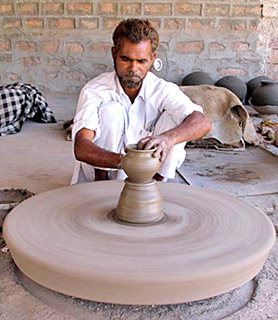
 The potter`s wheel or chak is a later invention. Kumars in the modern age use wheel with which they fashion various kinds of pottery, which then dried in the sun and later are heated in the kiln (panja). The wheel in its simplest form is a heavy disk pivoted in a central point to be set going by the hand of the workman squatting on the ground. A large wheel is placed in a horizontal position on a small and well lubricated pivot fixed strongly into the ground. On the centre of the wheel, above the pivot, a quantity of prepared clay is deposited; then by means of a stick the wheel is made to revolve very rapidly, and sufficient impetus is imparted to it to keep it in motion for several minutes. Seating himself on the ground before the wheel, and stretching his arms over, the potter manipulates the revolving clay into the shape intended, and, having done so, separates it by means of a cord from the rest of the clay, and recommences the same operation, there being enough clay on the wheel for a dozen vessels or more. When the wheel slackens in speed he places the stick in a hole near one of the spokes, and revolving it a few times forcibly, sends it on again with its original speed. A round ball of hardened clay is held inside, while with a wooden hammer the material is beaten from the outside into requisite shape and thinness.
Kumars or the potters use two kinds of earth, `bali` or sandy soil and `kalamati` or blackish sticky soil. Both the ingredients are mixed in the ratio 1:2 for production of strong pottery. The red laterite earth from Bhowal is used for making the common red earthenware vessels. The cheap red and black earthenware are both prepared with the same clay, the latter being blackened by covering up the kiln at a certain stage and by adding oil-cake to the fire. Many potters cannot glaze or fix the colours on the wares, but are content to paint the vessel after it has been baked. The colours used in the earthen wares are always made from different chemicals and metals such as copper, manganese, lead, arsenic etc. Red paint are prepared with red leads, yellow with arsenic, green by copper, blue from manganese, and black with the combination of different chemicals. The Kumbhakar also manufactures bricks and tiles.