





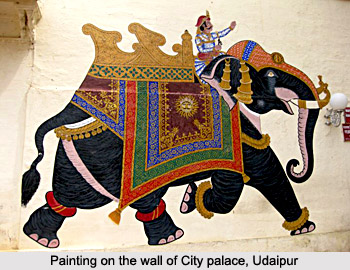
 The features of Rajput sculpture make it quite apparent that the Rajput rulers had a keen interest and were acquainted with the sculptural idiom. Their sense of beauty is predominant in their temples, havelis, forts and palaces. The architectural grandeur of the Rajput era is extensively found in North Indian and Upper Deccan. Their kind of art was termed as the Indo-Aryan style of architecture and sculpture. However in South India the Dravidian art and sculpture thrived under their reign. A detailed study of the Rajput sculpture, painting and architecture brings forth the fact that the Rajput style of architecture heavily borrowed from the Mughals. The later 18th and 19th century Rajput buildings assumed national character when they reduced the Mughal features to a subordinate position. These buildings were more elegant that that of the Mughals. The features of Rajput sculpture make it quite apparent that the Rajput rulers had a keen interest and were acquainted with the sculptural idiom. Their sense of beauty is predominant in their temples, havelis, forts and palaces. The architectural grandeur of the Rajput era is extensively found in North Indian and Upper Deccan. Their kind of art was termed as the Indo-Aryan style of architecture and sculpture. However in South India the Dravidian art and sculpture thrived under their reign. A detailed study of the Rajput sculpture, painting and architecture brings forth the fact that the Rajput style of architecture heavily borrowed from the Mughals. The later 18th and 19th century Rajput buildings assumed national character when they reduced the Mughal features to a subordinate position. These buildings were more elegant that that of the Mughals.
A distinct style evolved as far as the Rajput sculptures were concerned. Memorial stones, the bronze statues of the maharajas and deities, ceiling reliefs and funeral monuments were some of the main features. In addition to these distinct features the Mughal influence can also be noted in the sculpture of the horses, Jahangir's reign, Akbar's court and elephants and their riders. The features of Rajput sculpture are devoid of eroticism. Instead it is predominated by a romantic atmosphere. The images of Radha and Lord Krishna are quite common in Rajput sculpture as well as painting. Stone and wooden sculptures are the main attractions of the Rajput style. One of the most amazing features of these sculptures is that they look simple but the work is an elaborate one. Rajput Temples 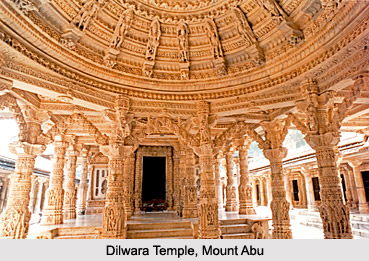 The garbhagriha, the vimana, the shikhara and the amalaka (the round stone on top of the shikhara on which a golden kalasa is placed) are the key features of Rajput temple architecture. As far as the temples architecture is concerned a 'sabha mandap' was mandatory for every shrine. In temples like Vishwanath and the Khandariya Mahadeva Temples, Surya Temple at Konark, Tejpala Temple at Mt. Abu and others such features are easily found. These temples, though built by other rulers, were built during the Rajput period and followed the Rajput idiom. The garbhagriha, the vimana, the shikhara and the amalaka (the round stone on top of the shikhara on which a golden kalasa is placed) are the key features of Rajput temple architecture. As far as the temples architecture is concerned a 'sabha mandap' was mandatory for every shrine. In temples like Vishwanath and the Khandariya Mahadeva Temples, Surya Temple at Konark, Tejpala Temple at Mt. Abu and others such features are easily found. These temples, though built by other rulers, were built during the Rajput period and followed the Rajput idiom.
Most of the temples in Rajasthan are dedicated to Lord Shiva and Lord Vishnu. However Jain and Buddhist temples are also to be found. It needs to be pointed put that the temple architecture of the Rajputs was quite conservative. Hence the medieval vocabulary of the temple sculpture and architecture was followed by these rulers. But the endowments of the artists are apparent in the intricate sculptural work. One of the finest examples of Rajput temple architecture is the Dilwara Temple at Mt. Abu. Rajput Palaces and Forts 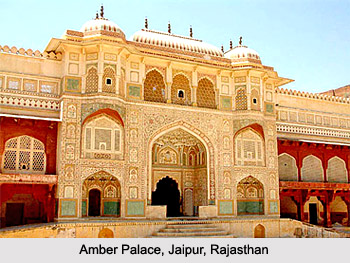 The lavish palaces and forts built by the Rajput kings bear testimony to their aesthetic sense. The majestic forts in Rajasthan comprise Chittorgarh, Gwalior, Jodhpur, Jaisalmer, Amber and Ranthambor speak volumes about their architecture. The colossal walls, square towers and mighty barriers spell out the Rajput skill. The lavish palaces and forts built by the Rajput kings bear testimony to their aesthetic sense. The majestic forts in Rajasthan comprise Chittorgarh, Gwalior, Jodhpur, Jaisalmer, Amber and Ranthambor speak volumes about their architecture. The colossal walls, square towers and mighty barriers spell out the Rajput skill.
One of the excellent specimens of Rajput architecture is the Jaya Sthamba or Victory Tower in Chittor. It is a 9 storeyed structure that has been elaborately decorated with sculpted statues of Hindu deities. Built by Maharana Kumbha in the 13th century the Jaya Sthamba is a square structure with balcony, windows and mouldings on its four sides. Elaborate architecture, impressive mosaic works, carved balconies, jharokhas, inlaid mirror works, and miniature paintings have been heavily used by the kings to build their palaces in Rajasthan. These royal abodes were often built by the lakeside or were accompanied by gardens. The palace at Jodhpur is a fine instance. Rajput Havelis 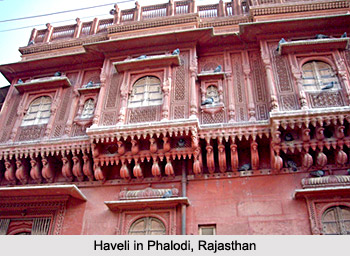 Arched gateways, jharokhas, miniature paintings, balconies and detailed mirror works are still found in the Rajput havelis. The sculptures on the niches of the outer and inner walls of the havelis were inspired from the folk tales. Besides these one would easily come across painted, stone and stucco murals and a plethora of wood carvings. These havelis in Rajasthan were actually the residing places of affluent businessmen. Arched gateways, jharokhas, miniature paintings, balconies and detailed mirror works are still found in the Rajput havelis. The sculptures on the niches of the outer and inner walls of the havelis were inspired from the folk tales. Besides these one would easily come across painted, stone and stucco murals and a plethora of wood carvings. These havelis in Rajasthan were actually the residing places of affluent businessmen.
The features of Rajput sculpture make them the perfect examples for Indo-Iranian architecture. The themes of the sculptures were definitely Indian. In fact these were rooted in the folk tales. But these sculptures and the Rajput architecture, at large, differed from the Hindu style as their spirit is strictly Iranian. |
| ||||||||||||||||||||||||||||

