Dhrupad, Indian Classical Music - Informative & researched article on Dhrupad, Indian Classical Music
  Indianetzone: Largest Free Encyclopedia of India with thousand of articles Indian Music


in  
Art & Culture | Entertainment | Health | Reference | Sports | Society | Travel
Forum  | RSS Feeds  | Free E-magazine
Indian Music : Indian Music l Traditional Indian Music l History of Indian Music l Indian Musicians l Gharanas Of Hindustani Vocal Music l Bollywood Music l Pop music l Western Music in India l Indian Classical Instrumentalists l Indian Music Bands l Indian Classical Vocalists l Indian Musical Instruments l Raaga
Home > Movies & Entertainment > Indian Music > Indian Music > Indian Classical Music > Dhrupad
Dhrupad, Indian Classical Music
A unification of spiritualism and appeal, Dhrupad stands as an ancient classical Indian musical form.
  Origin and Development of Dhrupad   Decline of Dhrupad Music    

Dhrupad is the most ancient form of Hindustani classical music that has outlived to this date in its original form. The Dhrupad tradition is a major heritage of Indian culture.

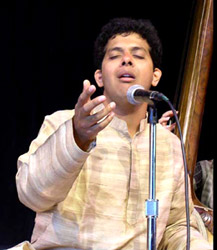
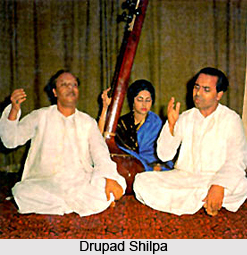
Dhrupad, Indian Classical  Music The nature of Dhrupad music is spiritual. Its main aim is not to entertain, but to stimulate feelings of peace and contemplation within the listener. The word `Dhrupad` is derived from `dhruva`, meaning the steadfast evening star that moves through the galaxy and pada, meaning poetry. It is a form of devotional music that traces its origin to the ancient text of Sama Veda. The Sama Veda was chanted with the help of melody and rhythm called Samgana. Slowly this developed into other vocal style called `Chhanda` and `Prabandha` with the initiation of verse and meter. The synthesis of these two elements led to the issuing of Dhrupad.

Dhrupad music is primarily divided into two parts (each further subdivided into smaller sectional units), the alaap and dhrupad. A dhrupad performance always starts with a detailed alaap in a preferred raga. Here, a singer tries to evoke the mood, tone and spirit of the chosen raga elaborately, exuberantly and regally, without any musical accompaniment. It will, definitely not be an exaggeration to say that the alaap is the very essence of this musical form. In fact, a dhrupad alaap is perhaps one of the supreme instances of pure music, in that it explores the limitless contours and configurations of sounds in rich detail and with the greatest and possible grace. The ebb and flow of the subtle euphonies and reverberations are obvious all through the alaap. A trained ear is engrossed, whereas, the untrained ear, but enthusiastic ear is enraptured by the glidings, the oscillations and the steadyings of the sound. Tones and microtones heave, swing, surge, roll and plunge in the sea of the singer`s voice, sometimes tempestuously, and at other times gently. Dhrupad singers belonging to the Dagar style do not use melodic accompaniments, like the harmonium or sarangi, during their recitals. Only the drone of the tanpura is perceptible in the background. However, those belonging to the Darbhanga tradition, resort to the sarangi.

A typical dhrupad alaap showcases the coalition of form and energy, subtlety and solemnity, meditative stillness and enthusiastic flow in all its various stages of unfolding. The singer, many a time, begins with an inventive chant of the Omkara in the chosen raga. As the alaap follows no fixed text, the singer is free to use words like re de ti ri li na nom ta, collectively called nom tom, to emphasize and expatiate the notes. The most perfect pitch and timbre of every note is explored, delved into minutely. It is supposed that these `nonsense` syllables possess a semantic and mystical vibrancy that signifies aum (mystic sound), antar (from inside), tarana (entire cosmos), tum (you), ananta (infinite), hari (god), which is vocalized in the nom tom alaap. Words would spoil the meditative effect achieved by the persuasive array of mantric and resonant nom tom syllables. The contemplative character of the alaap is amplified by the prayerful manner in which the singer articulates these syllables in the lower, middle and upper registers. The notes of the raga are explored and elaborated in the descending order until, gradually, the singer arrives at the lower register, at first, and then proceeds to the lower register of his voice (ati-mandra).

This convincing, and often overwhelming point in the alaap fully utilises the bass resonance of the singer`s voice to enunciate the very last caches of the audible and cognizable sound. Then comes the ascent to the middle octave and the gathering of tempo, where improvisations are done, using swings of voice. These vocal modulations ultimately culminate with the singer touching the climactic high octave (taar sa) with incredible effect. Singers often choose to postpone touching the high octave, by playing around the notes below it. This is only to tempt the listener and build up a sense of anticipation within him. When the singer touches the highest octave, in a climactic and dramatic manner, the listener is transported into a state of exhilarated relief.

The free alaap is followed by the jod or the madhya alaap, wherein, a regular pulse accentuates or rhythm-izes the alaap in a unique way. This section resembles the jod section in instrumental music. Notes are pulled and elongated the way the strings of a rudra veena are. In fact, the techniques used in the rudra veena are transposed on to vocal music many a time with incredible effect. Incidentally, it is remarkable to note that the rudra veena was often the instrument that accompanied a singer, during the Mughal era. In fact, a considerable number of dhrupadiyas also played the veena. The inter-relationship between the human voice and the veena is made adequately clear in the jod-alaap section, especially when the rhythm speeds up.

Then the tempo quadruples to give way to the drut-alaap, which is the same as the jhala section in instrumental music. The rhythmicity of vocal modulations becomes compelling at this stage. Complex phrases and articulations are subject to heavy oscillations. Ornamentations, like variety of gamaks and meends, are used to fancify the notes, giving a sense of their pulling and stretching. Spontaneity and adroitness are called for, at the same time. The gamaks used in dhrupad, demand massive vocal resources and breath-control. But here the method of voice production is dissimilar from that normally followed by khayal singers. The various heavy and oscillating gamaks used in dhrupad emit, as singers disclose, from the navel (nabhi) region, rather than from the throat, as is the case with khayal. Gamaks come in continual weighty spouts from the depths of the belly, whereas taans come as a rapid gush of fast figures from the throat. This is possibly one of the decisive differences between the embellishments used in dhrupad and those in khayal.

The effect of the jhala section is inebriating, unlike the initial section which is more intoxicating. The drop from the high tempo to the middle one and, ultimately, to the shadaj marks the end of the alaap section. A dhrupad alaap normally occupies the longest duration in a recital. All through the various sections of the alaap, the singer is the sole actor enacting and unveiling the subtlest and the most vibrant aspects of sound. The duration of the alaap deviates from singer to singer, as it does from style to style. Followers of the Dagar style, who perhaps offer the most comprehensive and rounded off alaaps, normally take not more than 45minutes to one hour to go through all the phases systematically.

After the prolonged alaap, comes the dhrupad or the song-text or bandish, set to a rhythmic cycle. The three components of the dhrupad section - song-text, melody and rhythm are evenly accentuated. Rhythmic accompaniment is provided by a two-headed barrel-shaped drum called chautaal. The ten-beat sool taal and the dhammar taal of 14 beats are also used often. The dhrupad itself is sub-divided into four sections - the sthayi, antara, sanchari and abhog. Of these, most dhrupad singers these days only sing the first two sections.

The first section sung is the sthayi (meaning steady). In fact, it is on the sthayi section that the weight of the raaga and of the composition falls. The first phrase of the bandish, which carries the characteristic melodic intonation and weight of the raaga, is sung first. The pakhawaj player joins the singer at count one of the tala cycle, providing accompaniment with booming beats from this point on, thus setting into motion the rhythmic cycle. As there is correlation between word, notes and rhythm, the singer and the pakhawaj player endeavour to move on a co-equal basis to create an interconnected effect.

While delivering the sthayi, the singer is free to pick the speed he wishes to. In the sthayi section only the lower tetra-chord (poorvanga) of the raaga is stressed. Following a series of improvisations, in the sthayi section, the singer moves on to the antara (intermediate) section, designated by his transition from the lower octave to the middle and high octaves - i.e., from ma or pa, to taar sa. Further improvisations take place in these two octaves, after which the singer returns to the sthayi, to attempt improvised variations in a rhythmically oriented manner. To this purpose, the words of the composition are broken and sub-divided rhythmically into their basic syllabic units and then re-organised, in order to create brilliant syllable-beat and word-beat synchronic patterns. This part is known as bol-baant (word-divisions). Using the sthayi, the singer attempts to sing the words inn different tempi, known as dugun (twice), trigun (thrice) and chaugun (quadruple). The tempo would be in multiples of the basic tempo, set by the singer. In the process, the singer tries to compress as many words of the composition into the rhythmic cycle, in stimulating and inebriating ways. Great mastery over tala and laya (tempo) is necessitated here. After having this astounding synchronisation with the percussionist for a while, the singer slows down the tempo severely, returns to the first line of the sthayi and concludes the recital.

Unlike the alaap, the dhrupad section as such is short, highly structured and follows a strictly sequential pattern. Unimaginative singers could well reduce the whole sequencing to a highly disciplined military march, with each section following the previous one mechanically. But, nifty and inspired singers bring out the poetic beauty and the poignant expressivity of the bandish through their enunciations and improvisations.

Yet, a dhrupad singer does not enjoy a khayal singer`s imaginative liberty. In fact, a dhrupad recital may seem, on a relative scale, colourless to those used to the emotional flexibility and poetic expressions of khayal. Dhrupad song-texts are very often hymns in praise of divinities. They, at times, celebrate the varied grandeurs of nature and seasons. Sometimes, they also underline the abstract and expressive beauties of the formal aspects of classical music such as raaga, tala and swara.

A good number of compositions are devotional in content and dignified in terms of poetry, Secular and romantic themes are normally avoided, because they are thought to weaken the patronising spirit of this dignified form. In the past, kings and emperors too were praised by court composers and singers. Yet, these are some variations to this tradition. Nayak Bakshu`s musical treatise Sahasraswara allegedly contains 1000 compositions that give predominance to the shringar ras. All shades and expressions of the amorous and the erotic are explored in the fullest detail here.

On the whole, dhrupad portrays all the traits of high classicism, both in content and spirit. Yet to argue that dhrupad is an emotionally dry style, is not only idiotic, but also flawed, given the tonal sweep and range that dhrupad singer has at his disposal. For those looking for the immaculate, the contemplative and the sublimity in music, there is no substitute for dhrupad in North Indian music.

A full-fledged dhrupad recital is normally followed by a Hori-dhammar or a sadra. Hori compositions, composed in Brij, always deal with the love mischief of the mischievous Krishna, during the time of Holi and are set to a cycle of 14 beats, called dhammar taal. Hori-dhammar, while intimately resembling dhrupad, is quicker in movement and sensuous in poetic tone. Sadras are again compositions that resemble dhrupad. The only dissimilarity is that they are set in a cycle of ten beats, called sadra or jhaptaal. Many dhrupad singers, as part to bringing diversification into their recitals, often sing abbreviated versions of dhrupad towards the close. These compositions are usually stutis or hymns in praise of divinities, furnished with the emotive and vibrant colours and shadings, typical of khayals. They are neither rigid, nor stern in tone, and most often surpass the thin line that separates the majestic dhrupad from the more expressive khayal.

Musical treatises make mention of the existence of different styles or vanis of dhrupad that existed during the 16th century. They themselves were supposed to have evolved out of five geetis, or styles of singing, referred to by the scholar Matanga during the 17th century. From these styles, came four dhrupad vanis - Gauhar, Nauhar, Khandar and Dagar. But scholars are not entirely convinced about the fate or the consequent history of these vanis, following their decline during the late Mughal era. Musical treatises inform that the Gauhar style gave massive importance to breath control, Nauhar to the melodic elements in songs, Khandar to sweep and sharpness of voice, and Dagar to expansive alaaps (maintained to this day by the singers of this style). Many of the existing dhrupad gharanas trace their origins back to one or the other of these vanis.

(Last Updated on : 6/01/2009)
  More on Indian Classical Music...
 
Indian Classical Music Forms Carnatic Music Dhrupad
Khayal Ghazal Indian Classical Music Composers
North Indian Classical Music    
Recently Updated Articles in Indian Music
  • Indian Classical Music
    Indian Classical music originated in the Vedas and later branched into two streams of Carnatic and Hindustani music.
  •  
  • Music in Medieval India
    Music in medieval India has great impact in the history of Indian music.
  •  
  • Music In Modern India
    Music in Modern India has developed in almost all aspects and a new genre has been introduced.
  •  
  • Indian Music Bands
    Indian Music Bands have created an upheaval of modernised music and concerts among the young generations of the nation.
  •  
E-mail this Article | Post a Comment
Free E-magazine
Subscribe to Free
E-Magazine on Indian Music

 
Dhrupad, Indian Classical Music - Informative & researched article on Dhrupad, Indian Classical Music
Sitemap
Contact Us   |   RSS Feeds
Copyright © 2008 Jupiter Infomedia Pvt. Ltd. All rights reserved including the right to reproduce the contents in whole or in part in any form or medium without the express written permission of Jupiter Infomedia Pvt. Ltd.