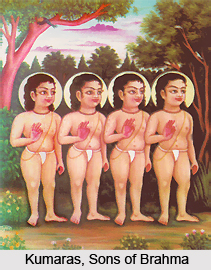
 In the Puranas it is mentioned that Kumaras are the sons of Lord Brahma born from his mind. Kumaras were Brahmas progeny and were pure and innocent.
In the Puranic texts of Hinduism, the numbers of Kumaras are said to be four, five, and even seven. One such list of seven names of these Kumaras consists of Sanaka, Sanandana, Sanatana, Asuri, Kapila, Barhu, and Panchsika.
In one hand the most popular Kumaras are Sanat Kumar, Sanandana, Sanak, and Sanatana. In another hand, Sana, Sanat Sujata, and Kapila are less known names. It is said that all these names are mere aliases; their real names are not revealed to the world at large. Often Kartikeya and Narada are also known as Kumaras.
In accordance with mystifying teachings, these Kumaras represent manifestations of certain order of divine spirit at certain stage of cosmic evolution to help the Primordial Creative Spirit, Brahma. However they did not function in the ordinary creative processes of manifestation. Being the personification of the highest principle in manifestation, they could not be contained in any physical body. Thus the Kumaras did not mingle with the mainstream of manifestation and concerned themselves only with the development of the inner man; from their supreme height they guide and watch the evolutionary process as the man aspires and struggles to realize one`s pristine nature.
The Kumaras are also described as the intelligent, conscious and living Principles. The primary seven lights manifested from light unman fasted-which to normal beings is darkness. They are the seven, exoterically four, Kumaras as `mind-born sons` of Brahma. They are also personified as the demi-gods or the lower gods.
The Kumaras are all virgin gods who remain eternally pure and innocent and decline to procreate. In their original nature, they are not the regents of the planets but they dwell beyond the planetary region. They are not Jivanmuktas or the liberated souls, who attain their status in the evolutionary process. They have not descended to the realm of matter; as such there is no question of their ascension to the higher realms: they are Kumaras, the Virgin Ascetics, who ever remain at the sublime height and radiate their impulses like the spring wind for the germination of spiritual seed within every individual.
The Kumaras are mixed up astronomically, physiologically and mystically in general with a number of Puranic personages and events. Even in non-Vedic literature, references to these cosmic or divine forces are made under different names. Astrologically, the five Kumaras are said to be closely associated with Capricorn, the pentagon representing the tenth sign, stands for the Kumaras, two of whom, out of the seven, having been kept secret. It is also referred that the Kumaras are the fifth order of Brahmadevas and the fivefold Chohans having the soul of the five elements in them, water and ether predominating and therefore their symbols are both aquatic and fiery.
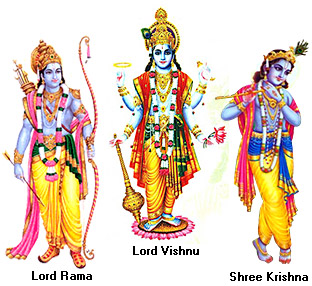
The Kumaras is believed in the Hindu mythology that they wander the cosmos in the forms of small children. They also play an important role in many Hindu spiritual traditions, mainly those related with the worship of Lord Krishna and Lord Vishnu.