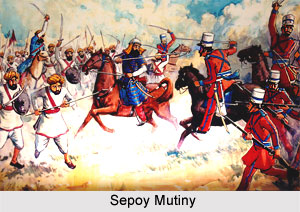
 The final outcome of the Indian Sepoy Mutiny was not a pleasant one from Indian point of view. However, it did made the intentions of the British quite clear to the Indian masses. The mutiny had been waged for more than a year, beginning in the early years of 1857. The British East India Company had started to branch out their endeavour to do flourishing business with Indian traders. However, instances of several occurrences gradually proved to Indians that the Company trading rule must be ousted. To the surprise of British generals and the Maharajas of the princely states, common man started rising against the English rule.
The subsequent times that passed, witnessed the tremendous revolts and uprisings in places like, Delhi, Meerut, Agra, Lucknow, Kanpur, Calcutta, Oudh, Central provinces, Bihar, Rajputana, Allahabad and Rohilkhand. To sum up, the whole of India rose up in flames. Every clever move made by the natives was thwarted by English forces, though with much pain and strain. Although the revolt did not last for long, yet it left lasting impression on every native mind. Finally, the outcome of the Sepoy Mutiny was decided directly from Britain itself.
On the 27th of January 1858, the King of Delhi had been brought to trial in the Privy Council chamber of his palace. He was charged with devising war against the British Government, with abetting rebellion and with numerous other seditious wrongs. After a patient trial, extending over forty days, the King was declared to be guilty of the main points of the charges, and sentenced to be transported for life. Ultimately, he was sent to Pegu (presently in Burma), where he ended his days in peace.
Meanwhile, in England, it had been found necessary, as usual, to find a scapegoat for the disasters which had fallen upon India. With a singular agreement of opinion the scapegoat was declared to be the British East India Company which had won for England that splendid appendage. In consequence it was ordained to transfer the administration of India from the Company to the Crown. An Act carrying out this transfer was signed by Queen Victoria on the 2nd of August 1858.
Queen Victoria thought it right, as soon as possible after the transfer had been thus put to effect, to issue to her Indian subjects a proclamation declaratory of the principles under which she intended thereafter to administer their country. To the native princes of India she announced in that proclamation, that all treaties in force with them would be accepted and meticulously maintained.
The proclamation also stated that she would respect their rights, their dignity and their honour as her own. She would sanction no encroachments on the rights of any one of them. The same obligations of duty which bound her to her other subjects, would bind her also to them. To the natives of India generally, Her Majesty promised not only complete toleration in matters of religion, but also admission to office, without question of religion. Every individual as might be qualified for holding office by his or her education, ability and integrity, were also promised equality.
The Queen declared, further, that she would direct that, in administering the law, due attention should be paid to the ancient rights, usages and customs of India; that clemency should be extended to all offenders (in the matter of Mutiny), save to those who had been or should be convicted of having taken part in the murder of British subjects; that full consideration should be given to men who had thrown off their allegiance, or who had been moved to action by a too credulous acceptance of the false reports circulated by designing men; that to all others who would submit before the 1st of January 1859, unconditional pardon should be granted.
This proclamation virtually approved the right of adoption. It was hailed everywhere as a binding charter. In the large centres of India natives of every religion and creed, Hindus, Muhammadans and Parsis, met in numbers to draw up loyal addresses expressive of their deep sense of the beneficent feelings which had prompted the proclamation. They also expressed their gratitude for its contents and of their loyalty to the person of the illustrious lady to whose direct rule they had been transferred.
Published on the 1st of November 1858, this proclamation immediately followed the complete collapse of the Sepoy Mutiny. Practically, there remained only the capture of Tantya Topi and the expulsion of the remnant of the rebels from Oudh. In both these cases the conclusion was inevitable. It was but a question of a brief time. The rebels in Central India and in Oudh, as well as those few still remaining in Western Bihar and in Chota Nagpur, represented the dying embers of a fire which had been extinguished.
The moral of the Mutiny, the lessons which it taught to humanity, its warnings and its final outcome were to some extent predictable, yet were unprecedented. The gradual conquest of India by a company of merchants inhabiting a small island in the Atlantic has ever been regarded as one of the most marvellous achievements of history. In 1857, the English garrison in India was surprised. There were not a dozen men in the country who, on the 1st of May of that year, believed that a catastrophe was impending which would shake British rule to its foundations. The explosion which took place at Mirath (Meerut) ten days later was followed, within five weeks, by similar explosions all over the North-western Provinces and Oudh. Explosions occurred not only on the part of the sipahis, but likewise on the part of the people. The rebel sipahis (soldiers) were strong in the possession of many fortified places, numerous artillery, several arsenals and magazines.
The rebellious men inaugurated their revolt by successes which appealed to the imagination of an impulsive people. At Delhi, at Kanhpur, at Jhansi, in many parts of Oudh and in the districts around Agra, they proved to them the possibility of expelling the foreign master. The majority of the population in those districts, landowners and cultivators alike, displayed a marked sympathy with the revolted sipahis. For the English, in those first five weeks, the situation was bristling with danger. A false move might have temporarily lost India. In a strictly military sense they were too few in numbers and too scattered, to attempt an offensive defence. It is to their glory that, regardless the strictly scientific view, they did attempt it. The men who administered British India recognised at a glance that a merely passive defence would ruin them.
They displayed, then, the truest forecast, when they insisted that the resources still available in the North-west and in Punjab should be employed in an offensive movement against Delhi. That offensive movement saved them. Delhi offered a resistance spanning over four months. The constituting of the main army of the rebels within the city`s walls gave to the surprised English the time necessary to improvise resources, to receive reinforcements, to straighten matters in other portions of the empire.
The secret of success of the British in the stupendous conflict which was ushered in by the revolt of Mirath (Meerut) and the seizure of Delhi, lay in the fact that they never, even in the darkest hour, despaired. When the news of the Kanpur unrest reached Calcutta early in July 1857, every Englishman realised that the cruel deed would be avenged. The same spirit was apparent in every corner of India where an English man or an English woman dwelt.
The determining cause of the Great Revolt of 1857 was the attempt to thrust Western ideas upon an Eastern people. This was especially the case in the North-western Provinces, where the introduction of the Thomasonian system unsettled the minds of noble and peasant. It was the case in Oudh, where the same system suddenly replaced the congenial rule of the ex-King. Nowhere else in India was the rebellion more rampant and more persistent than in those provinces. Three hundred years previously the great Akbar had attempted to interfere with the village system, but after a short experience, had recoiled. He recognised in due course that custom is nowhere as strong as in India. And interfering with that system would uproot customs as dear as their lives to the children of the soil. The English, rushing in where Akbar had feared to tread, met their reward in a general uprising.