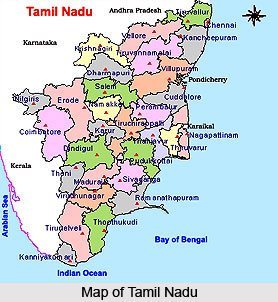
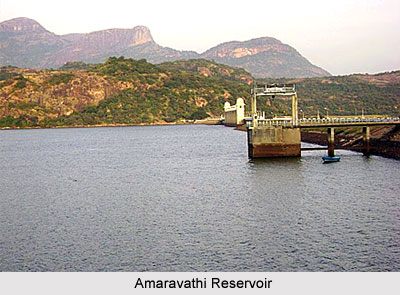
 Amaravathi Reservoir in Tamil Nadu is situated in Amaravathinagar. It is in close proximity to the Indira Gandhi Wildlife Sanctuary in the district of Coimbatore in Tamil Nadu state. This reservoir in Amaravathinagar is situated at a distance of about 25 kilometers to the south on the national Highway number 17 from Udumalpet. The Amaravathi reservoir was constructed by the steep Amaravathi Dam built across the River Amaravathi. This reservoir is well-known for its high fisheries yield and it is also the largest wild breeding population of Mugger crocodiles in south India, living there and in the rivers leading to it. The Amaravathi reservoir encompasses 9.31 km and is almost 33.53 meters deep.
The Amaravathi reservoir was formed by the steep Amaravathi Dam. This dam was constructed in the year 1957 at the time of the K. Kamaraj administration across the River Amaravathi about 25 kilometers upstream and lies south from Thirumoorthy Dam. The capacity of the dam has reduced from 4 TMCFT to 3 TMCFT because of heavy siltation. The Amaravathi reservoir was mainly constructed with an aim of providing water for irrigation and control of flood. In the year, 2003-04, the Tamil Nadu Electricity Board designed to set up a 4 MW electricity generating capacity from this dam which is operating currently.
The Amaravathi reservoir is a suitable breeding place for different varieties of fish. The non-indigenous fish tilapia is a major portion of the fish preserved in this reservoir. There is a well laid-out park which is situated close to the reservoir, where the tourists climb steep steps on the dam to have a bird`s eye view to the north of the plains below and south to the Anaimalai Hills and Palni Hills above. This place is located at a distance of 25 kilometers from Pollachi is also being developed as a District Excursion Centre for tourism. The Fisheries department has formed the Amaravathi Nagar Tribal Fishermen Cooperative Society to provide the tribals with fishing rights, so that they can fish in the Amaravathi Reservoir. In the year 2007, fifty tribal communities who reside at Karattupathi settlement, close to the reservoir, registered themselves as members of the society and from them eight have already received a fishing license.
The largest population of wild Crocodiles in the state of Tamil Nadu dwells in the Amaravathi Reservoir. These crocodiles breed in the Thennar, Chinnar and Pambar rivers that drain into the Amaravathi reservoir. These broad-snouted Mugger crocodiles are also known as Persian crocodiles and Marsh crocodiles. These species are the most widespread of the three species of crocodiles found in India. These crocodiles eat fish and other reptiles, both large and small mammals and are sometimes dangerous to human beings. In the Amaravathi reservoir in Tamil Nadu, the largest wild breeding population of crocodiles in India lives. They are also found in the Thennar, Chinnar and Pambar rivers which drain into this reservoir. These wild creatures are currently estimated to have a population of about 60 adults and 37 sub-adults. Various other fish predators available at this place are Oriental Small-clawed Otters, Indian Flap-shelled Turtles and Indian Cormorants. The Amaravathi Sagar Crocodile Farm which was founded in the year 1976 is considered to be the largest Crocodile nursery in India. This crocodile nursery is situated at a distance of one kilometer before the site of the Amaravathi dam. A number of adult crocodiles have been reintroduced into the wild from this nursery. Eggs of the crocodiles are Eggs are accumulated from different wild nests along the margin of the reservoir so that the same can be hatched and reared at the Farm. A large number of small and big crocodiles can be seen at this place, resting under sunshine and striding on one another. Three Forest Department personnel are deployed in order to take care of this Centre.
Close to the Amaravathi reservoir, one can get to see a beautiful park, where one can climb some steep steps on the dam in order to get an amazing view north of the plains beneath and south to the Palni Hills and Annamalai Hills above. It has been designed as a District Excursion Centre in order to promote tourism. The Crocodile farm and the Park are open for the tourists from 9.00 A.M. to 6.00 P.M every day. In order to enter, one needs to pay and entry fees of Rs.0.50/- per adult and Rs.0.25/- per children below the age of 12 years. Visiting this place is very easy and one can travel by road from Coimbatore district via Pollachi. From Udumalpet to Amaravathynagar the distance is 96 kilometers. Tourists visiting this place an avail suitable accommodation in the Forest Rest House situated close to the crocodile farm.
Amaravathi reservoir is thus one of the reservoirs in Tamil Nadu which was constructed in order to cater to the water requirements for irrigation and to control flood. This reservoir also serves as one of the most suitable breeding place for a large variety of fish. It also holds one of the breeding centers of crocodiles.