"Powada" is a genre of Marathi poetry that emerged during the late 17th century in India. The Powadas are a kind of Marathi ballad written in an exciting style, narrating historical events in an inspiring manner. This includes description of heroic deeds by great kings. The composers-cum-singers of these Powadas are known as "Shahirs". The earliest Powadas have mostly been composed by the eyewitnesses of the great events celebrated in these ballads.
The professional Powada singers later formed a guild or community known as the Gondhalis. The earliest notable Powada was the "Afzal Khanacha Vadh" (The Killing of Afzal Khan) by Agnidas in 1659, which recorded Shivaji`s encounter with Afzal Khan. The next notable Powada was "Tanaji Malusare" by Tulsidas, which gave an account of the capture of the Sinhagad Fort by Maratha military leader Tanaji Malusare. Another notable contemporary Powada was the "Baji Pasalkar" by Yamaji Bhaskar.
During the Peshwa rule, several celebrated Shahir poet-singers, which include Ram Joshi (1762-1812), Anant Phandi (1744-1819), Honaji Bala (1754-1844) and Prabhakar (1769-1843), composed a number of Powadas.
About 60 Powadas were collected by Harry Arbuthnot Acworth and S. T. Shaligram, and published under the title "Itihas Prasiddha Purushanche Va Striyanche Powade" in 1891. Out of these, ten of them were translated into English verses by H. A. Acworth and published as "Ballads of the Marathas", in 1894. In the Marathi movie "Me Shivajiraje Bhosale Boltoy" of 2009, the "Afzal Khanacha Vadh" is played.
Mahatma Jyotirao Phule discovered the `samadhi` of Chhatrapati Shivaji Maharaj, and celebrated Shivaji Maharaj Jayanti in Pune for the first time in 1869. Phule repaired the "samadhi" and wrote his first book - a Ballad (Powada) on Shivaji, which is noted in British records.
Form and Enactment of Powada
A Powada is a kind of Marathi ballad describing the heroic deeds by great warriors and kings, the origins of which lie in Vedic literature. Powada is similar to Birmal sung by the Charan Bhats of Rajasthan. Probably, it came with them when they migrated from the north and settled down in Maharashtra during Shivaji`s time. The earliest Powadas date back to the seventeenth century. The famed Shahir Agindas composed Powadas on thrilling incidents from Shivaji`s life. The term may also be associated with the "Pavada" ritual, in which devotees of Hindu god Khandoba break iron chains inspired by the love of God.
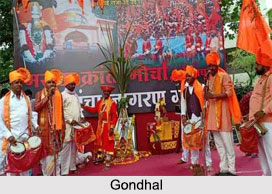
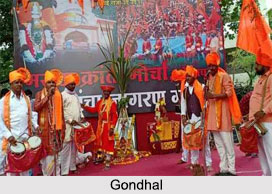
The Powada is essentially a narrative tale, composed in 4 to 40 "chauks", i.e., stanzas of 3 or 4 lines. The presenter dresses in "angarakha", a long and loose upper garment and "salwar" with a cummerbund. The presenter also wears a tall "kanganidar pagri" or turban on his head and carries the "halgi", i.e., tambourine that he plays. He is the coordinating force, acts as the protagonist and also narrates as the "sutradhara". His companions, called "jhilkari", play the minor characters and provide musical, vocal and instrumental support. The Powada begins with the "gana", a prayer-song invoking the blessings of Lord Ganesha. The narration proceeds in poetry and prose, and the Jhilkaris join in the refrain or repeat certain lines, also offering appropriate responses.
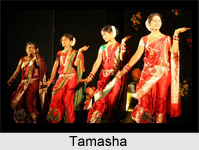
The language in a Powada is simple, sometimes uncouth, but the rhythms are very fast and vigorous. The instruments that are used can be mentioned as "dholak", "dimdi" or small drum, "halgi", and the stringed "tuntuna" that they invariably excite. Powadas evoke various "rasas", namely heroic, erotic, pathetic and devotional. These generally take place in a Lalit or Tamasha folk drama. Sometimes, the Shahirs enact them independently at festivals. Various communities, including Muslims, compose and perform them, though normally "Gondhalis", i.e., Gondhal performers and "Vaghyas", i.e., male worshippers of Khandoba, along with Shahirs specialise in their singing. Social and political events are also now included as subject matters in Powadas.
Related Articles:
Marathi Literature
Marathi Drama and Theatre
Folk Theatre In India
Gondhal, Folk Theatre of Maharashtra
Afzal Khan
Shivaji, Maratha Empire
Sinhagad Fort, Deccan Forts
Maratha Empire
Jyotirao Phule
Shivaji Jayanti
Vedic Literature
Sutradhara, Indian Theatre Character
Lalit, Indian Folk Form
Tamasha, Indian Folk Theatre