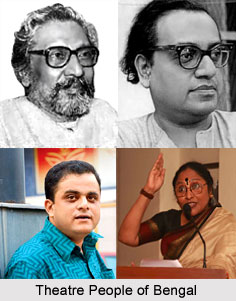
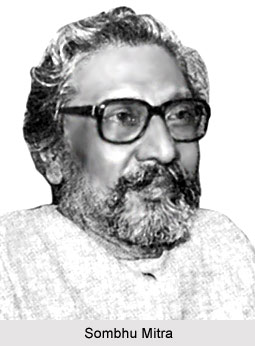
 Sombhu Mitra was a powerful actor in the Bengali theatre circuit. He was born in Hoogli district in 1915 and drawn towards drama early in life. He subjected himself to arduous practice, learning the basics of acting and voice control. He joined the commercial theatre at Kolkata in the year 1939. This was a valuable experience because of the opportunity it afforded to work with and watch at close quarters renowned actors and actresses like Sisir Bhaduri, Ahindra Choudhury, and Sarajubala Devi. Mitra used this period to study acting techniques and aspects of production, and identified public theatre`s deficiencies. He foresaw the dead end it got into, and soon gave up his association with it.
He joined the Indian People`s Theatre Association (IPTA) in 1943. He joined this while acting in the productions of its Bengal unit and jointly directing Bijon Bhattacharya`s Nabanna or `New Harvest` in 1944. The play heralded the beginning of the political-realistic `new drama movement` that, before long, became the dominant voice and pathfinder of modern Bengali theatre. Although the stint with IPTA sharpened his social awareness, Mitra severed his connection within a few years of Nabannas success. Meanwhile, in 1945, he married fellow thespian Tripti Mitra, and entered films with the IPTA-produced Hindi classic Dharti ke lal or `Children of the Earth` in 1946. This was partly based on Nabanna. In 1948, with Manoranjan Bhattacharya as guide and philosopher, he formed the group Bohurupee, though they named and formally started it later. Shortly, Bohurupee came to occupy the leading position in the new drama and group theatre movements. Sombhu Mitra was primarily responsible for its pre-eminence. His assets, built with discipline and labour, included a fine physique, a resonant and mellifluous voice honed for interpretative delivery of lines, mastery over acting, wide reading of dramatic literature, a poetic sensibility, and understanding of and ability to execute a director`s conception of a play in its totality. All of these contributed to make him the foremost actor and director of modern Bengali theatre.
A good part of his deserved reputation rests on his magnificent productions of many of Tagore`s major plays, considered till then unstageable because of their symbolism, new dramatic language, and rejection of established norms of Bengali playwriting and theatre. After directing Char adhyay or "Four Chapters" in 1951, that was dramatized from Tagore`s novel he produced Raktakarabi or Red Oleander in 1954. This remains a high-water mark in Bengali stage history, inspiring theatre workers across India. He also acted as the failed author in the film of Tulsi Lahiri`s play, Pathik or `Wayfarer` in 1953 and scripted and directed the award-winning expressionistic Hindi movie Jagte raho or Stay Awake in 1956.
Sombhu Mitra has acted in a variety of heroic roles in his long career. He did heroic roles in plays by Sophocles, Ibsen, Rabindranath Tagore, and Brecht, as well as portraying ordinary men. What made him an outstanding actor was his economical use of the considerable equipment at his disposal in interpreting this wide range of complex renderings and emotions. He brought out the inner reality of the myriad facets of life while adding, by gestures or inflection of voice, his own commentary on the characters. As director, he never lost sight of the total design of the production and combined the different elements with meticulous attention to detail, to make theatre out of a text much as an orchestra conductor extracts music from the composer`s score. The best of his productions achieved an exceptional unity.
Mitra gradually distanced himself from Bohurupee in 1971 and, though he performed occasionally, finally left the group at the end of the decade. He acted very infrequently during the 1980s, and his rare stage appearances in the 1990s were limited to play readings and recitations. He also wrote a few plays including one of epic dimensions, Chand banikerpala i.e. The Merchant Chand`s Pala` in 1978. Eventually this was premiered in 1999 by a Bangladeshi group. In numerous essays he expounded his views on the essence and destiny of Indian theatre.