Pali Language
  Indianetzone: Largest Free Encyclopedia of India with thousand of articles Indian Languages


in  
Art & Culture | Entertainment | Health | Reference | Sports | Society | Travel
Forum  | RSS Feeds  | Free E-magazine
Indian Languages : Languages of India l Origin of Indian Languages l Official languages of India l Indo Aryan languages l Indian Classical Languages l Scripts of South India l Indo - European languages l Indian Tribal Languages l Indology l Brahmic family Languages l Indian Spoken Languages l Languages of South India l Linguistic History of India l Indian Language Movements l Indian Regional Languages l Indian Scripts l Amara Kosha l English Language in India l Indian Language Families
Home > Reference > Indian Languages > Indo Aryan languages > Pali Language
Pali Language
Pali language owes its origination to Gautama Buddha and his disciples, who were chief to propagate it.

Buddhist Monk and Pali, Sacred LanguagePali language is regarded as a cardinal ancient language of India, belonging to the Middle Indo-Aryan language or Prakrit of India. It is wholly popular and acknowledged as the language of the earliest surviving Buddhist scriptures, as compiled in the Pali Canon or Tipitaka and as the liturgical language of Theravada Buddhism. The hallowed and consecrated scriptures of Buddhism are absolutely penned in ancient Pali language. Pali literally stands for `sacred text`. It is assumed that Gautama Buddha was of the habit to mouth in Pali and thus, Pali canon is regarded as the most veritable version of the sermons delivered by Buddha. Buddhist scriptures in Pali are generally referred to as Tipitaka, standing for Threefold Basket. These three Baskets of fundamental law further are divided as: Vinaya-Pitaka (the collection of rules for Monks), Sutta-Pitaka (principal body of collected teachings) and Abhidhamma-Pitaka (the more advanced teachings).

Pali language bears with itself rich historical development and maturing into that language, which still is being experimented by researchers worldwide. When the Aryan-speaking populace had moved into north India, approximately 2000 years B.C.E., they transported with them numerous variations of the Aryan language. Some of these dialects evolved into literary forms (i.e., with grammar) later. The most substantial dialect of these was Sanskrit. The word Pali literally with its meaning "the refined language" was lent a formalised appearance, the acclaim of which solely goes to the legendary grammarian Panini, who lived approximately 500 years B.C.E.

In this context of Pali language, another language, Magadhi comes into the public eye. Magadhi spoken in the eastern part of north India very soon arrived, which was probably the language preferred and employed by Buddha. It was this language that came to be matured and evolved into a written language, which is now referred to as "Pali". The word "Pali" also stands for "text" and its vocabulary bears a special signification for the study of Buddhism, since its words have been well outlined for the demands of Buddha`s teachings. For example, in Pali language the word "Dhamma", is earmarked exclusively for Buddha`s ideas and ideals. On the other hand, "Dharma" in Sanskrit, possesses an extensive application - it is applied to physical and moral teachings, general teachings and even to the laws of nature.

In the same manner, with the Pali word "Kamma", this is the moral law as laid down by Buddha. In Sanskrit, the word "Karma" assimilates Hindu theistical ideas. Thus, it can be stated that Pali is wholly the language of Theravada Buddhism. Pali is definitely not derived from Sanskrit. Pali language is called "the language of mankind`s philosophy". This is too because it has the most copious literature based upon religion and philosophy in the whole wide world.

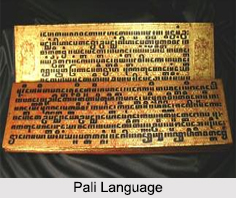
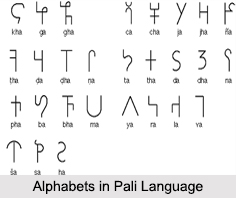
Pali essentially serves as a written language, though it possesses no special script to call its own. Although trade-links were developed first, Buddhist monks and royal envoys throughout the region further bettered its use. Pali was also the lingua franca of the Buddhist countries of south and south-east Asia for well over a thousand years. Each country subsequently developed its own Pali literature and chronicles.

Pali language is almost always enlivened with its qualities of being booming, rhythmical, mellifluous and pleasing to the ear, especially when chanted by monks. The underlying personality of Buddha comes to light clearly in the Tripitaka of Pali language.

The word Pali as an individual connotes "line" or "(canonical) text" and this name for the language is accepted to bear its origins in commentarial traditions, in which the word "Pali" was differentiated from the commentary or the vernacular pursuing it on the manuscript page. As a result, the name of the language had given rise to debates and disputations among scholars of all ages; the spelling of the name also lies in variance to this date. Still to this day, there lies no single standard spelling of the term; all four spellings are to be noticed in texts. Pali belongs to the Prakrit language family as a literary language. When the canonical texts were penned down in Sri Lanka during first century B.C.E., Pali stood close to being called a `living language`; this is however not the case when the commentaries are concerned. Despite exceptional research and investigation on this problem, confusion still prevails with regard to the inter-relation of Pali to the lingo spoken in the ancient kingdom of Magadha.
Pali as a Middle Indo-Aryan language lies in variance with Sanskrit and this is not so much with reference to the time of its origin as to its dialectical origin. This is so because a number of its morphological and lexical features lead the fact that it is not a direct continuation of Rigvedic Sanskrit towards a reverse direction; on the other hand, it is stressed that Pali language has descended from a dialect (or a number of dialects) which were, regardless of many similarities, dissimilar from Rigvedic.

Pali language was deemed by early Buddhists to bear linguistic similarity with Old Magadhi or even a direct extension of that language. Many Theravadin sources in fact interpret the Pali language as "Magadhan" or the "language of Magadha." This seems to further generate trouble, as the later form of Magadhi in Ashokan inscriptions (3rd century B.C.) is in Eastern Indian language, while Pali most closely corresponds to Western Indian inscriptions. Ancient Magadha is although also believed to have been located in West of ancient India. There exists numerous extraordinary likenesses between Pali and Ardhamagadhi (Half Magadhi), an old form of Magadhi preserved in ancient Jain texts. Ardhamagadhi stands in difference from the eastern Prakrit of Ashokan inscriptions on just the identical points as does Pali. For instance, Ardhamagadhi too does not alter r into l and in the noun modulation it demonstrates the ending -o in place of the eastern Prakritic -e in many metrical places. This similarity is not merely an accident of nature, as Mahavira, the 24th Tirthankara of Jainism had preached in the same area (Magadha) as did Gautama Buddha.

Whatever the relationship of Buddha`s verbalisation was with the Pali language, the Pali Canon was eventually transliterated and conserved wholly in it, whereas the commentarial tradition that went with it (according to the information provided by Buddhaghosa, a 5th-century Theravadin Buddhist commentator and scholar) was translated into Sinhalese and conserved in local languages for several generations. However Pali language was ultimately absolutely replaced in India by Sanskrit as a literary and religious language following the conceptualisation of Classical Sanskrit by the tremendous scholar Panini.

In present times, Pali language is studied primarily to smoothly grasp and assimilate Buddhist scriptures and is recurrently chanted during times of ritualistic contexts. The secular literature of Pali historic chronicles, medical texts and inscriptions, is also of immense historical significance. The great centres of Pali learning are present in the Theravada nations of South-East Asia, comprising Myanmar (also popular as Burma), Sri Lanka, Thailand, Laos and Cambodia. From the 19th century, numerous social orders for the revivification of Pali studies in India have boosted awareness of the language and its literature, perhaps most conspicuously the Maha Bodhi Society established by Anagarika Dhammapala.

The Pali language lexicon and glossary, just like any other ancient Indian language is filled with complex and meticulous structures, the elaboration of which is subjected to modern scientific researches recurrently. Nearly every word in Pali possesses a cousin equivalent in the other Prakritic "Middle Indo-Aryan languages", like in the Jain Prakrits. The relationship with earlier Sanskrit (e.g. Vedic language) is comparatively less direct and much more elusive. Historically, a magnetic pull between Pali and Sanskrit has been felt from mutual directions. Pali language`s semblance with Sanskrit is often overstated by comparing it to later Sanskrit pieces, which were penned centuries after Sanskrit discontinued to be a `living language`. On the other hand, they were heavily influenced by developments in Middle Indic, including the direct loaning of a portion of the Middle Indic lexicon. Then again, a reasonable amount of later Pali technical terminology has been loaned from the vocabulary of corresponding fields in Sanskrit, both directly and with certain phonological adaptations.

Post-canonical Pali language also possesses a few loan-words from local languages where Pali was made use of (for instance in Sri Lankans adding Sinhalese words to Pali). These usages tell apart the Pali found in the Suttapitaka from later compositions like the Pali commentaries on the canon and folklore (stories of the Jataka commentaries) and comparative study. Geological dating of such texts on the basis of such loan-words is now a specialised field by its own right. Pali language was not exclusively made use to transmit the teachings of Buddha, as can be derived from the existence of a number of secular texts, like books of medical science/instruction, in Pali. However, academic interest in the language has been concentered upon religious and philosophical literature, because of the inimitable scope it opens up on one phase in the development of Buddhism.

Although Sanskrit was believed in Brahmanical tradition, to be the ageless language mouthed by the gods, in which every word had an underlying significance, this was not the view of language during early Buddhist tradition. Buddhists regarded usage of words to be just conventional and changeable according to symbols. Neither Gautama Buddha nor his early followers shared the brahmans` veneration for the Vedic language or its sanctified texts. This view of language naturally had reached as far as Pali, which just might have contributed to its usage (as an approximation or calibration of local Middle Indic dialects) instead of Sanskrit. However, by the time of the compilation of the Pali commentaries (4th or 5th century), the language was regarded as the natural language, the root language of every being.

Just like in Ancient Egyptian, Latin or Hebrew in the occult traditions of the West, Pali language recitations were often conceived to possess an innate supernatural power (which could be ascribed with regard to their meaning, the lineament of the reciter, or calibres of the language itself). In the early layers of Buddhist literature it was already witnessed that Pali dharanis were employed as charms, such as against snake bites. Many people from Theravada cultures still are of the faith that taking a vow in Pali bears a special significance.

Vowels in Pali Language
Long and short vowels stand in huge disparity in open syllables for Pali language. On the other hand, all vowels are always short in case of closed syllables. Short and long e and o have been established in complementary distribution: the short variants arise only in closed syllables, while the long versions arise only in open syllables. Short and long e and o are hence not the so-called `clear-cut phonemes`.
A sound by the name anusvara (refers to as nigghahita in both Pali and Sanskrit languages), symbolised by the letter m in romanisation and by an erect dot in most traditional alphabets, originally distinguished the fact that the previous vowel was nasalised in tone. To be precise, am, im and um were of the habit to exemplify ã, ? and ? respectively. In umpteen traditional pronunciations, although, the anusvara is enunciated more forcefully, like the velar nasal ? , so that these sounds are pronounced as ã? , ?? and ?? instead. In whichever way they are pronounced, m is never followed by a long vowel. ?, ? and ? are transformed into the subsequent short vowels when m is appended to a stem culminating in a long vowel, e.g. kath? + m becomes katham, dev? + m becomes devim.

Morphology in Pali Language
Pali is an exceedingly inflected language, wherein almost every word contains, besides the root expressing the central meaning, one or more affixes (normally suffixes) which amend and transform the meaning in some way. Nouns are inflected for gender, number, and case; verbal inflections communicate further understanding related to a person, number, tense or mood.

Nouns in Pali language inflect for the basic three grammatical genders (masculine, feminine, neuter) and two numbers (singular and plural). The nouns also, in principle, demonstrate eight cases: nominative or paccatta case, vocative, accusative or upayoga case, instrumental or karana case, dative or sampadana case, ablative, genitive or samin case, and locative or bhumma case. However, in several illustrations, two or more of these cases are identical in form; this is particularly the case with the genitive and dative cases.

Pali writing
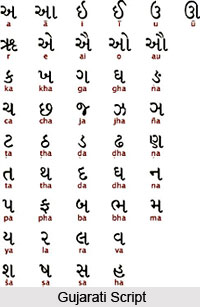
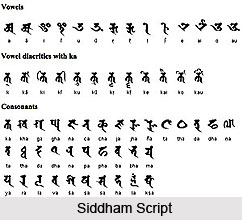
Writings utilising Pali language can be witnessed amongst various ancient royals, dedicated to spreading knowledge about ancient languages in India for later generations to come. During the rule of Emperor Ashoka, he had ramped up a pillar in Lumbini (presently in Nepal) with his edict in Pali in Brahmi script. Historically, the first written record of the Pali Canon is known to have been compiled in Sri Lanka, based on a prior an earlier oral tradition. According to the Mahavamsa (the chronicle of Sri Lanka), due to a ground-breaking famine in the country, Buddhist monks had actually penned down the Pali canon during the time of King Vattagamini in 100 B.C. The transmittance of written Pali has held back a universal system of alphabetic values, but has conveyed those values in a rather unique variety of actual scripts. Since the 19th Century, Pali has also been successfully penned in the Roman script.

(Last Updated on : 23/09/2009)
  More on Indo Aryan languages...
 
Pali Language Prakrit Language  
Recently Updated Articles in Indian Languages
  • Indian Tribal Languages
    Indian tribal languages have no legend of their own and spoken by people of ethnic groups from remote areas.
  •  
  • Kumaoni Language
    Kumaoni Language, generally spoken in Uttarakhand, is classified as one of the Pahari languages in India.
  •  
  • Indian Spoken Languages
    Indian spoken languages emote exceeding differentiation and diversification in terms of number and count.
  •  
  • Mahavanso
    Mahavanso is the historical poem written in the Pali language.
  •  
  • Anubhavamrita
    Anubhavamrita is a vairagya treatise, which is available only in the Dravidian languages.
E-mail this Article | Post a Comment
Free E-magazine
Subscribe to Free
E-Magazine on Indian Languages

 
Pali Language Sitemap
Contact Us   |   RSS Feeds
Copyright © 2008 Jupiter Infomedia Pvt. Ltd. All rights reserved including the right to reproduce the contents in whole or in part in any form or medium without the express written permission of Jupiter Infomedia Pvt. Ltd.