 Padmapurana is said to be a huge manuscript and one of the major eighteen Puranas. In the first part of the book sage Pulastya explains to Bhishma about religion and the essence of the religion. The second division describes in detail Prithvi or the earth. In the third part it explains the cosmos and the description is given, including creation and description of Bharat Mata. The fourth part signifies the life and deeds of Rama. The fifth part is in the style of a dialogue between Shiva and his consort, Parvati, and deals with the essential knowledge about religion.
Padmapurana is a book with fifty-five thousand slokas. All the slokas are divided into five books or Khandas. They are the Srishti Khanda or section on Creation; Bhumi Khanda or a description of the Earth; Svarga Khanda or a chapter on Heaven; Patala Khanda, a chapter on the regions below the earth and Uttara Khanda, the last or supplementary chapter. There is also current a sixth division, the Kriya Yoga Sara, a treatise on the practice of devotion.
Padmapurana is said to be a huge manuscript and one of the major eighteen Puranas. In the first part of the book sage Pulastya explains to Bhishma about religion and the essence of the religion. The second division describes in detail Prithvi or the earth. In the third part it explains the cosmos and the description is given, including creation and description of Bharat Mata. The fourth part signifies the life and deeds of Rama. The fifth part is in the style of a dialogue between Shiva and his consort, Parvati, and deals with the essential knowledge about religion.
Padmapurana is a book with fifty-five thousand slokas. All the slokas are divided into five books or Khandas. They are the Srishti Khanda or section on Creation; Bhumi Khanda or a description of the Earth; Svarga Khanda or a chapter on Heaven; Patala Khanda, a chapter on the regions below the earth and Uttara Khanda, the last or supplementary chapter. There is also current a sixth division, the Kriya Yoga Sara, a treatise on the practice of devotion.
The denominations of these divisions of the Padmapurana expresses but an imperfect and partial notion of their contents. In the first section, which treats of creation, the narrator is Ugrasravas the Suta, the son of Lomaharshana, who is sent by his father to the Rishis at Naimisharanya to communicate to them the Purana. In the lotus Brahma appeared at creation, is termed the Padma or Padma Purana. The Suta repeats what was originally communicated by Brahma to Pulastya, and by him Bhishma. The early chapters relates the cosmogony, and the genealogy of the patriarchal families, much in the same style, and often in the same words, as the Vishnu; and short accounts of the Manwantara and regal dynasties: but these, which are legitimate Puranic matters, soon make way for new and unauthentic inventions, illustrative of the virtues of the lake of Pushkara, or Pokher in Ajmir, as a place of pilgrimage.
The Bhumi Khanda, or section of the earth, defers any description of the earth until near its close, filling up one hundred and twenty-seven chapters with legends of a very mixed description, some ancient and common to other Puranas. The greater part peculiar to itself, illustrative of Tirthas, either figuratively so termed as a wife, a parent, or a guru, considered as a sacred object or places to which actual pilgrimage should be performed.
The Swarga Khanda contains details of the sequence of creation of the cosmos. In the first chapters the relative positions of the Lokas or spheres above the earth is placed above all Vaikuntha, the bubble of Vishnu. Various notices of some of the most celebrated princes then succeed, conformably to the usual narratives. Further these are followed by rules of conduct for the several castes, and at different stages of life. The rest of the book is occupied by legends of a diversified description, introduced without much method or contrivance. A few of which, as Daksha`s sacrifice, are of ancient date, but of which the most are original and modern.
The Patala Khanda or the Book of the Underworld narrates the life story of Rama, an avatar of Vishnu, to an assembly of sages. There are also sections devoted to the life and deeds of Lord Krishna. An originality of addition may be suspected, however, in the adventures of the horse destined by Rama for an Asvamedha, which form the subject of a great many chapters. When about to be sacrificed, the horse turns out to be a Brahman, condemned by an imprecation of Durvasa, a sage, to assume the equine nature, and who, by having been sanctified by connation with Rama, is released from his metamorphosis, and dispatched as a spirit of light to heaven. This section of Vaishnava fiction is followed by praises of the Bhagavata, an account of Krishna`s juvenilities, and the merits of worshipping shipping Vishnu. These accounts are communicated through machinery borrowed from the Tantras. They are told by Sadaavato Parvati, the ordinary interlocutors of Tantrika compositions.
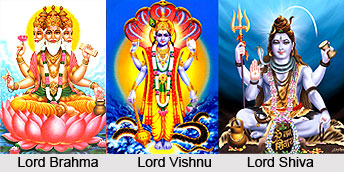
The Uttara Khanda is a most huge aggregation of very heterogeneous matters. The Uttara Khanda presents the metaphysical aspects of religion in the form of a dialogue between Shiva and Parvati. The chief subjects are first discussed in a dialogue between king Dilipa and the Muni Vasishtha. They were the merits of bathing in the month of Magha, and the potency of the Mantra or prayer addressed to Lakshmi Narayana. But the nature of Bhakti, faith in Vishnu the use of Vaishnava marks on the body the legends of Vishnu`s Avataras, and especially of Rama and the construction of images of Vishnu. All of them are explained by Shiva to Parvati, and wound up by the adoration of Vishnu by those divinities. The dialogue then reverts to the king and the sage and the latter states why Vishnu is the only one of the triad entitled to respect. Shiva is described as being profligate, Brahma, arrogant, and Vishnu alone pure. Vasishtha then repeats, after Shiva, the Mahatmya of the Bhagavata Gita; the merit of each book of which is illustrated by legends of the good consequences to individuals from perusing or hearing it. Other Vaishnava Mahatmyas occupy considerable portions of this Khanda, especially the Kartika Mahatmya, or holiness of the month Kartika, illustrated as usual by stories, a few of which are of an early origin, but the greater part modern, and peculiar to this Purana
The Kriya Yoga Sara is repeated by Suta to the Rishis, after Vyasa`s communication of it to Jaimini, in answer to an inquiry how religious merit might be secured in the Kali age. In the Kali age in which men have become incapable of the penances and abstraction by which final liberation was formerly to be attained. The answer is, of course, that which is intimated in the last book of the Vishnu Purana personal devotion to Vishnu thinking of him, repeating his names, wearing his marks, worshipping in his temples, are a full substitute for all other acts of moral or devotional or contemplative merit.
The Patala Khanda dwells profusely upon the Bhagavata, and is consequently posterior to it. The Uttara Khanda is intolerantly Vaishnava, and is therefore unquestionably modern. It enjoins the veneration of the Salagram stone and Tulasi plant, the use of the Tapta-mudra, or stamping with a hot iron the name of Vishnu on the skin, and a variety of practices and observances undoubtedly no part of the original system. It speaks of the shrines of Sri-rangam and Vankatadri in the Dekhin, temples that have no pretension to remote antiquity; and it names Haripur on the Tungabhadra, which is in all likelihood the city of Vijayanagar, founded in the middle of the fourteenth century. The Kriya Yoga Sara is equally a modern, and apparently a Bengali composition. No portion of the Padma Purana is probably older than the twelfth century, and the last parts may be as recent as the fifteenth or sixteenth.