 Mukhachhadanam or masks not only protect but also transform, disguises, and enhance the face. This was born of mankind`s myth-creating faculty that transposes experiences from the subconscious into images. It seems probable that deep in the prehistoric past each primitive society developed its own Mask to minimise the feeling of helplessness and exposure to the forces of nature. Their myth-making imagination suggested that the good forces that help in sustaining life are gods, and the evil forces that destroy life are demons or evil spirits. They devised rituals, which are but enactments of myths, to please the gods and appease the evil spirits. From myth and ritual, therefore, were born many idols, images, and icons.
Mukhachhadanam or masks are a special kind of icon. If theatre is defined as the enactment of a series of situations through assumption of one or more characters, the person who shaped the first mask unknowingly gave birth simultaneously to theatre. Masked rituals are but a kind of theatre and to distinguish them from other kinds, epithets like "religious" or "bizarre" are used. But it is now generally accepted that theatre began as ritual and aesthetic considerations came later. Many Indian theatre traditions still have ritualistic overtones and some of them decorate the actor`s face either with Mukhachhadanam or mask like make-up. Masks are generally used in three ways. When the wearer totally identifies with the mask, its magic power seizes him and what he performs is more or less a ritual, sometimes classed as possession. Here the mukhachhadanam serves the purpose of an instrument to re-enact some elemental experience by projecting and reflecting supernatural powers. But when the wearer realises that by putting on the mask he has only changed his outward appearance and not his true self, ritual gives way to human drama.
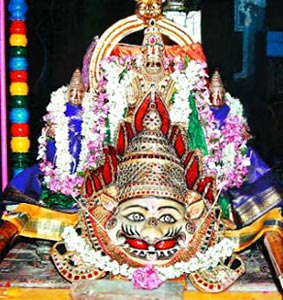
The mukhachhadanam is then a means of treating the actor`s face. Of course, when the mask is stripped of its symbolic character and used as a protective covering, such as the mask worn by astronauts and surgeons, the purpose is entirely utilitarian. In India, masks have been used for centuries either as ritual objects or to cover actors` faces and, sometimes, for both purposes. In such a traditional form as Prahlada Nataka, the mask of Narasimha, that is Lord Vishnu`s fourth avatar, is worshipped in a temple when it is not donned by the actor in a performance. When used in a ritual, the mask is considered as an antenna of some supernatural power. The wearer experiences the force flowing through the mask to his body to possess it. A kind of double metamorphosis takes place in this case. The mukhachhadanam psychologically elevates him to influence the supernatural power to which he appeals and at the same time permits the power to transfigure him. He then acquires psychic substance from the power and passes this on to the passive participants of the ritual. The magic spell is not limited to the wearer of the mask. All participants in the ceremony feel the presence of the supernatural power summoned by the magic force of the mask.
Most Indian mask rituals are dances. Quite a few tribal communities, such as the Sherdukpens and Monpas living in the north-east, perform ritual mask dances. Especially this happened in a festival called Torgyap. It is believed that the performance of these dances drives away evil spirits and ensures prosperity, good harvest, and favourable weather throughout the year. Ritualistic masked dances are also performed by lamas of Himalayan monasteries in Ladakh, Jammu and Kashmir, Kinnaur District and Dharamsala in Himachal Pradesh, and Sikkim. Their themes centre on the legend of Lord Buddha and depict his victory over evil to attain enlightenment. Among mask dances that give their audience entertainment as well, some styles of Chhau deserve mention because they have pronounced theatrical elements.
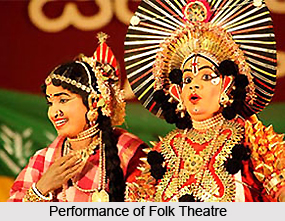
Many traditional theatre forms employ masks. Very few, such as Sahi Yatra of Orissa, mask all the dramatic characters. Most mask only some characters, such as Krishnattam, Ramlila, Ankiya Nat, Bhagavata Mela, Terukkuttu, Desia Nata. In the repertoire of Bandi Pethir, only the play named Shikarga features several characters that wear masks. Another variety, the pliant mask, comprises highly stylised make-up that gives the face a mask-like appearance. Its theatrical function is the same. This is a device for imparting impersonality to an actor so that the spectator is discouraged from identifying with the character in favour of a more intense dramatic experience. Some major forms utilising this kind of mask are Kutiyattam and Kuttu , Kathakali, Teyyam, Mutiyettu, Patayani, and Yakshagana.
Mukhachhadanam
Mukhachhadanam or mask is something that covers the face and has always been a way of defying human vulnerability. Mukhachhadanam or mask has ever been the unfailing companion of the face as its mysterious double the alter ego.