


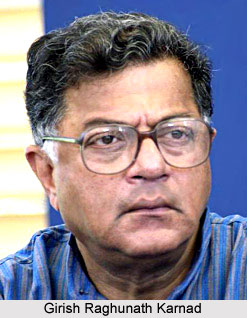
 Girish Raghunath Karnad is a prominent Kannada playwright, actor, film director and dramatist in other languages too. He was born in Matheran, near Mumbai in the year 1938. He did his education at Sirsi in Uttar Kannada district and Dharwad in western Karnataka. Later he studied in Oxford where he went as a Rhodes Scholar, during 1960-3. He found his interest shifting from science to literature. Although initially he had ambitions of becoming a poet in English, he later discovered his real aptitude for drama. On returning to India, he worked at the Madras branch of Oxford University Press till 1970, a period when he acted and directed English theatre in India for the Madras Players. In his younger days, Karnad saw that Indian cities like Chennai, Mumbai, Delhi, and Kolkata welcomed British troupes offering performances of Western plays. He also discovered that Parsi theatre, with its gorgeous scenes, heavy doses of music, drop curtains, and proscenium stage, had a great influence on the regional professional form called Company Nataka but was rather antique in its mode of presentation. Karnad, therefore, thought of presenting truly Indian themes in a modernist style, by borrowing relevant aspects from Western theatre as well as Sanskrit theatre and folk theatre in Karnataka. When Indian amateur drama was at its lowest ebb, especially in Karnataka, he gave a new fillip to Kannada theatre, as well as to national theatre through translations of his plays in Indian languages including English. Girish Raghunath Karnad is a prominent Kannada playwright, actor, film director and dramatist in other languages too. He was born in Matheran, near Mumbai in the year 1938. He did his education at Sirsi in Uttar Kannada district and Dharwad in western Karnataka. Later he studied in Oxford where he went as a Rhodes Scholar, during 1960-3. He found his interest shifting from science to literature. Although initially he had ambitions of becoming a poet in English, he later discovered his real aptitude for drama. On returning to India, he worked at the Madras branch of Oxford University Press till 1970, a period when he acted and directed English theatre in India for the Madras Players. In his younger days, Karnad saw that Indian cities like Chennai, Mumbai, Delhi, and Kolkata welcomed British troupes offering performances of Western plays. He also discovered that Parsi theatre, with its gorgeous scenes, heavy doses of music, drop curtains, and proscenium stage, had a great influence on the regional professional form called Company Nataka but was rather antique in its mode of presentation. Karnad, therefore, thought of presenting truly Indian themes in a modernist style, by borrowing relevant aspects from Western theatre as well as Sanskrit theatre and folk theatre in Karnataka. When Indian amateur drama was at its lowest ebb, especially in Karnataka, he gave a new fillip to Kannada theatre, as well as to national theatre through translations of his plays in Indian languages including English.
Girish Karnad made his playwriting debut with Yayati in 1961. This play was about reworking this Mahabharata legend about responsibility. Tughlaq in 1964 was inspired by Albert Camus's Caligula, shot to fame as it made history contemporaneous by reading the dilemmas of Prime Minister Jawaharlal Nehru's period into Tughlaq's rule in 1325-51. Hayavadana in 1971 took its leitmotif from an ancient tale in the Sanskrit language -Vetalapancavimsatika retold by Thomas Mann in The Transposed Heads. This was of the dichotomy between mind and body, and the problem of completeness, using folk elements such as masks and the supernatural. Anjumallige i.e. 'Fearing Jasmine' in 1977, recalling Edward Albee's 'Who's Afraid of Virginia Wool', has a foreign setting and deals with incest. Hittina hunja i.e. 'Dough-Cock' in 1982 describes Queen Amrutamatis sexual attraction for an ugly mahout, the theme borrowed from Janna's Yasodhara charite, a Jain poem. In Naga-mandala in 1988, Karnad gave a Freudian interpretation to a folk tale about a woman's love for a cobra that impersonates her husband. Tale-danda in 1990 demythologizes the life of Basaveswara, the poet, mystic, and social revolutionary of twelfth-century Karnataka. Agni mattu male i.e. 'The Fire and the Rain' in 1994 depicts the story of Yavakrita in the Ramayana. Girish Karnad made his name as a lead actor in Kannada art films like Samskara i.e. 'Funeral Rites' in 1970 and Vamsha vriksha i.e. 'Family Tree'. The latter one he co-directed in 1971. He did stage productions of Sophocles's Oedipus and Kambar's Jokumaraswami in 1972, and Hindi movies like Shyam Benegal's Nishant i.e. 'Night's End' in 1975 and Manthan i.e. 'Churning' in 1976. He also acted in Basu Chatterjee's Swami i.e. 'Husband' in 1977, and Jabbar Patel's Subah i.e. 'Dawn' in 1981. In cinema, he played ordinary but educated, idealistic, progressive men, rarely negative roles as in Kumar Shahani's Tarang i.e. 'Wave' in 1984. He scripted and directed the critically acclaimed Kannada films Kadu in 1973 and Ondanondu kaladalli i.e. 'Once upon a Time' in 1978. This was based on martial arts. Some of the other films can be mentioned as Hindi features Utsav i.e. 'Festival' in 1984, based on Sudraka's Mricchakatika and Bhasa's Daridra-Carudatta and Cheluvi in 1992. A much-lauded public figure, Karnad served the Film and Television Institute of India, Pune, as its Director during 1974-5 and the Sangeet Natak Akademi as its chairman during 1988-93. Since he translates his plays into English, critics sometimes treat him as a dramatist in English. Commissioned by BBC Radio, he wrote his first original script in English, The Dreams of Tipu Sultan in 1997, presenting the gap between Tipu's dreams of liberty and the reality of colonial bondage, against the historical events of 1799. He reworked it into Kannada in 1999. Awards and Honours Received by Girish Karnad For literature * Sangeet Natak Akademi award - 1972 * Padma Shri - 1974 * Padma Bhushan - 1992 * Kannada Sahitya Academy award - 1992 * Sahitya Academy award - 1994 * Jnanpith Award - 1998 * Kalidas Samman - 1998 * Rajyotsava Award * D. Litt., Karnatak University - 1994 * Honorary Doctorate, University of Southern California, Los Angeles - 2011 Films National Film Awards * 1970: Best Film (Golden Lotus): Samskara Kannada * 1972: Best Direction: Vamsha Vriksha (with B.V. Karanth) * 1974: Second Best Feature Film: Kaadu * 1978: Best Screenplay: Bhumika (with Shyam Benegal and Satyadev Dubey) * 1978: Best Feature Film in Kannada: Ondanondu Kaladalli * 1989: Best Non-Feature Film: Kanaka Purandara * 1990: Best Non-feature Film on Social Issues: The Lamp in the Niche * 1993: Best Film on Environment Conservation: Cheluvi * 2000: Best Feature Film in Kannada: Kaanuru Heggadathi Filmfare Awards * 1980: Filmfare Best Screenplay Award: Godhuli (with B.V. Karanth) * 1980: Filmfare Best Supporting Actor Award: Aasha: Nominated * 1982: Filmfare Best Supporting Actor Award: Teri Kasam: Nominated Others * Karnataka State Award for the Best Supporting Actor in "Santa Shishunala Shareef"- 1991 * Mysore State Award for Best Kannada film and the Best Direction for VamshaVruksha- 1972 * Gubbi Veeranna Award * Honorary Doctorate from University of Southern California, Los Angeles - 2011 He also served as the director of the Film and Television Institute of India from 1974-1975, the Indian co-chairman for the Joint Media Committee of the Indo-US Sub-Commission on Education and Culture from 1984-1993, chairman of the Sangeet Nataka Academy from 1988-1993, and president of Karnataka Nataka Academy from 1976-1978. |
| |||



Home > Movies & Entertainment > Indian Drama & Theatre > Personalities in Indian Theatre > Theatre Personalities of Karnataka > Girish Raghunath Karnad
Girish Raghunath Karnad
| Girish Raghunath Karnad is a well-known actor-playwright, scenarist, film director, and actor.Girish Raghunath Karnad is a well-known actor-playwright, dramatist, film director and actor. |
| ||||||||||||||||||||||||||||

