





|
In this rocky terrain of dense forest and craggy cliffs, over 600 rock shelters belonging to the Neolithic age were recently unearthed. Here, in an intense breathtaking detail, the paintings in over 500 caves depict the life of the pre-historic cave dwellers. This great historical unfolding now makes Bhimbetka an archaeological treasure, a priceless chronicle in the history of mankind and also a world heritage site as reported by UNESCO. 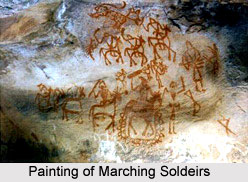 The paintings are done mostly in red and white colour. However, the occasional use of green and yellow is also done. The themes were taken from their daily events, The paintings usually depicted hunting, dancing, music, horse and elephant riders, animals fighting, honey collection, decoration of bodies, disguises, masking and household scenes. Animals such as bisons, tigers, lions, wild boar, elephants, deer, antelopes, dogs, monkeys, lizards, crocodiles etc. have been abundantly depicted. In some caves, popular religious and ritual symbols also occur frequently. The paintings are done mostly in red and white colour. However, the occasional use of green and yellow is also done. The themes were taken from their daily events, The paintings usually depicted hunting, dancing, music, horse and elephant riders, animals fighting, honey collection, decoration of bodies, disguises, masking and household scenes. Animals such as bisons, tigers, lions, wild boar, elephants, deer, antelopes, dogs, monkeys, lizards, crocodiles etc. have been abundantly depicted. In some caves, popular religious and ritual symbols also occur frequently.
Over these caves the Stone Age artists were expressive enough to paint their optimisms and anxieties, which was an enchantment that still enthrall us. These specimen, display great vitality and narrative skill. One sees on the weather worn walls, rhinoceros, elephants, horses, as well as domestic animals. There are scenes of domestic bliss-a women with a child or performing household chores, and documentation of a hunt, raid during warfare. Site & Architecture The paintings show that a single canvas was used by various people and at different times. The drawings and paintings can be classified under seven different periods: Period I - (Upper Paleolithic): These are direct representations, in green and dark red colour depicting huge figures like bisons, tigers and rhinoceros. 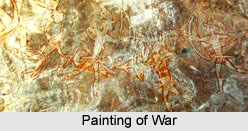 Period II - (Mesolithic): The embellished figures are comparatively small in size and they show linear decoration of the body. Apart from the animals, there are also human figures and hunting scenes, which reveal the weapons they used - barbed spears, pointed sticks, bow and arrows. The depiction of communal dances, birds, musical instruments, mother and child, pregnant women, men carrying dead animals, drinking and burials too appear in rhythmic movement. Period II - (Mesolithic): The embellished figures are comparatively small in size and they show linear decoration of the body. Apart from the animals, there are also human figures and hunting scenes, which reveal the weapons they used - barbed spears, pointed sticks, bow and arrows. The depiction of communal dances, birds, musical instruments, mother and child, pregnant women, men carrying dead animals, drinking and burials too appear in rhythmic movement.
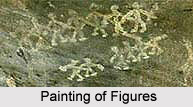 Period III - (Chaleolithic): These paintings are similar to the pottery of the same age. These drawings reveal that during the period, the cave dwellers of this area had come in contact with the agricultural communities of the Malwa plains and started an exchange of their requirements with each other. Period III - (Chaleolithic): These paintings are similar to the pottery of the same age. These drawings reveal that during the period, the cave dwellers of this area had come in contact with the agricultural communities of the Malwa plains and started an exchange of their requirements with each other.
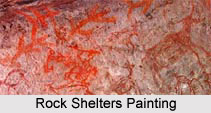 Period IV & V - (Early History): In this group the figures have a schematic and decorative style, and are painted mainly in red, white and yellow. The association is of riders, depiction of religious symbols, tunic-like dresses and the existence of scripts of different periods. The religious beliefs are represented by the figures of the gods and evil forces. Period IV & V - (Early History): In this group the figures have a schematic and decorative style, and are painted mainly in red, white and yellow. The association is of riders, depiction of religious symbols, tunic-like dresses and the existence of scripts of different periods. The religious beliefs are represented by the figures of the gods and evil forces.
Period VI & VII - (Medieval): These paintings are geometric, linear and more planned ones, but show degradation and are naïve in their artistic style. |
| ||||||||||||||||||||||||||||

