


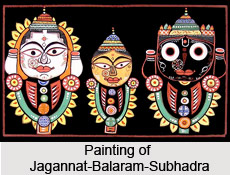
 Puri paintings are paintings done on cloth to which a plaster of cow-dung is first applied to impart stiffness to the cloth so that the paintings would appear attractive. The Puri paintings are described as 'very rude oil paintings'. The paintings are done by the hereditary sub caste of chitrakars or professional artists of Orissa. These paintings are sold to the pilgrims who carry them as mementoes of Lord Jagannatha. Great skill is depicted in the pictures of Jagannath sold at Puri. Puri paintings are paintings done on cloth to which a plaster of cow-dung is first applied to impart stiffness to the cloth so that the paintings would appear attractive. The Puri paintings are described as 'very rude oil paintings'. The paintings are done by the hereditary sub caste of chitrakars or professional artists of Orissa. These paintings are sold to the pilgrims who carry them as mementoes of Lord Jagannatha. Great skill is depicted in the pictures of Jagannath sold at Puri.
The painters take a long piece of cloth on which they lay a paste of black earth, or black earth and mix cow dung. When it is dry, a coating of lac is put upon it. Thus stiffness is acquired and the absorbent quality of the cloth is destroyed. Paint is then applied on this cloth and the figures and accessories depicting Lord Jagannath are represented by a symbolical figure without hands or feet. The painters used colors as rich Indian red, dull blues, soft greens and rich yellow and depicted the Jagannatha trio in a variety of roles. The two subjects that dominated Puri Paintings are: 1. Puri temple shown with the center shrine imbedded in a tapering tower and with subsidiary features included and with them is a row of the ten incarnations of Vishnu with Jagannatha replacing Buddha. There are murals depicting the milkmaid Manika and Rama's struggle with Ravana, Brahma and Shiva revering the trio, Shavian shrines with lingams and yonis, parts of the temple complex such as the cook-house and bathing tank and the apparatus of festivals such as the Chandana Jatra boat and the Rath Jatra temple-cars. Such pictures are characterized by diagrammatic boldness, an over-all air of neat and tidy balance and by brilliant colors, which convey a sense of gaiety and sun-drenched splendor. The maximum amount of 'guidebook' information is imparted and, even when details are treated with 'shorthand' slickness. 2. The second main subject is the Jagannatha trio (Balbhadra, Subhadra and Jagannatha himself) staring boldly in primitive vigor. The painter portrays them accurately and in all liveliness. In the paintings we notice that apart from 'heads', which contained eyes, nose and mouth, the original images had no clear torsos, thighs, legs and feet. They possessed no 'normal' arms and hands but had two strange projections ending in blunt stumps. Even the 'heads' were weirdly distorted of those of Jagannatha and Balabhadra. They are painted abnormally large and either over-round or over-angular. All these idiosyncrasies of form had to be interpreted. The human or super-human character of the three prime images must be vividly suggested. It must be noted that from the early nineteenth century onwards, the painters made no attempt to show the 'arms' projecting forwards; on the contrary they were depicted as if upraised. But these disfigured characters were preserved and were shown as protuberances rising like incomplete horseshoes around the faces or sprouting like wings from before or behind the shoulders. These devices undoubtedly expressed part of the mysterious appearance of the powerful trio. Two experiments were made to render the deities a realistic form. In some cases peg-like tops were given to the 'arms', thereby suggesting, to a slight extent, the presence of hands. In other cases the arms were treated as meaningless appendages and additional 'true' arms, anatomically positioned vis-a-vis the torse were added beneath them. Simultaneously, the log-like posts which had served to indicate the rest of the body were given a more human appearance. Legs were separated out, torsos received waists, feet were added and the two main figure shown dressed as princes in sleeved coats and trousers. None of these experiments were wholly successful and in the twentieth century painters tended to revert to the early more geometric treatment, sensing that an element of vital geometry was necessary for expressing forceful character to the trio. More recently, Jagannatha's identity with Krishna has been re-emphasized by pictures celebrating Krishna's life among the cowherds and his supreme romance with Radha and the maids. There are also pictures depicting male members riding on horses and encountering a milkmaid who stands before them, which refers to an incident which is said to have involved the Raja Purushottama Deva of Orissa was despised by the Raja of Conjeeveram whose daughter, Padmavati, he desired to marry. He was defeated in his attempt to win his ladylove and on his way back entreated Lord Jagannatha to aid him. Jagannatha instructed him to move on to Conjeeveram once more. The Orissan raja obeyed but finding no sign of Jaganatha he was about to abandon the place, when a milkmaid appeared before him and gave him a ring saying that it was given to her by two horsemen, one on a black horse and the other on a white horse. 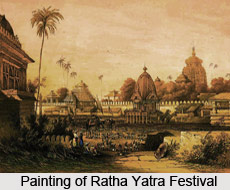 The Raja at once believed that it was Lord Jagannatha and Balabhadra and he continued his way to Conjeeveram, defeated his rivals and brought Padmavati to his capital. The Raja at once believed that it was Lord Jagannatha and Balabhadra and he continued his way to Conjeeveram, defeated his rivals and brought Padmavati to his capital.
There are other paintings depicting the pictures of Rath Jatra or a car festival. The three gods(Balbhadra, Subhadra and Jagannatha) were depicted in a single car preceded by various animals and mythical beings - an elephant, a lion, a bull, the golden deer (Maricha) and Rama's monkey ally, Hanuman. The Chandana Jatra is depicted showing a flute-playing Krishna and four lingams in boats. There are paintings depicting Jagannatha's identity and also other paintings showing him up a tree with nude milkmaids standing below and in another painting he is seen killing the crane demon Bakasura. Finally, in another picture, all three members of the trio are shown on pipal leaves floating on the cosmic ocean of Vishnu. Pictures of this category were not produced for long after 1800. |
| |||



Puri Paintings
| Puri paintings are paintings done on cloth to which a plaster of cow-dung is first applied to make the cloth stiff. |
| ||||||||||||||||||||||||||||

