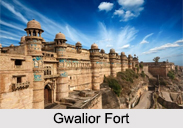
 Gwalior Fort is one of the most unconquerable forts in India, located in Gwalior, Madhya Pradesh. This fort has witnessed many battles in the turbulent times as well as festivals in the peacetime. The Mughal emperor Babur denoted the Gwalior Fort as "the pearl amongst fortresses in India". Since then, the fort had been controlled by different rulers in different times - the Tomars, Mughals, Marathas and lastly British, who finally handed it over to the Scindias (Marathas).
Etymology of Gwalior Fort
The name Gwalior has been derived from the name Gwalipa, who was a saint.
History of the Gwalior Fort
The exact construction time of this fort is still uncertain. It has been heard from some local people that the fort was first built by the local ruler Suraj Sen in 3 CE. Saint Gwalipa saved him from leprosy by offering water from a sacred pond, which still exists in the fort. So Suraj Sen named the fort after the saint Gwalipa.
Mostly, the existence of this fort traces back to the 10th century, but the inscriptions and monuments in it say that it might have existed since the beginning of the 6th century. The Kachchhapaghatas captured the fort at this period.
From 11th century, Muslim dynasties attacked the fort for several times. Then in 1196 Ghurid General Qutb Al-Din Aibak of Delhi Sultanate captured the fort. Lastly, in 1232 CE, the fort was recaptured by Iltutmish.
In 1398, the Tomar dynasty came to power in Gwalior. Man Singh Tomar was the greatest of the Tomar rulers, who was in throne from 1486-1516 CE. He sanctioned several monuments in the fort. Man Singh was successful in preventing the attack of Delhi Sultan Sikander Lodi in 1505. In 1516, Ibrahim Lodi attacked the fort to capture it. This time the Tomars had to surrender and Man Singh died, but his son held on to the fort for one year before surrendering. After the Lodis, the fort passed onto the hands of the Mughal Emperor Babur. He soon lost the fort to Sher Shah Suri in 1542. Again in 1558, Akbar, Babur"s grandson captured the fort and turned it into a prison for political prisoners.
After the death of Aurangzeb of Mughal Dynasty, Rana Chieftains of Gohad invaded the fort but soon lost it to Maratha General Mahadaji Shinde, Scindia. They also lost the fort to the British and the British East Indian Company conquered the fort.
In 1780, the fort was restored to the Ranas of Gohad by the British Governor Warren Hastings. Again the Marathas invaded the fort but lost it to the British again in the second Anglo-Maratha war. There have been several changes in control over the fort from 1808 to 1844 between the British and the Marathas. But lastly, in January 1844, after the battle of Maharajpur, the fort was finally occupied by the Marathas.
Architecture of Gwalior Fort
The fort is built on a hill of sandstone and towers 100 m from the plain. The outer wall of the fort is almost 2 miles in length. The encircled walls of the fort are solid and nearly 10m high and they give way onto the steep slopes. The fort also enjoys the advantage of an unlimited water supply, as there are many water tanks on the plateau.
The entrances are from south and northeast, where the later approach starts from the archaeological museums and leads to the doors of the Man Singh Palace. The southern entrance is via the Urbai Gate and goes past the cliff face with Jain Sculptures on it. Near the fourth gate of the northeast entrance to the fort is a small four pillared Hindu temple dedicated to the saint Gwalipa.
Monuments of Gwalior Fort
Within the fort there are some marvels of medieval architecture-
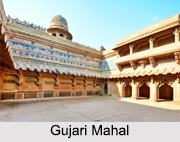 The Gujari Mahal: The 15th century Gujari Mahal is a monument of love by Raja Man Singh Tomar for his Gujar queen, Mrignayani. After he had wooed and won her, Mrignayani demanded for a separate palace with a constant water supply from the River Rai. The outer structure of the Gujari Mahal has survived in an almost total state of preservation; the interior has been now converted into an archaeological Museum.
Teli Ka Mandir: The Teli ka Mandir is a 9th century Dravidian-style shrine which is notable for its profusely sculpted Indo-Aryan style exterior; the doorway to the temple is 100 ft high and is topped with a sculpture of the Garuda. This is a Pratihara Vishnu temple with a blending of unique architectural styles. The shape of the roof is distinctively Dravidian, while the decorative embellishments have the typical Indo-Aryan characteristics of Northern India. The whole temple is covered with sculptures.
Sahastrabahu Temple: The graceful little Saas-Bahu-ka-Mandir or Sahastrabahu temple built in 11th century is a dedication to Lord Vishnu.
Gurdwara Data Bandi Chhor: Another landmark is the historic Gurudwara Data Bandi Chhor built in the memory of Guru Hargobind Sahib, the 6th Sikh Guru who was imprisoned here by Jehangir for over two years. At the time of his release, he wanted 52 Hindu kings who were his fellow prisoners, released with him. Jehangir was very impressed with the Guru and agreed to his condition.
Chaturbhuj Mandir: This temple is also known as the temple of the four-armed Lord Vishnu and it is dedicated to him. The temple was built in 876A.D. It is located on the northeast entrance to the fort.
Some other remarkable monuments of Gwalior Fort are Siddhachal Jain Temple Caves, Urvahi, Gopachal and Garuda Monument.
Palaces of Gwalior Fort
Along with the monuments, the gorgeous palaces in the fort enhance the beauty of it more distinctly.
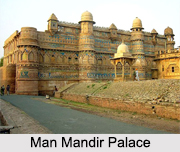 Man Mandir Palace: Man Mandir Palace was built between 1486 and 1517 by Raja Man Singh Tomar. The tiles that once adorned its exterior have not survived, but at the entrance, traces of those still remain. Vast chambers with fine stone screens were once the music halls, and behind those screens, the royal ladies would learn music from the great masters of those times. Below the circular dungeons once housed the state prisoners of the Mughals. The Emperor Aurangzeb had his brother Murad imprisoned, and later executed, here.
Karan Palace / Kirti Mandir: This palace is situated on the western side of the fort. It is a long two- storied building.
Jehangir Mahal & Shah Jahan Mahal: They both are located at the northern end of the fort.
Along with the mentioned palaces, some other important ones of Gwalior Fort are Hathi Pol, Karn Mahal, Vikram Mahal and Chhatri of Bhim Singh Rana.
Other Significant Structures of Gwalior Fort
Along with the marvelous monuments and palaces there are some other significant places in Gwalior Fort that need to be focused upon-
Jauhar Pond: This is where the Rajput `ranis` committed mass `sati` after their consorts had been defeated in battle.
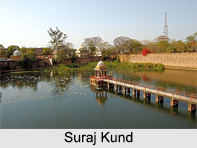 Suraj Kund: This kund is within the Gwalior Fort walls, the original pond, where the Saint Gwalipa cured Suraj Sen.
Jain Sculptures: Along the path leading to the Gwalior Fort from the southern side are many Jain sculptures along the rock faces. These sculptures were originally cut in the mid-15th century but were defaced by the marauding armies of Babur in 1527. However, they were later restored. The sculptures can be divided into 5 groups.
Gates on the Northeast Entrance: Hathiya Paun or elephant`s foot is on the entrance to the palace. Besides there is the Badalgarh gate named after Raja Man Singh`s Uncle Badal Singh. The first gate is the Alamgiri gate and was built in 1660 A.D. The fourth gate was built in the 15th century and is named after Lord Ganesha.
Scindia School: And, finally, within the Gwalior Fort complex is Gwalior`s unique gift to modern India, the Scindia School. Acknowledged as one of the finest schools in India, its aim is that the country`s young citizens receive the best educational grounding surrounded by historical monuments, which constantly inspires them.