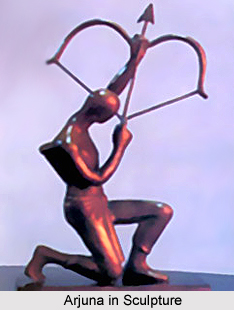
 Arjuna was one of the Pandavas, the protagonists of the Sanskrit epic Mahabharata. He is considered to be one of the greatest archers and warriors and a major historical character in the Dwapara Yuga.
Arjuna was the third son born to Pandu and Kunti. His name means shining and brightness. Like his other brothers he too was born through a special boon granted to Kunti by Rishi Durvasa. Kunti through her mantra had invoked Indra to give birth to him. Arjuna, a master-archer, was termed as outstanding warrior or "Maharathi" by Guru Dronacharya.
An exemplar of skill, duty and compassion as well as a seeker of true knowledge, Arjuna is a magnanimous figure in Hindu myth and theology. He is also known to be a lady`s man as he had married four times. He had found a true and loyal friend in his charioteer and brother in law, Lord Krishna. He was also known to be sensitive and loyal to his friends. The story about Arjuna`s concentration is still being narrated to children of modern times to make them understand its essence.
Etymology of Arjuna
Throughout history, Arjuna has been known by a plethora of names, each encompassing distinct facets of his character and achievements.
Among many appellations bestowed upon Arjuna is "Dhananjaya," a name that reflects his triumph over wealth and gold, symbolizing his prowess as a conqueror of riches. Additionally, he is referred to as "Gu?akesha," signifying his mastery over sleep, as well as denoting the abundance of his hair. The name "Vijaya" highlights his indomitable spirit, rendering him always victorious and unconquerable.
Arjuna`s remarkable ambidexterity on the battlefield is captured by the name "Savyasachi," describing his ability to shoot arrows with equal skill using both his right and left hand. This unparalleled talent earned him the epithet "Ambidextrous." The title "Shvetavahana" associates him with milky white horses, which drew his immaculate white chariot.
Characterizing his noble and virtuous nature, Arjuna is also referred to as "Anagha," symbolizing his purity and freedom from sin. "Bibhatsu" exemplifies his conduct in war, signifying his commitment to fairness, style, and awe-inspiring tactics while shunning any dishonorable acts during battle.
Arjuna`s illustrious accomplishments and recognition as a hero led him to be known as "Kiri?i," the one who proudly wears the celestial diadem presented by Indra, the King of Gods. The name "Ji??u" resonates with his triumphant nature, acknowledging his prowess as a conqueror of adversaries.
Furthermore, the designation "Phalgu?a" is derived from his birth under the star Uttara Phalguni, which corresponds to the constellation Denebola in Leo. Another remarkable epithet is "Mahabahu," which highlights his exceptional strength, exemplified by his large and powerful arms.
One of Arjuna`s most renowned attributes is his mastery of archery, and this is captured in the name "Ga??ivadhari," which translates to the holder of the mighty bow, Gandiva. He is also affectionately referred to as "Partha," the son of Pritha, and "Kaunteya," the son of Kunti, both names in honor of his beloved mother. Similarly, "Pa??uputra" and "Pa??ava" acknowledge his lineage as the son of Pandu, his esteemed father
Lastly, the name "K???a" evokes his dark complexion, while emphasizing his immense purity and virtue. In a fascinating turn of events during the epic, Arjuna assumed the name "B?hannala" for the 13th year of his exile. This particular name marked a significant transformation in his life, representing a period of disguise, during which he displayed his versatility and adaptability.
Life of Arjuna
Arjuna, a significant figure in the epic Mahabharata, belonged to the illustrious Pandava clan, whose name was derived from their father, Pandu, the heir to the Lunar dynasty. However, Pandu was under a curse that forbade him from having relations with a woman, leading to a unique and mystical method of his sons` birth.
In this curious tale, Pandu`s wives, Kunti and Madri, turned to a mantra bestowed upon Kunti by the sage Durvasa during her maiden days. Through the use of this mantra, Kunti invoked different gods, and each god blessed her with a child. Thus Kunti decided to invoke Dharma, Lord Vayu and Lord Indra and gave birth to 3 sons of divine power. Arjuna was born as a demigod, a divine blessing following Kunti`s invocation of the god Indra, in response to her husband`s request.
In some versions of the legend, Arjuna`s origin takes on an even more mystical aspect, as he is regarded as the reincarnation of a revered sage named Nara, adding to the divine significance of his birth.
Early life of Arjuna
Despite being the younger brother of Dhritarashtra, Arjuna`s father, Pandu, ascended to the throne of Bharata due to Dhritarashtra`s blindness, which made him ineligible for the royal succession. As king, Pandu fathered the famous Pandava brothers, while Dhritarashtra sired the formidable Kaurava brothers, numbering a hundred in total.
Brought up alongside their cousins, the Kauravas, the Pandavas received their education under the wise supervision of Bhishma. Among their esteemed teachers was Drona, a brahmin warrior, who quickly recognized Arjuna as his favorite and most accomplished pupil.
According to legends, once Dronacharya wished to test his students. He hung a wooden bird from the branch of a tree and then summoned his students. One by one, he asked his students to aim for the eye of the wooden bird and be ready to shoot; then, when they were ready, he would ask the student to describe all that he was able to see. The students generally described the garden, the tree, flowers, the branch from which the bird was suspended and the bird itself. Guru Dronacharya then asked them to step aside. He called upon Arjuna and asked what he could see; to this Arjuna told his Guru that he could only see the bird`s eye. The above story is a testimony for Arjuna`s diligence and dedication in work.
Upon completing their rigorous training, Arjuna showcased his capabilities on the battlefield by defeating Drupada of Panchala. Impressed by Arjuna`s skills, Drupada acknowledged the prince`s valor and offered him the gurudakshina (a token of gratitude to the teacher) on behalf of his beloved teacher, Drona.
 Marriage of Arjuna
Arjuna first married the dusky and beautiful Draupadi- the daughter of King Drupada. When Draupadi was very young, her father began to look for a suitable match for her. There were many kings who attended this major event. The Pandavas too attended the Swayamwara under the disguise of Brahmin as they were still in exile. There was a contest that the winner prince would marry Draupadi. The contest was that there would be a target. The target was a fish which is placed on a revolving disc. It should be struck by an arrow only by looking at its reflection in the water below. A huge bow was kept for that purpose. Most kings failed to even string the bow. Only Arjuna was successful in hitting the target and won Draupadi`s hand in marriage.
Besides Draupadi, Arjuna also married a woman by the name Chitraganda. She was a soft-spoken princess of Manipur. But he could not take her with him as her father- the King of Manipur explained to Arjuna that they followed the matrilineal system and so the heir born to Arjuna and Chitraganda had to stay back at Manipur. Arjuna agreed to it. A son, whom they named Babruvahana, was soon born to them who were to succeed his grandfather.
While Arjuna was in Manipur, Ulupi, a Naga Tribe princess of otherwise noble character, became infatuated of him. She abducted Arjuna by intoxicating him. Ulupi induced an unwilling Arjuna to take her for wife. Later on she returned back Arjuna to the lamenting Chitrangada. She took care of their son Babruvahana and had a major influence over him.
Subhadra married Arjuna when he stayed with Lord Krishna in Dwaraka during a one-year exile. During his stay he got attracted to Subhadra and proposed to her for marriage. She agreed in spite of knowing that Arjuna was already three times married. She also knew that her family would never agree to this marriage. Hence, Krishna facilitated the elopement of the couple and their departure for Indraprastha. To avoid further controversies from their family, Krishna advised Arjuna and Subhadra that they need to keep this in mind that it was Subhadra who abducted Arjuna and not the other way around. Soon Subhadra gave birth to their son called Abhimanyu.
Burning the Khandava Forest
Once Lord Krishna and Arjuna had gone to Khandava Forest, there they encountered Lord Agni- the Lord of Fire who asked their help in consuming the forest in its entirety.
Takshaka the serpent-king, a friend of Indra resides in it and Indra would thus cause rain whenever Agni tried to burn this forest. It was further revealed that the fire-god had to do this to relieve a sickness he suffered from, hence the importance of destroying the forest. Arjuna told him that while he has training in the divine weapons, he was informed that to withstand the power of Indra`s Astras he must have an exceptionally powerful bow; an unbreakable one. Agni then invoked Lord Varuna, who gave Arjuna the Gandiva, an incredibly powerful bow, which gave its user sure victory in battle. This bow played a great role in Arjuna`s future battles. Also, he gave Arjuna a divine chariot, with powerful white horses that do not tire, and are unwounded by normal weapons. Arjuna tells Agni to proceed, and fights with his father in the process. The battle lasts several days and nights. A voice from the sky proclaimed Arjuna and Krishna the victors, and ordered Indra to withdraw.
The Game of Dice in Mahabharata
In Mahabharata, a pivotal moment in the intense rivalry between the Pandavas and the Kauravas unfolded during the ill-fated game of dice. Yudhishthira, the rightful heir to the lordship of Kurukshetra, attracted the envious gaze of his cousin Duryodhana, who harbored ambitions for the throne.
The turning point arrived during the grand royal consecration known as "rajasuya," a Vedic ceremony that spanned several years and culminated in a ritualized game of dice. This game, notorious in Indian literature for its implications, proved to be the catalyst for a sequence of tragic events.
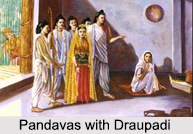
In a calculated act of deceit, Duryodhana manipulated the game, ensuring Yudhishthira`s misfortune and causing him to gamble away everything he held dear. The stakes were impossibly high, and Yudhishthira suffered the loss of his kingdom, wealth, and even his shared wife, the virtuous Draupadi.
The humiliation inflicted upon Draupadi by the Kauravas further fueled the animosity between the Pandavas and their cousins. The disgraceful treatment she endured served as an added motivation for the Pandavas to seek vengeance and reclaim their rightful position.
During the ordeal, Karna, one of the Kaurava allies, scornfully taunted Draupadi for marrying five men, an act that he deemed inappropriate. In response, Arjuna, the valiant Pandava prince and one of Draupadi`s husbands, took a solemn vow to avenge her honor by slaying Karna.
As a consequence of the rigged game and the ensuing chaos, the Pandavas, including Arjuna, faced a harsh fate. They were compelled to endure a twelve-year exile in the wilderness, followed by an additional year of living incognito, with the condition that Yudhishthira could regain his kingdom only upon completing this arduous ordeal.
Arjuna during Exile
In the course of the Pandavas` exile, Arjuna embarked on a remarkable journey to acquire celestial weapons that would aid him in his ultimate confrontation with the Kauravas. The Himalayas, with its divine allure, became his destination, where he sought these potent armaments.
Venturing into the realm of the heavens, Arjuna honed his battle skills by visiting Swarga, the celestial abode of Indra, his spiritual father. In this heavenly realm, he displayed his valor by emerging victorious in a formidable battle against the Daityas. Moreover, he fought alongside Indra, wielding his renowned bow, Gandiva, in service of his divine benefactor.
Prior to his exile, after a significant battle at Khandava, Indra had pledged to grant Arjuna all of his celestial weapons. However, there was a condition: Arjuna had to gain the approval of Lord Shiva. Heeding the counsel of his dear friend and guide, Krishna, Arjuna embarked on a path of meditation or tapasya to earn the divine weapon called Pashupatastra.
Leaving his brothers behind, Arjuna embarked on a period of intense penance on the sacred Indrakeeladri Hill. Deep in meditation, a wild boar suddenly charged toward him. Reacting swiftly, Arjuna drew an arrow and aimed at the boar, but to his surprise, another arrow had already struck it. Incensed by this, he confronted the one responsible for the interference— a formidable hunter. An arduous battle ensued between the two, with neither able to gain an advantage.
It was only after a prolonged and strenuous struggle that Arjuna came to a profound realization—the enigmatic hunter was none other than Lord Shiva himself. Pleased with Arjuna`s valor and humility, Shiva revealed his true divine form and bestowed upon him the mighty Pashupatastra—the coveted celestial weapon. As an intriguing twist, Arjuna learned that the boar was an embodiment of Indra, who sought to test Arjuna`s mettle.
Having acquired the potent Pashupatastra, Arjuna was elevated to the heavens by Indra. There, the celestial god generously bestowed upon him a myriad of divine weapons, further enhancing Arjuna`s formidable arsenal.
During his exile, Arjuna`s unwavering determination, spiritual devotion, and valor were rewarded with the acquisition of celestial armaments, each imbued with extraordinary power. These weapons would prove to be instrumental in shaping the destiny of the impending war and contributing to Arjuna`s indelible legacy as a warrior of divine prowess.
Arjuna - Mahabharat
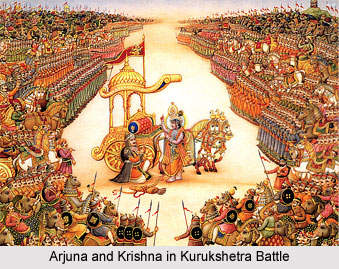
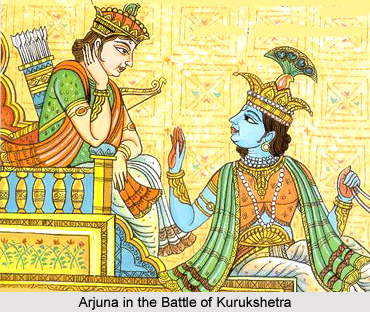
Arjuna was third son of Pandu and Kunti, and a master archer and a great warrior in epic Mahabharata. Known for his unwavering devotion to duty and righteousness, Arjuna played a pivotal role in the Kurukshetra War. His profound dialogue with Lord Krishna, known as the Bhagavad Gita, remains a timeless source of spiritual wisdom.