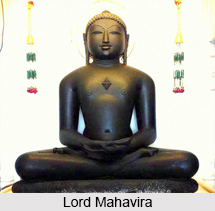
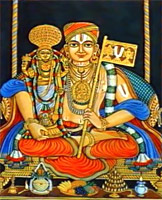
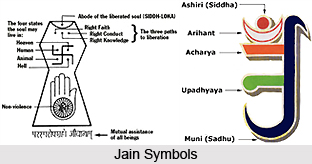
 According to Jain Philosophy Moksha is an ecstatic state of existence of a soul, completely free from the karmic bondage, free from samsara, the cycle of birth and death. A released soul believed to have attained its true and pristine nature of infinite bliss, infinite knowledge and infinite perception. Such a soul is called siddha or paramatman and conceived as supreme soul or God. In Jainism, it is the highest and the noblest objective that a soul should endeavour to achieve. It fact, it is the only objective that a person should have; other objectives are adverse to the true nature of soul. With right faith, knowledge and efforts all souls can achieve this state.
It has been said that the spiritual development of the soul is conditioned by the elimination of the Karmas which disturb faith and conduct. The binding of a new Mohaniya-karma cannot him be hindered by a good condition of the mind, for the production of a Mohaniya-karma causes the binding of a new Karma of the same type which, in addition, has a significant duration (Sthiti). The Jiva has rather to go through three processes for this purpose. They last only for a portion of a Muhurta (48 minutes), and their consequence is the reduction of Karma. Only the rational, completely developed beings having five senses and all four stages of existence, which have a control over body, speech, organ of thinking, knowledge which is formally determined and one of the best Lesyas, are qualified for it.
The second process "Apurva-karana" works also in the same manner promoting purity of the soul. By carrying it out, the "knot" (Grantha) in our inside, i.e. the disturbance of the faith and conduct rooted in our heart is split and thereby a door is opened to the spiritual process.
The third process "Anivrtti-karana" again reduces duration and intensity of Karma, but besides, a part of the karma- matter fallen upon heterodoxy is divided into three heaps, one impure for heterodoxy, one half-pure for mixed faith and one pure for lower (Ksayopasamika) faith. After a short period one of them is realized and thereby determines the further fate of the soul which either returns to heterodoxy so that the whole process was without any lasting influence or attains finally the lower form of true faith.
The separation of Karmas from the life-long passions takes place also in similar manner; the one attaining the Ksayopasamika-faith can move forward up to the apramatta-samyata-gunasthana, i.e. up to the seventh stage of virtue in which he possesses self-discipline without negligence; if he wants to come further, he must go one of the two methodical ways: two methodical ways: the Upasana-sreni or the Ksapaka-sreni. They help in the Karma not being produced.
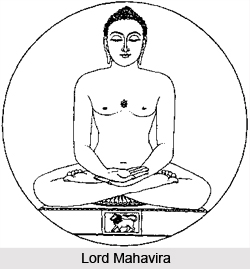 Upasana means pacification, appeasement; one who exercises Upasama of the Karmas can conlrol himself to-such an extent that the Karmas cannot produce their effect. The heaped-up potential (Satta-) karma is sup pressed so that it cannot be manifested, but it cannot be eradicated with the roots, exists, therefore, in a latent condition and can break forth in an opportune moment. If the suppression of Karma is taken up in a systematic way in a definite order, then an "Upasanasreni" arises, a rung of the ladder which ends up finally with the complete suppression of all "Mohaniya-karmas" This rung of the ladder can be "climbed" by a soul in the fourth to the seventh Gunasthana; then in a regular course it passes to the following Gunasthanas till the eleventh, and thus we have an Upasarita-moha stays in this condition only for a short period, i.e. only for Samaya. The moment this duration is over, it falls down from the Gunasthana. The fall is due to two causes: either by cessation of existence, by the death of an individual, or the expiry of the period which is possible for this Upasanta-moha. If a being dies in this condition, then it is born again as Anuttarasura-god, but falls at once from the eleventh to the fifth Gunasthana. If the period expires, Jiva falls to the seventh
Gunasthana, under circumstances also to one of the Gunasthanas which are still lower.
Upasana means pacification, appeasement; one who exercises Upasama of the Karmas can conlrol himself to-such an extent that the Karmas cannot produce their effect. The heaped-up potential (Satta-) karma is sup pressed so that it cannot be manifested, but it cannot be eradicated with the roots, exists, therefore, in a latent condition and can break forth in an opportune moment. If the suppression of Karma is taken up in a systematic way in a definite order, then an "Upasanasreni" arises, a rung of the ladder which ends up finally with the complete suppression of all "Mohaniya-karmas" This rung of the ladder can be "climbed" by a soul in the fourth to the seventh Gunasthana; then in a regular course it passes to the following Gunasthanas till the eleventh, and thus we have an Upasarita-moha stays in this condition only for a short period, i.e. only for Samaya. The moment this duration is over, it falls down from the Gunasthana. The fall is due to two causes: either by cessation of existence, by the death of an individual, or the expiry of the period which is possible for this Upasanta-moha. If a being dies in this condition, then it is born again as Anuttarasura-god, but falls at once from the eleventh to the fifth Gunasthana. If the period expires, Jiva falls to the seventh
Gunasthana, under circumstances also to one of the Gunasthanas which are still lower.
The Upasana-sreni lasts on the whole for 48 minutes it can be climbed twice during one existence the case, redemption during this birth is impossible. But if it is climbed on the other hand only once, then an individual has still a chance to reach after his fall Ksapaka-sreni which leads to Nirvana.
The Ksapaka-sreni is a stage to wipe out the Karmas. A man who is older than 8 years having the best articulation (of joints) and who is in fourth to seventh Gunasthana is capable of beginning to climb on it. This wipes out successively the different types potential Karma. Finally he becomes a Sayogi-kevali, an omniscient saint, who roams about bodily only for a short on the earth to go then into Salvation.
However, from the point of view of potency of moksha, Jain texts divide the souls in two categories - bhavya and abhavya. Bhavya souls are those souls who have faith in moksha and thus will make some crusades to reach liberation. This potentiality or quality is called bhavyata. However, bhavyata itself does not ensure salvation, because the soul needs to put in necessary pains to attain it. On the other hand, abhavya souls are those souls who cannot attain liberation, because they do not trust in moksha and hence never make any effort to attain it.