


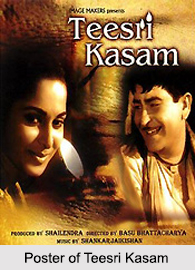
 ‘Teesri Kasam’ is a Hindi film, which was released in 1966 and directed by Basu Bhattacharya. The plot of the movie is based upon the short story ‘Mare Gaye Gulfam’, by the Hindi novelist Phanishwarnath Renu. The star cast of the film was Raj Kapoor and Waheeda Rehman. ‘Teesri Kasam’ revolves around Hiraman who is a bullock cart driver. The film was critically acclaimed. It sees Waheeda Rehman and Raj Kapoor at their career best roles. The film deals with social realities and explores human relationships. ‘Teesri Kasam’ is a Hindi film, which was released in 1966 and directed by Basu Bhattacharya. The plot of the movie is based upon the short story ‘Mare Gaye Gulfam’, by the Hindi novelist Phanishwarnath Renu. The star cast of the film was Raj Kapoor and Waheeda Rehman. ‘Teesri Kasam’ revolves around Hiraman who is a bullock cart driver. The film was critically acclaimed. It sees Waheeda Rehman and Raj Kapoor at their career best roles. The film deals with social realities and explores human relationships.
Plot of Teesri Kasam Hiraman is a bullock cart driver who is rounded by the police for carrying smuggled goods. After much pleading he is let free and he vows never to carry illegal goods again in his life. This is his first vow or 'kasam.' Again while carrying bamboo he is beaten up by two men. Hiraman's bullock cart almost collide their horse cart. Outraged by this incident they beat up the poor bullock cart driver. After this unfortunate incident Hiraman decides never to transport bamboo again. This was his second vow or 'kasam.' His next passenger is Hirabai (Waheeda Rehman), a Nautanki performer. She is to travel to the fair for a performance. As they travel together Hirabai is impressed by Hiraman's innocence and simplicity. His forte of singing also impresses her. While singing a song Hiraman narrates the legend of Mahua to Hirabai. According to the legend Mahua, a beautiful motherless girl fell in love with a stranger but she is sold away to a trader by her stepmother. The story touches Hirabai. She is charmed by Hiraman and convinces him to stay with her at the fair to see her performance. While she performs at the Nautanki Hiraman gets involved into a brawl with a drunkard as the latter makes insulting comments about Hirabai.
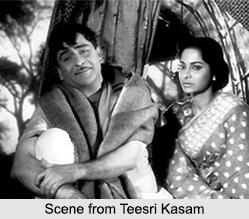 Hirabai is upset over the fight and reprimands Hiraman. Heartbroken Hiraman avoids the show. However realizing her mistake Hirabai calls him to her tent and apologizes. On the other Hiraman asks her to abandon a profession where people speak ill of her. His simplicity and selfless concern for her once again touches Hirabai's heart. It becomes increasingly difficult for her to explain to him that she is not the respectable woman as he thinks of her. Hirabai is unhappy with her life and she turns down the local landlord's indecent proposal. The man tires to force himself upon her but she valiantly fights him off. Hirabai decides to leave the nautanki troupe for good. Her presence would create problems for the other members of the group as the zamindar has threatened her with dire consequences. Hirabai is upset over the fight and reprimands Hiraman. Heartbroken Hiraman avoids the show. However realizing her mistake Hirabai calls him to her tent and apologizes. On the other Hiraman asks her to abandon a profession where people speak ill of her. His simplicity and selfless concern for her once again touches Hirabai's heart. It becomes increasingly difficult for her to explain to him that she is not the respectable woman as he thinks of her. Hirabai is unhappy with her life and she turns down the local landlord's indecent proposal. The man tires to force himself upon her but she valiantly fights him off. Hirabai decides to leave the nautanki troupe for good. Her presence would create problems for the other members of the group as the zamindar has threatened her with dire consequences.
Hirabai relents to compromise with the zamindar as she no more wants to lie to Hiraman. She decides to leave Hiraman as well. At the railway station she reveals the truth to Hiraman and that she was returning to her old group. She tells Hiraman that like Mahua she too had been sold years ago. With this she departs and Hiraman returns to his cart to take the third vow or the 'Teesri Kasam' never to carry a woman passenger who works for the nautanki company. ‘Teesri Kasam’ amazingly explores the unspoken ties that developed between two individuals. Cast of Teesri Kasam Cast of ‘Teesri Kasam’ is enlisted below:
Soundtracks of Teesri Kasam 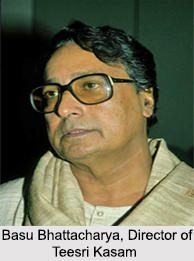 There are total 10 soundtracks in the film, which are as follows: There are total 10 soundtracks in the film, which are as follows:
Recognitions to Teesri Kasam ‘Teesri Kasam’ has been awarded with these following recognitions:
|
| |||



Teesri Kasam
| ‘Teesri Kasam’ is a Hindi film released in 1966 and directed by Basu Bhattacharya. The film is based on Phanishwar Nath`s short story ‘Mare Gaye Gulfam’. Lead characters were played by Raj Kapoor and Waheeda Rehman. |
| ||||||||||||||||||||||||||||

