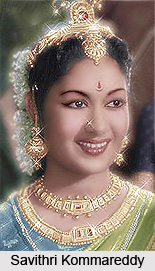
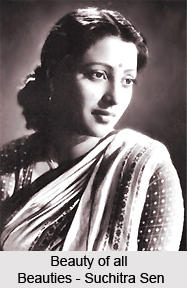
 Suchitra Sen was one of the sought after heroines of that age. Her beauty and acting prowess enthralled the audience for years. To top it all her pairing with Uttam Kumar rendered Suchitra Sen a cult status. The roles of the tragic heroine became popular after Suchitra Sen. She was armed with a million dollar smile and an impressive personality that she easily won the heart of the audiences.
Early Life of Suchitra Sen
Suchitra Sen was born in Pabna in present day Pabna District of Bangladesh. Her father Karunamoy Dasgupta was the headmaster of the local school and her mother Indira Devi was a homemaker. She was their fifth child and third daughter. She had her formal education in Pabna. Later Suchitra Sen married to Dibanath Sen, son of a wealthy Bengali 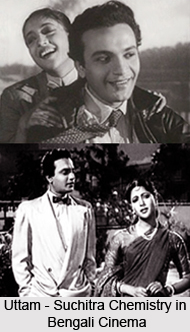 industrialist, Adinath Sen in 1947. Suchitra Sen made a successful entry after marriage into Bengali films in the year 1952 and then a less successful transition to the Bollywood film industry.
Career of Suchitra Sen
Suchitra Sen`s first film was Shesh Kothaye in 1952. However she was first paired with Uttam Kumar in 1953 in the film Sharey Chuattar, directed by Nirmal Dey. This film is even remembered today for its comedy and the funny dialogues. Uttam-Suchitra chemistry worked in several films together as the lead pair. Some of their memorable films together are Shap Mochan (1955), Sagarika (1956), Harano Sur (1957), Indrani (1958), Chaowa-Paowa (1959), Saptapadi (1961), Bipasha (1962), Grihadaha (1967) and others.
Born as Roma Dasgupta she delivered her career`s best performance in Deep Jwele Jaai (1959). She had essayed the character of Radha, a nurse at the hospital that deal with psychiatric patients. Basanta Choudhury starred opposite her in this particular time. Suchitra Sen was outstanding in this film. The film was remade in Hindi by Asit Sen with Waheeda Rehman and Rajesh Khanna in the lead. Another landmark film in Suchitra Sen`s career was Uttar Falguni (1963), directed by Asit Sen. Once again Suchitra left the audiences spell bound with her role of a courtesan in the film. She played the double character of mother and daughter. Pannabai, the protagonist is 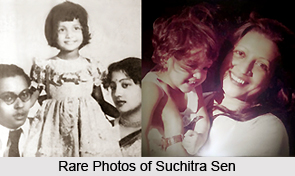 determined to see her daughter well positioned in society so that she does not face the same kind of environment as her mother. This film too was remade in Hindi as Mamta with Ashok Kumar and Dharmendra alongside Suchitra Sen herself.
Saat Pake Bandha (1963) with Soumitra Chatterjee established Suchitra Sen as the undisputable queen of Bengali films. The film dealt with a married couple, Archana and Sukhendu. Sukhendu played by Soumitra Chatterjee is a simple University Lecturer and not as well of as his spouse. His mother-in-law, played by Chhaya Devi, is not too happy with the match and keeps on reminding him about his 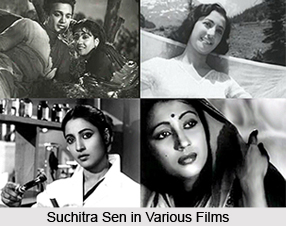 poverty. Her excessive interference into Archana`s marital life destroys her marriage completely. The legendary actress was duly rewarded with the Best Actress Award at the Moscow International Film Festival in 1963. Saat Pake Bandha was remade in Hindi with Jaya Bachchan essaying the same character.
Suchitra Sen also made her foray into Hindi films but these were less successful barring a few. Her first Hindi film was Bimal Roy`s Devdas (1955) where she enacted the role of Parvati and later went onto play leading roles in Musafir (1957) by Hrishikesh Mukherjee, Champakali (1957), Bombay ka Babu (1960) and Aandhi (1975). The latter saw her in the role of a lady politician who sacrifices her personal life. Suchitra Sen starred opposite Sanjeev Kumar and the flick was directed by Gulzar.
Filmography of Suchitra Sen:
| Year |
Film |
Year |
Film |
1953 |
Saat Number Kayedi |
1957 |
Champakali |
| 1953 |
Bhagaban Srikrishna Chaitanya |
1958 |
Rajlakshmi O Srikanta |
| 1953 |
Saare Chuattor |
1958 |
SuryaToran |
| 1953 |
Kajori |
1958 |
Indrani |
| 1954 |
Sadanander Mela |
1959 |
Deep Jwele Jai |
| 1954 |
Agnipariksha |
1959 |
Chaaowa Pawoa |
| 1954 |
Ora Thaake Odhare |
1960 |
Hospital |
| 1954 |
Grihaprabesh |
1960 |
Smriti Tuku Thaak |
| 1954 |
Atom Bomb |
1960 |
Bombai Kaa Babu |
| 1954 |
Dhuli |
1960 |
Sarhad |
| 1954 |
Maraner Parey |
1961 |
Saptapadi |
| 1954 |
Balaygraas |
1961 |
Saathihara |
| 1954 |
Annapurnar Mandir |
1962 |
Bipasha |
| 1955 |
Shapmochan |
1963 |
Saat Paake Badha |
| 1955 |
Sabar Upare |
1963 |
Uttar Phalguni |
| 1955 |
Snaajhghar |
1964 |
Sandhya Deeper Sikha |
| 1955 |
Devdas |
1966 |
Mamta |
| 1955 |
Snaajher Pradeep |
1967 |
Grihadaha |
| 1955 |
Mejo Bou |
1969 |
Kamallata |
| 1955 |
Bhalabaasa |
1970 |
Megh Kalo |
| 1956 |
Sagarika |
1971 |
Fariyaad |
| 1956 |
Trijama |
1971 |
Nabaraag |
| 1956 |
Amar Bou |
1972 |
Alo Amaar Alo |
| 1956 |
Shilpi |
1972 |
Haar Maana Haar |
| 1956 |
Ekti Raat |
1974 |
Debi Choudhurani |
| 1956 |
Subharaatri |
1974 |
Srabana Sandhya |
| 1957 |
Harano Sur |
1975 |
Priyo Bandhabi |
| 1957 |
Pathe Holo Deri |
1975 |
Aandhi |
| 1957 |
Jeeban Trishna |
1976 |
Datta |
| 1957 |
Chandranath |
1978 |
Pranoy Pasha |
Awards Received by Suchitra Sen
| Year |
Award |
Result |
Film |
1963 |
Moscow Film Festival |
Won |
Saptapadi |
| 1963 |
Filmfare Best Actress Award |
Nominated |
Mamta |
| 1972 |
Padma Shri |
|
For notable contribution in Arts |
| 1976 |
Filmfare Best Actress Award |
Nominated |
Aandhi |
| 2012 |
Banga Bibhushan |
Won |
Lifetime Achievement in Film acting |
Suchitra Sen, the most beloved actress of the Bengali silver screen had retired by 1978. After her retirement she chose to live in seclusion and avoided public appearance completely. As she bid goodbye to acting, Bengali cinema was left behind with a void that hardly had any chances to be filled in the coming years.
Suchitra Sen who was suffering from acute heart problems, died of a heart attack on January 17, 2014. She was 82.