Milestones towards moksha, Jain philosophy - Informative & researched article on Milestones towards moksha, Jain philosophy
  Indianetzone: Largest Free Encyclopedia of India with thousand of articles Indian Philosophy


in  
Art & Culture | Entertainment | Health | Reference | Sports | Society | Travel
Forum  | Free E-magazine
Indian Philosophy : Indian Philosophy l Schools of Indian Philosophy l Classical Indian Philosophy l Indian Religious Philosophy l Buddhist Philosophy l Upanishads l Indian Philosophers l Atomic Theories l Hindu Philosophy
Home > Reference > Indian Philosophy > Schools of Indian Philosophy > Jain Philosophy > Milestones towards moksha, Jain philosophy
Milestones towards moksha, Jain philosophy
A definitive threefold path must be pursued to achieve moksha from worldly bondage.

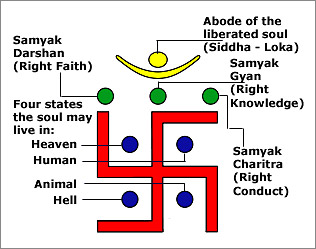
Ratnatraya or the three Jewels of JainismA soul is bound by the karmas since time immemorial. The first step to achieve moksha is to instill Samyaktva or rational faith or perception.

Samyaktva
According to Jainism, Samyak Darsana (Rational Perception), Samyak Jnana (Rational Knowledge) and Samyak Caritra (Rational Conduct), together also known as Ratnatraya or the three Jewels of Jainism, compose true Dharma. According to Umasvati, Samyak Darsana and Jnana Caritra together constitutes mokshamarga, or the path to liberation.

Samyak Darsana or rational perception is the logical faith in the true nature of every substance of the universe.

Samyak Jnana or rational knowledge is the right knowledge of true and appropriate knowledge of the reality, the tattvas. It comprises the two principles of Anekantvada or non-absolutism and Syadvada or relativity of truth. Right knowledge must be free from three main faults: doubt, delusion, and indefiniteness.

Samyak Caritra or rational conduct is the natural conduct of a (soul) living being. It consists in following asceticisms, pursuing right activities and observance of vows, carefulness and controls. Once a soul secures samyaktva, moksha is guaranteed within a few lifetimes.

Kevala Jnana
Kevala Jñana, the highest form of transcendental knowledge that a samyakdristi soul can achieve, also means "absolute knowledge", "Enlightenment" and "Omniscience". Kevala is the state of isolation of the java from the ajava attained through austere practices which burn off one`s karmic residues, releasing one from bondage to the cycle of death and rebirth. Kevala Jñana, thus signifies infinite knowledge of self and non-self, accomplished by a soul after eradication of the all ghatiya karmas. A person who has attained Kevala Jñana is called a Kevali. He is also known as Jina (the victor) or Arhat (the worthy one) and worshipped as the Almighty by the Jains. The soul who has reached this stage attains moksha at the end of his life span, after eradication of the aghatiya karmas.

Nirvana Nirvana means final release from the karmic bondage. When an enlightened human, such as an Arhat or a Tirthankara crushes his remaining aghatiya karmas and ends his worldly existence, is termed nirvana. Theoretically, the death of an Arhat is called nirvana of Arhat, as he has ended his worldly existence and attained liberation. Moksha, to be precise, liberation follows nirvana. An Arhat becomes a siddha - the liberated one, after attaining nirvana.

(Last Updated on : 26/04/2011)
  More Articles in Jain Philosophy
 
Constituents of reality in Jain philosophy Metaphysics in Jain philosophy Milestones towards moksha, Jain philosophy
Morality and Ethics in Jain philosophy Nature of Divinity and God in Jain philosophy Path to Salvation in Jain Philosophy
Jain Symbols Social Utility of the Jaina Karmic Theory Classification of Karma
Karma In Jain Philosophy Dissociation of karma Cause of karmic bondage
Nirvana Pushpadanta Pushpottara
Dravyas or Substances in Jain Philosophy Pudgala Basic Truths of Jain Philosophy
Body Functions Reform Movement of the Jains Action of the soul
Conduct of Life Types of Soul Conditions of Soul
Concept of Suffering Fourteen Gunasthanas Jain Cosmology
Anekanta Vada Syadvada Nayavada
Nigrantha Movement    
Recently Updated Articles in Indian Philosophy
  • Suhrawardi Order
    Suhrawardi Order, founded by Shihab-ud-din Suhrawardi, is considered one of the most prominent principles of Sufism.
  •  
  • Naqshbandi Order
    Naqshbandi Order is a notable Sufi order that originated during the reign of Akbar in India.
  •  
     
  • Hakim Sanai
    Hakim Sanai is considered to be the earliest Afghan teacher to use the love-motif in Sufism.
  •  
  • Sufi Philosophy
    Sufism is the philosophy that traces back to the Prophet Mohammad with a copious tradition.
  •  
  • Satya
    Satya means truth and is the quality of goodness, purity, knowledge and quiescence.
  •  
    E-mail this Article | Post a Comment
    RSS Feeds
    Forum
    Forum on Indian Philosophy

    Free E-magazine
    Subscribe to Free
    E-Magazine on Indian Crafts
     
     
    Milestones towards moksha, Jain philosophy - Informative & researched article on Milestones towards moksha, Jain philosophy
    Sitemap
    Contact Us   |   RSS Feeds
    Copyright © 2008 Jupiter Infomedia Pvt. Ltd. All rights reserved including the right to reproduce the contents in whole or in part in any form or medium without the express written permission of Jupiter Infomedia Pvt. Ltd.