Cilappatikaram, Epics in Tamil Literature - Informative & researched article on Cilappatikaram, Epics in Tamil Literature
  Indianetzone: Largest Free Encyclopedia of India with thousand of articles Indian Literature


in  
Art & Culture | Entertainment | Health | Reference | Sports | Society | Travel
Forum  | Free E-magazine
Indian Literature : Indian Literature l History of Indian Literature l Sanskrit Literature l Indian English Literature l Regional Indian Literature l Indian Comics l Indian Poetry l Indian Literary Personalities l Indian Epic Poetry l Renaissance in Indian Literature l Indian Novels l Indian Literary Organisations l Indian Literary Movements l Contemporary Indian Literature l Medieval Indian Literature l Ancient Indian Literature l Themes In Indian Literature l Genres in Indian Literature l Influencing Factors On Indian Literature l Forms of Indian Literature l Religious Influence on Indian Literature l Modern Indian Literature l Vedas
Home > Reference > Indian Literature > Indian Literature > Cilappatikaram
Cilappatikaram, Epics in Tamil Literature
Cilappatikaram is one of the five great epics of ancient Tamil Literature.
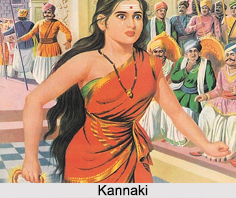
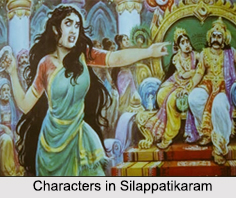
  Kannaki   Kovalan    

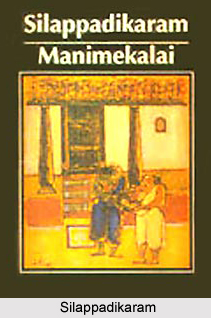
Cilappatikaram, also spelled as Silappatikaram is one of the Five Great Epics of Tamil literature of the Sangam age. The other epics of Sangam literature are Manimekalai, Civaka Cintamani, Valayapathi and Kundalakesi. The Jain monk Ilanko Atikal, who was a poet prince, has composed the epic. He is considered as the brother of the Chera King Senguttuvan. Cilappatikaram, which literally means Lay of the Anklet, is narrative in nature and contains a moralistic undercurrent. Cilappatikaram has 3 chapters and 5270 lines of poetry. The story of the epic revolves around the legendary Kannaki who set out to avenge the death of her husband Kovalan at the hands of a Pandya king. The story includes the 3 Tamil kingdoms of the ancient era, the Chola, the Chera and the Pandya.

Cilappatikaram is an elaborate poetic interpretation of Tamil culture, its diverse religions, its towns and cities, the arts of music and dance and the blend of Arab, Greek and Tamil people. Controversies abound about the time of its composition, swinging from the second century BC at one extreme to the eighth century AD at the other. Unlike the other epics, Cilappatikaram tells a fully native tale, which must have been prevalent over a long period as part of Tamil folklore. The epic contains 3 chapters, Puharkkandam, Maduraikkandam and Vanchikkandam.

Cilappatikaram teaches three eternal truths:
* A king failing in his duty will be punished by Dharma or justice.
* A chaste woman will be worshipped by all.
* Fate is powerful. Ones past actions will have their repercussions in the next birth.

Cilappatikaram was written towards the end of second century AD. The story is rooted in the ordinary lives of the early Tamils. Cilappatikaram is irreplaceably valuable in understanding ancient Tamil culture.

Content of Cilappatikaram
The story narrates the events in three kingdoms, namely Chera in western, Chola in eastern, and Pandyan in the middle of South India respectively. The story is full of information about contemporary events and personalities. From Sri Lanka, Gajabahu the First and Ellara the Tamil ruler of Sri Lanka are first mentioned in this Epic only. The Northern kingdoms like Chedi, Uttarakosala, and Vajra are also mentioned. The warlike Yaudhayas who worshipped Karthikeya are mentioned as the people of Balakumara. The towns like Thiruthangal mentioned by Ptolemy figure in Cilappatikaram only. The epic is more than a literary masterpiece. It is a predecessor of Nigandu. The Tamil lexicographic tradition is maintained by Nigandu. This tradition can be found in taking roots in Ilango`s Epic. Though a Jain, the Poet is free from any parochial attitude. He records the hymns in praise of Sakthi, Murugan and Vishnu too. Thus he also inaugurates the tradition of Bhakthi or devotion which is a unique feature of Tamil Literature. Ilango has also given voice to the folk tradition like the Kuravai Dance.

This love story, of Kovalan and Kannaki, is still current in varying versions of folk narrative. Cilappatikaram is significant in Tamil theatre history because of what it tells us of art and culture, specifically dance, music, and theatre. In the Arangetrra katai i.e. `debut chapter`, the episode in which the courtesan Madhavi performs her debut, the author writes in detail of the individual roles of an ideal dancer, flautist, percussionist, the dancer`s teacher, and vina player. He spells out the nuances of the grammar of acting as a discipline for performers. On other occasions he describes dance forms such as folk and classical, northern and southern, and the requirements and specifications of stage construction as well.

According to the Cilappatikaram, Varikkuttu is a form of dance that contains masquerading acts, where one does different roles. In the context of the epic, the hero Kovalan receives a messenger bearing a letter from the courtesan-dancer Madhavi, pleading him to return to her. Kovalan tells the messenger that he has nothing to do with her, as he has seen through the eight deceptive masquerades of character that Madhavi played on him. He will not be taken in by her pious pleadings. Eventually Kovalan returned back to his wife and the couple went to the grand city of Madurai to restart their life. When Kovalan went sell the precious anklet of his wife in order to start a business, the royal guards accused him of stealing from the queen and he was immediately beheaded without trial. Kannaki was infuriated and set out to prove her husband`s innocence and cursed the entire city to be burnt in flames. Due to the power of her chastity, her curse came true and Madurai was set ablaze.

A detailed description of the eight components of Varikkuttu, explained by Kovalan and enumerated by the commentators are Kankudu vari, Kan vari, Ul vari, Punpura vari, Kilar vari, Terchi vari, Katchi vari, and Edutukattu vari. All relate to the finer nuances of deception that Madhavi allegedly practised. After Bharata`s Natyasastra and Cilappatikaram, no work discusses the Indian performing arts until Matanga`s Brihaddesi in fifth century. Interestingly, Matanga speaks of the communication and fusion taking place between the art forms of the subcontinent`s poles i.e. Kashmir. This produced the Natyasastra, and Kerala produced Cilappatikaram.

Cilappatikaram is not only the first identified Tamil epic poem, but it is also very significant for its contributions in literary innovations. Cilappatikaram has introduced the merger of prose with poetry, which was not commonly seen in earlier Tamil literary works.

(Last Updated on : 6/01/2012)
  More Articles in Indian Literature
 
Cilappatikaram Vivekananda`s Sojourn in the South Written Literature in India
Children`s Literature in India Brahmanas Indo Aryan Literature
Manimekalai Kundalakesi  
Recently Updated Articles in Indian Literature
  • Arunakiriyar
    Arunakiriyar was a Tamil poet saint who is credited with the composition of the devotional poetic anthology titled Thiruppugazh. The work is devoted to Lord Murugan.
  •  
  • Thiruppugazh
    Thiruppugazh or Tiruppukal is a poetic anthology in Tamil language that is devoted to Lord Kartikeya, known as Murugan in Tamil. It was composed by a poet saint named Arunakiriyar.
  •  
     
  • Astappirapantam
    Astappirapantam is a popular poetic anthology series in Tamil Literature. Several of the peotic works in Astappirapantam anthology were written with astonishing talent and creativity.
  •  
  • Talapuranams
    Talapuranams in Tamil literature were implemented as instruments for describing tales based on real life situations. The most well known Talapuranam was composed by Parancoti.
  •  
  • Puranas in Tamil Literature
    Puranas in Tamil literature were primarily based on the Sanskrit Puranas. Some of the renowned Tamil Puranas are Kantapuranam, Ilinkapuranam, Kurmapuranam, Ariccantira puranam and others.
  •  
    E-mail this Article | Post a Comment
    RSS Feeds
    Forum
    Forum on Indian Literature

    Free E-magazine
    Subscribe to Free
    E-Magazine on Indian Crafts
     
     
    Cilappatikaram, Epics in Tamil Literature - Informative & researched article on Cilappatikaram, Epics in Tamil Literature
    Sitemap
    Contact Us   |   RSS Feeds
    Copyright © 2008 Jupiter Infomedia Pvt. Ltd. All rights reserved including the right to reproduce the contents in whole or in part in any form or medium without the express written permission of Jupiter Infomedia Pvt. Ltd.