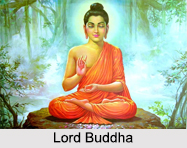
 As with ancient Indian tradition, transmission of teaching was done orally. The fundamental purpose of the Buddhist assembly or council was to collectively recite the teachings to ascertain that no errors occurred in oral transmission. After Buddha passed away, he did not appoint a successor, and asked his followers to work for individual salvation. The teachings of the Buddha thus survived only in oral traditions. The Sangha, as a result, held a number of Buddhist Councils in order to observe a mass consent on matters of Buddhist doctrine and practice. Six Buddhist Councils were thus held, and with paramount historical significance. Beginning from the 1st century B.C. and continuing as late as 1956 A.D., the councils were held in number of places within India, also including Sri Lanka, Yangon and Myanmar.
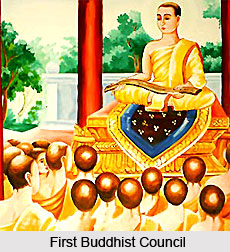
First Buddhist Council, Buddhism
Called forth immediately after the demise of Buddha, the first council was sponsored by King Ajatashatru. The meet was presided over by the Elder Mahakassapa after he was alarmed by hearing a certain monk Subhadda speak deprecating issues about Buddha and his teachings. Subhadda was hell-bent to not abide by the Buddha`s rules stated for the ascetic life of a monk. The Dhamma and Vinaya were being debased. As a result, Mahakassapa received the Sangha`s approval and gathered 500 Arhants, specially depending on Ananda. The revered Upali was present on the day of the council and cleared every query on Vinaya. Then Ananda took position and accurately answered about the queries on Dhamma. Thus, the sangha gave unanimous approval to both.
Second Buddhist Council, Buddhism
The Second Buddhist Council was called forth under dire circumstances, which was necessary for the Sangha to make things straight. A serious dispute had arisen among the monks regarding the Vinaya and its rules. A gap had occurred among the sect of unorthodox and orthodox monks. The unorthodox bunch had deliberately disregarded Buddha`s discourses, and had breached a set of cardinal rules. They were in fact adamant to not listen to the serious followers, and ignored the Vinaya. Fearing the worse, the Sangha thus called forth the Second Council. And after much discussions, a unanimous decision to not loosen the rules was taken.
Third Buddhist Council
Known to have been patronised by emperor Ashoka, the third Buddhist council was held in Pataliputra, in the presence of one thousand monks. According to records, the Sangha, by now, was deeply penetrated by heretical and corrupted monks. As a result, it was urgently necessary to make the sangha get rid of these impure monks from various monasteries. To held a council was thus of prime importance, and it was presided over by Elder Moggaliputta Tissa. However, it was emperor Ashoka who fetched foremost importance, and it was he who was responsible for expelling the monks.
Fourth Buddhist Council, Buddhism
Sri Lanka and Kashmir were the chosen places, where the Fourth Buddhist Council was held. However, there lies a difference of a century between the two meetings. The latter Council was held according to the Sarvastivada tradition, and was convened by the Kushana emperor Kanishka. People are of the faith that Kanishka had gathered five hundred monks to compile the vast commentaries on the Sarvastivadin Abhidharma.